
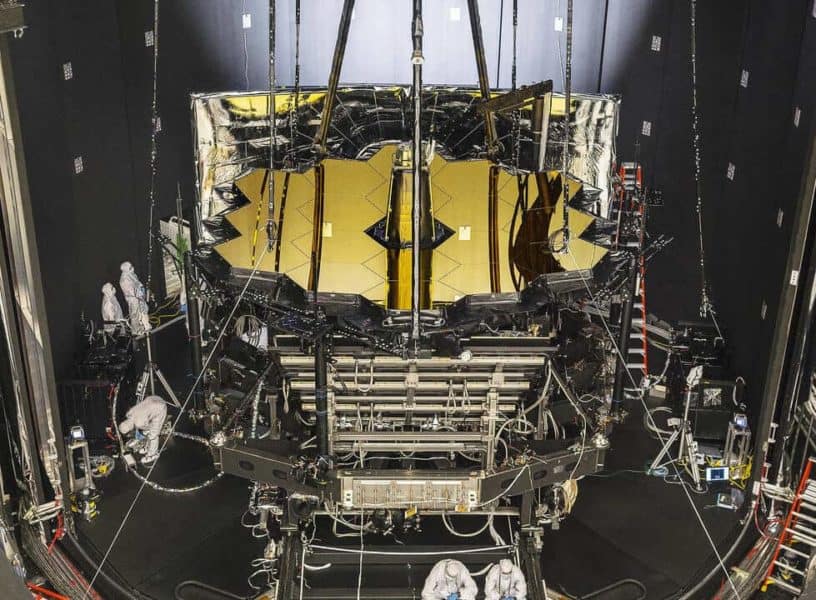
Engineers will perform the test to prove that the telescope can operate in space at these temperatures. Chamber A will simulate an environment where the telescope will experience extreme cold — around 37 Kelvin (minus 236 degrees Celsius or minus 393 degrees Fahrenheit).
In space, the telescope must be kept extremely cold, in order to be able to detect the infrared light from very faint, distant objects. To protect the telescope from external sources of light and heat (like the sun, Earth, and moon), as well as from heat emitted by the observatory, a five-layer, tennis court-sized sunshield acts like a parasol that provides shade. The sunshield separates the observatory into a warm, sun-facing side (reaching temperatures close to 185 degrees Fahrenheit) and a cold side (400 degrees below zero). The sunshield blocks sunlight from interfering with the sensitive telescope instruments.
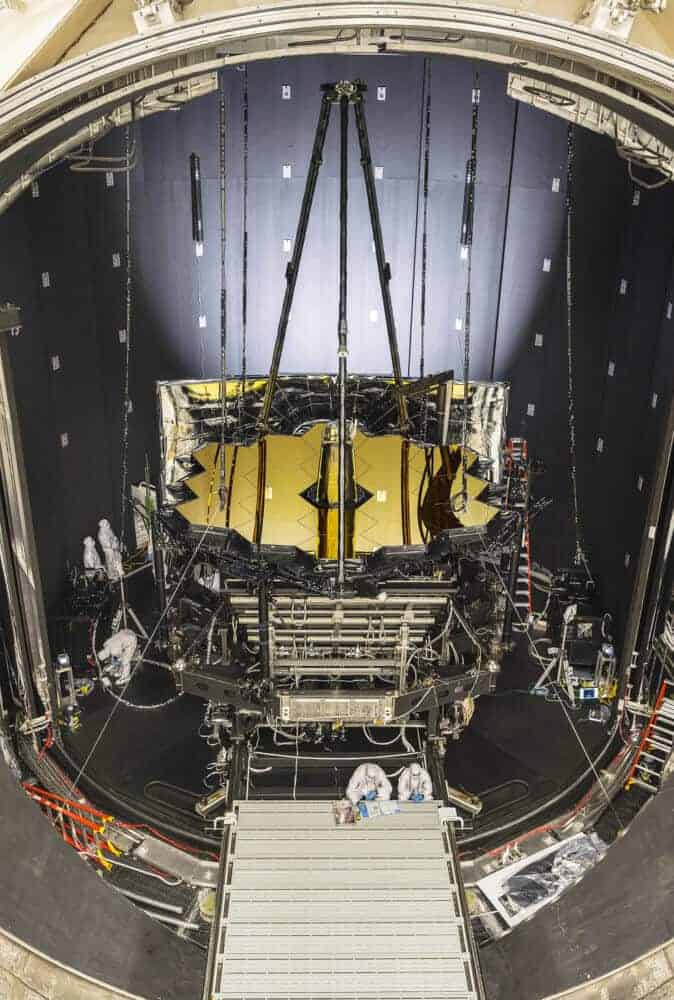
The James Webb Space Telescope is the scientific successor to NASA’s Hubble Space Telescope. It will be the most powerful space telescope ever built. Webb is an international project led by NASA with its partners, ESA (European Space Agency) and the Canadian Space Agency.
For more information about Chamber A, visit: https://www.nasa.gov/feature/goddard/2017/nasas-apollo-era-test-chamber-now-james-webb-space-telescope-ready
For more information about the Webb telescope visit: www.jwst.nasa.gov or www.nasa.gov/webb
ScienceBlog.com has no paywalls, no sponsored content, and no agenda beyond getting the science right. Every story here is written to inform, not to impress an advertiser or push a point of view.
Good science journalism takes time — reading the papers, checking the claims, finding researchers who can put findings in context. We do that work because we think it matters.
If you find this site useful, consider supporting it with a donation. Even a few dollars a month helps keep the coverage independent and free for everyone.