

Deer mice look, for the most part, like deer mice. Small, large-eyed, improbably soft. They turn up in barns and tool sheds across the American West without much fanfare, and most people who encounter one will never give it a second thought. Which is, in a way, exactly the problem. A new study of rodents across the Palouse region of eastern Washington and western Idaho found that roughly 26% of western deer mice showed serological evidence of past infection with Sin Nombre virus, the hantavirus responsible for a respiratory syndrome that kills about a third of everyone it hospitalises. Some 10% were actively infected at the time of capture. The numbers were, by the researchers’ own account, a surprise.
What was perhaps equally striking was why this came as a surprise at all. Despite 109 cases of hantavirus pulmonary syndrome recorded across Idaho, Oregon and Washington since 1993, essentially no full genome sequences of the virus existed from the northwestern United States before this study. A population-scale threat, hiding in plain sight, largely unmapped.
A Virus That Has Been Here All Along
Sin Nombre virus, which translates from Spanish as “virus with no name” (an early diagnostic puzzle left a naming gap that somehow stuck), first surfaced in the public consciousness during a 1993 outbreak near the Four Corners region of the southwest. The cases were severe and sudden: healthy adults developing pulmonary failure within days. The culprit turned out to be a hantavirus maintained almost exclusively in deer mice of the genus Peromyscus, shed in urine, droppings, and nesting material, and inhaled by people who had the misfortune of disturbing a contaminated space. Sweeping out a dusty barn. Opening a long-closed cabin. Running a leaf blower near a rodent-favoured corner of a property. From 1993 to 2022, the US recorded 864 cases with a case-fatality rate of roughly 36 percent. Not common, but not minor either.
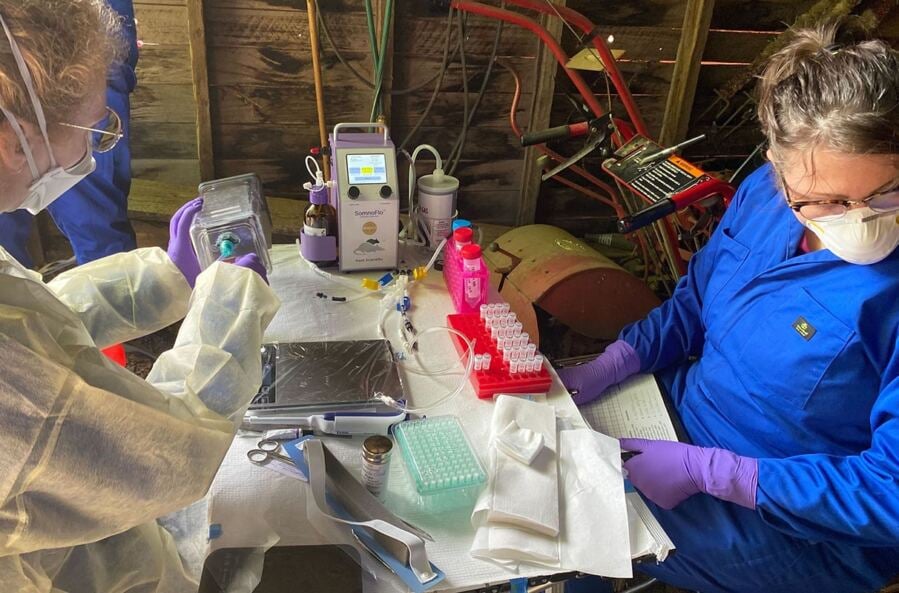
What the new study found complicates the picture considerably. The research team, led by Stephanie Seifert at Washington State University’s Paul G. Allen School for Global Health, trapped 189 individual rodents across farms and natural areas during the summer of 2023, testing serum for antibodies and lung tissue for active viral RNA. In montane voles, the numbers were striking: 50% seropositive, with 22% testing positive by PCR in lung tissue. Voles are not the canonical reservoir for this virus. Finding it in them at those rates suggests something rather more dynamic than a single-host transmission story.
“We were surprised both by how common the virus was locally and by how little data existed for the Northwest,” said Seifert. “We’re really just beginning to understand how widespread and complex this virus is in rodent populations here.”
Viral Reshuffling in the Wheat Fields
Part of what makes the Palouse findings significant is not just prevalence but genomics. The team sequenced full Sin Nombre virus genomes from ten individual animals, including two montane voles, producing the first complete genomic sequences of the virus from this region. What they found in those sequences points to a virus doing something we should perhaps pay more attention to: reassortment. Hantaviruses, like influenza, carry segmented genomes, which means that when two strains infect the same cell, they can swap genetic segments and produce new hybrid variants. The phylogenetic analysis showed topological discordance across the three genome segments, which is exactly the kind of signature that suggests this mixing is happening in the field. The Palouse sequences clustered most closely with SNV genomes collected from Montana around 2008 to 2009, with the phylogeographic reconstruction suggesting the virus may have moved into Washington from Montana somewhere around 1915, give or take a few decades of uncertainty.
Whether all that reassortment changes anything for human risk is, at this point, unclear. What it does mean is that the virus is actively diversifying, that multiple rodent species are plausibly exchanging it, and that the existing genomic reference library, which contains fewer than 100 full Sin Nombre sequences from the entire United States, is not remotely adequate for tracking what’s happening. The team also found a technical wrinkle: a persistent dropout in the medium genome segment that their existing sequencing primers failed to recover, requiring the design of new flanking primers to fill the gap. A small methodological note in the paper, but significant for anyone trying to build a surveillance programme in this region.
Male rodents, incidentally, were about nine times more likely than females to test positive by PCR in lung tissue. The reason for that is not fully understood (it probably has something to do with male ranging behaviour and the corresponding increase in encounters with infected conspecifics), but it’s a consistent pattern in SNV ecology and perhaps worth bearing in mind for anyone modelling exposure risk.
The Gap Between Exposure and Diagnosis
One thread running through all of this is the question of what we’re missing on the human side. The prevalence in rodents is high. Human cases remain, in absolute terms, rare. Those two facts don’t necessarily contradict each other, but they do raise a question: are people genuinely not being exposed, or are mild or asymptomatic exposures going unrecorded because only severe cases prompt hantavirus testing?
Pilar Fernandez, a disease ecologist at WSU and co-author on the study, thinks the latter is probably part of the explanation. “People may be exposed more often than we realize, but severe cases are more likely to be tested for hantavirus,” she said. Understanding how exposure translates into disease, she said, is the next big step.
It is, in some ways, a familiar problem in emerging infectious disease surveillance. The cases you catch are the severe ones. The background rate of mild infection, subclinical exposure, or immune clearance without hospitalisation tends to be invisible until someone specifically goes looking for it with the right tools, usually a seroprevalence study in humans rather than rodents. That work hasn’t been done here yet, partly because funding for this kind of regional surveillance is perpetually thin, and partly because Sin Nombre, relative to more headline-grabbing pathogens, does not attract the same sustained attention. The WSU team has stated they hope to expand their work if further funding becomes available.
In the meantime, the practical advice for people spending time around farms, outbuildings, or anywhere rodents might nest remains much the same as it has for three decades: ventilate enclosed spaces before entering, avoid dry sweeping, wet-mop rather than disturb dust, and treat any space that smells of rodents with appropriate caution. What the new data add is something less actionable but arguably more important: a reminder that a dangerous pathogen, thriving and diversifying in the fields and farms of the rural Northwest, has been sitting largely outside the genomic record. We have been, until now, effectively flying blind.
https://doi.org/10.3201/eid3205.251476
Frequently Asked Questions
If so many rodents carry hantavirus, why aren’t more people getting sick?
Exposure requires inhaling aerosolised particles from contaminated rodent droppings, urine, or nesting material, which typically only happens when people disturb enclosed or rarely-visited spaces. Beyond that, researchers suspect that mild or asymptomatic infections may be going undetected because hantavirus testing tends to be reserved for severe cases. The true rate of human exposure in the Pacific Northwest is an open question, and one the WSU team is hoping to investigate next.
What does it mean that the virus is “reassorting” between rodent species?
Sin Nombre virus, like influenza, carries a segmented genome, meaning that when two strains infect the same animal simultaneously, they can swap genetic segments and produce new hybrid variants. The Palouse study found genetic signatures consistent with this mixing occurring between deer mice and montane voles in the same farming landscapes. It doesn’t necessarily make the virus more dangerous, but it does mean the pathogen is actively evolving, and that a surveillance system based on tracking a single reservoir species may be missing part of the picture.
Why has nobody sequenced this virus in the Pacific Northwest before?
It’s a data gap that the researchers themselves describe as surprising given the region’s case history. Fewer than 100 full Sin Nombre genome sequences exist from the entire United States, and none, before this study, came from the Northwest. Hantavirus surveillance has historically been concentrated in the Four Corners region where the virus was first identified. Regional surveillance work requires sustained funding that doesn’t always materialise for pathogens that cause relatively small numbers of cases annually, even when those cases are severe.
Are montane voles a new reservoir for this virus?
The study found Sin Nombre virus antibodies in 50% of montane voles trapped on farmland, with active infection in roughly 22%. This is a notably high prevalence in a species not traditionally considered a primary reservoir. Researchers have found SNV in other rodent species outside deer mice in previous work, and the Palouse findings suggest cross-species transmission may be more common than the standard deer-mouse-centric model implies. Whether voles play a sustained role in maintaining the virus or are mainly picking it up from deer mice sharing the same habitat remains to be determined.