

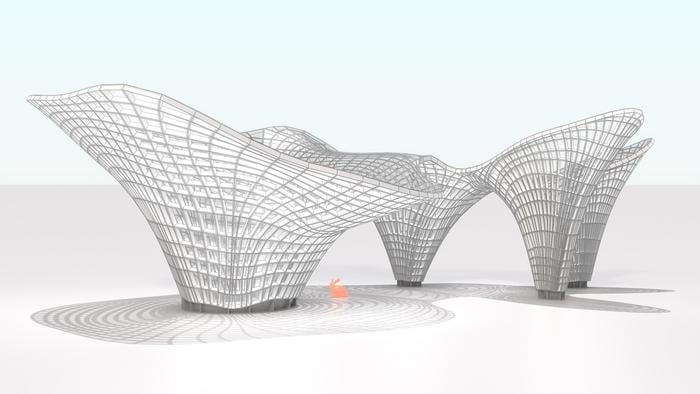
A new computer method from the University of Tokyo and U.S. engineering firm Thornton Tomasetti lets architects design large, curving glass-and-steel roofs in about 90 minutes on a normal computer instead of roughly 90 hours on a specialist graphics machine. The work, published in ACM Transactions on Graphics, focuses on “gridshells” – airy roof structures made from a crisscrossing grid rather than solid concrete – and shows how an updated mathematical approach can keep them both beautiful and structurally safe.
If you have ever walked into a museum courtyard or train hall and looked up to see a flowing glass canopy with no columns in the middle, you have experienced the sort of structure this research targets. A gridshell behaves like a thin shell, but it is made from a lattice of beams instead of a solid slab, which means it can be much lighter and let in far more daylight. Famous roofs like those over the British Museum’s Great Court or modern timber gridshells in the UK countryside use this principle to turn once-drab spaces into dramatic gathering places.
Until now, creating such forms has taken a lot of custom calculation and very powerful hardware, so they remained the preserve of landmark, high-budget projects. The new method is important because it bakes much of that structural thinking into the same software many architects already use, lowering both the cost and the expertise barrier. In practical terms, that means many more everyday buildings – schools, markets, stations – could afford the kind of open, bright spaces that used to be reserved for flagship cultural buildings. For readers interested in how advanced structural ideas trickle into daily life, ScienceBlog has covered similar shifts in design software that make energy-efficient building envelopes and earthquake-safe structures more routine rather than exceptional.
From Heavy Concrete To Light Grids
For most of the twentieth century, dramatic roofs were usually made from thick reinforced concrete shells, shaped so that forces flowed smoothly through the surface. These shells can be structurally efficient, but they are heavy, use a lot of material, and often demand complex temporary support during construction. As concern grows about carbon emissions and construction waste, many designers want lighter options that use steel, glass, or engineered timber instead of tons of concrete.
Gridshells offer that lighter path. Imagine a flexible net that is pulled into a gentle dome or wave: once locked in place, the curved shape helps carry its own weight. In a modern gridshell, that “net” might be steel tubes or timber strips, with glass or other panels laid over the top for weather protection. The challenge comes in deciding exactly what shape that net should take so that it looks good, does not sag or buckle, and can still be built from real-world parts and joints. As a recent explainer on EngineeringSkills shows, engineers call this “form finding” – searching for a shape that naturally balances the push and pull of forces without demanding impossible materials or connections.
The University of Tokyo–Thornton Tomasetti team previously created a unified mathematical framework that treated shape, structural behavior, and constructability together instead of as separate steps. However, that earlier method struggled with very irregular outlines – such as when a roof has to snake around existing buildings – and it took far too long to compute for use in day-to-day practice. The new paper tackles both issues at once.
“The project began in 2020 with an interest in shell structures, often made of concrete,” Miki said.
What The New Method Changes
Most architectural software represents smooth surfaces using something called NURBS, a standard mathematical way to describe curves that car designers and product engineers also rely on. Traditional structural tools often convert these smooth surfaces into thousands of tiny flat triangles before analyzing them, which slows things down and can blur fine details. The new method instead keeps everything in the NURBS world: it represents the pattern of internal stresses on the same type of surface that the architect draws.
By staying in this native format, the algorithm can more quickly adjust the surface until the stresses settle into a safe, balanced pattern. The researchers report roughly a 98 percent reduction in computation time for tough cases, enough to move from overnight jobs on powerful graphics hardware to coffee-break runs on ordinary office machines. Just as importantly, the method can handle “topologically arbitrary boundaries” – in plain language, roof edges that are not neat circles or rectangles, but kink, twist, or fork to follow messy real sites.
The team implemented the system as a plug-in for Rhinoceros, a popular design tool in architecture and engineering. That choice matters for non-specialists: instead of exporting models to a separate analysis package and waiting for a specialist to send results back, an architect can stay in one environment and see how small tweaks to the form change its structural soundness. The ScienceBlog archive includes many examples where putting better simulation tools directly in designers’ hands led to more energy-efficient facades or safer bridges; this work extends that “simulation in the sketchbook” idea to expressive, column-free roofs.
“Because we are addressing a real-world problem, we have been rigorously validating our solutions by several test methods we also developed,” Miki said.
Why Everyday Readers Should Care
For people who will never open a CAD file, the impact shows up in how public spaces feel. When it becomes cheaper and easier to design safe, curved, transparent roofs, more cities can choose light-filled halls instead of low, dark ceilings supported by thick columns. That can mean train stations where you can see the sky, school atriums that feel welcoming rather than cramped, and market halls where daylight reduces the need for artificial lighting.
The method also nudges construction in a more sustainable direction. Lightweight gridshells use less material than equivalent flat roofs spanning the same distance, and they can be tailored to use timber or efficient steel sections, which aligns with many cities’ climate goals. Because the tool checks structural performance as it shapes the form, it can help avoid overbuilding “just to be safe,” which wastes materials and money.
Finally, democratizing advanced form finding supports design diversity. When only a handful of elite practices can afford the time and expertise for gridshells, city skylines tend to repeat a narrow range of showcase projects. When mid-sized firms and even students can explore these forms from a laptop, more local ideas can enter the mix. Over time, that can lead to public spaces that better reflect the character of their communities, not just the look of a few global icons.