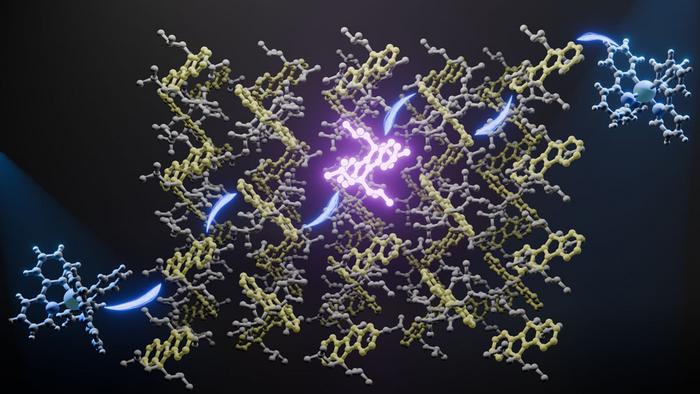
Two cups of warm water will never give you one cup of boiling water. Pour them together and you get a larger volume of lukewarm water, nothing more. The energy simply does not pool that way. And yet, down at the scale of single particles of light, that is more or less exactly what a team in Japan has just pulled off in a solid block of material, under nothing fancier than the sun.
The trick is called photon upconversion, and the idea is to take two low-energy photons of visible light and fuse their energy into one photon of ultraviolet. Researchers at Kyushu University in Fukuoka have now done this in a stable solid, driven by light no more intense than ordinary daylight, and reported it in Nature Communications.
Why bother chasing UV in the first place? Because we use rather a lot of it. UV light cures the resins in 3D printers, hardens the gel in dental fillings and nail salons, and sterilises air and water. The snag is that ultraviolet makes up only a sliver of the sunlight reaching the ground, somewhere around 3 to 6 percent depending on how you count, and only a fraction of that is practically usable. So the sun pours down a flood of visible light we can see but, for these purposes, mostly waste.
“What we do here is ‘add together’ the energy from two visible light photons to make one ultraviolet photon. It’s a fascinating process called photo upconversion,” explains Yoichi Sasaki, an associate professor at Kyushu’s Faculty of Engineering and the study’s corresponding author.
The Crowding Problem
The mechanism behind it has a suitably violent name: triplet-triplet annihilation. A “donor” molecule soaks up a visible photon and kicks its electrons into a high-energy, long-lived state called a triplet. It hands that energy to a neighbouring “acceptor” molecule, and when two excited acceptors meet, they annihilate one another, dumping their combined energy out as a single UV photon. In liquids, where molecules drift about freely and bump into each other, this works a treat. But liquids evaporate, leak, and often need toxic solvents, which is hardly ideal for a coating on a window or a printer.
Solids ought to fix all that. The trouble is what happens when you pack the molecules in tight. In solids, Sasaki explains, the molecules sit cheek by jowl and their π electron clouds, the regions of dense electron charge hovering above and below each flat molecule, start to overlap. When they overlap too much, the precious triplet energy drains away as heat before two triplets ever manage to find each other. “When that happens, triplets easily fizzle out before they ever meet. Molecules must be close enough for energy to transfer but separated enough to prevent quenching of excitons.”
That is the needle the team had to thread. Close, but not too close.
Building in the Gaps
Their answer was a tongue-twisting organic semiconductor, dihydroindenoindene, or DHI for short. The clever bit lies in where they bolted on the extra chemistry. DHI carries sp³ carbon atoms, the kind whose four bonds point off in fixed three-dimensional directions rather than lying flat. By hanging short alkyl chains off those carbons, sticking up above and below the molecule’s flat π-surface, the researchers built tiny spacers into the crystal itself. The chains hold neighbouring molecules at arm’s length, shielding the electron clouds from smothering one another while still leaving a clear path for energy to hop across. Of the versions they tried, an isobutyl-tipped variant came out best, hitting a solid-state fluorescence yield above 60 percent (in some measurements as high as 83) where the bare, unprotected molecule managed a feeble 10. Triplet states that would normally wink out in a fraction of a millisecond instead lingered for several.
The payoff is a film that reaches an upconversion efficiency of 1.9 percent. “This means roughly two UV photons are produced for every hundred visible-light photons absorbed,” Sasaki adds. That may not sound like much. The team is the first to admit it. “It may sound low, but it runs on natural sunlight alone. Most solid-state materials cannot realize this even at much higher light intensity.”
And that is the part worth dwelling on. The threshold intensity needed to switch the process on sits at about 1.2 milliwatts per square centimetre, just under the strength of real sunlight at the relevant wavelength. There is no laser, no concentrating mirror, no special kit. Just a window’s worth of daylight. The dense packing throws in a bonus, too: the material shrugs off oxygen, the usual assassin of these excited states, and keeps working in open air.
There are caveats, naturally. Spin-coating and drop-casting are cheap and simple, but they give you little control over crystal size and grain boundaries, which means performance can wobble a bit from batch to batch. Pushing the efficiency higher will likely mean tidying up the donor molecule and the crystallisation process. Still, the synthesis is straightforward and the starting materials cheap, and the team has already filed for a patent, with an eye on solar-driven photocatalysis, indoor air purification, and low-power 3D printing.
Eleven Days to Spare
For the people involved, the work carried a weight beyond the chemistry. Back in 2012, Nobuo Kimizuka, now a professor emeritus at Kyushu, pioneered this whole approach of coaxing light upconversion out of self-assembling molecules. For more than a decade his group inched forward in solutions and gels, yet the solid-state version stayed stubbornly out of reach. The breakthrough finally landed in May 2024, less than a year before Kimizuka was due to retire, and what followed was a sprint to compress years of writing-up into a few frantic months. “We handed the draft to Professor Kimizuka just 11 days before he left the lab, which for us felt like a heartfelt retirement gift,” says Sasaki.
“This discovery is the culmination of over 14 years of our research and marks a major milestone in photon-upconversion and molecular self-assembly research,” reflects Kimizuka. Whether that milestone ends up curing the resin in your next pair of printed spectacles or simply scrubbing the air in a stuffy room, the underlying idea is radical: that the light we already have, and mostly squander, might yet be talked into doing far more than it does today.
DOI / Source: https://doi.org/10.1038/s41467-026-73898-0
Frequently Asked Questions
Why does turning visible light into UV actually matter?
Ultraviolet does a lot of useful work, from hardening 3D-printing resins and dental fillings to sterilising air and water, yet it makes up only a few percent of the sunlight hitting the ground. A material that converts abundant visible light into scarce UV could let the sun power those jobs directly, without UV lamps. The Kyushu film is the first solid to manage it under plain daylight.
How does fusing two photons into one even work?
It relies on a process called triplet-triplet annihilation. Light-absorbing molecules store energy in long-lived excited states, and when two of those states collide they merge their energy into a single, higher-energy photon. The hard part is engineering a solid where the molecules sit close enough to share energy but far enough apart that the energy does not leak away first.
Is 1.9 percent efficiency too low to be useful?
It sounds modest, but the number comes with a crucial condition: it runs on ordinary sunlight, with no laser or concentrating optics. Most rival solid materials cannot upconvert at all at such low light levels. For low-power applications like air purification, that combination of cheap materials and daylight operation may matter more than raw efficiency.
What’s stopping this from reaching real products?
The simple coating methods that make the films cheap also make them inconsistent, with performance varying between batches as crystal sizes and grain boundaries shift. Tightening up the crystallisation process and refining the donor molecule are the obvious next steps. The team has filed a patent, so the push toward practical devices is already under way.