

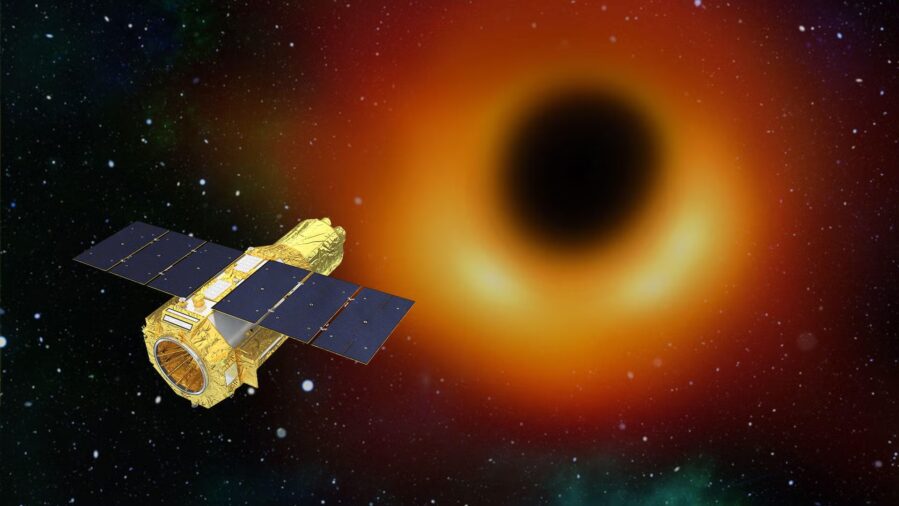
Scientists using Japan’s new X-ray space telescope have witnessed an extraordinary sight: fast-moving gas clumps shooting away from a supermassive black hole at speeds reaching nearly one-third the speed of light. The groundbreaking observation, published in Nature, reveals that these cosmic winds have a complex, clumpy structure rather than flowing smoothly as previously assumed, transforming our understanding of how black holes influence their host galaxies.
The XRISM space telescope, launched in September 2023, captured unprecedented high-resolution X-ray spectra of PDS 456, a quasar containing a supermassive black hole approximately 500 million times more massive than our Sun. The telescope’s Resolve instrument detected five distinct streams of gas flowing outward at speeds between 22-33% of light speed – a level of detail impossible to observe with previous technology.
What makes these findings particularly significant is how they might answer a longstanding cosmic mystery: how do supermassive black holes regulate the growth of their host galaxies? Could these newly discovered wind patterns be the mechanism astronomers have been seeking?
A Million Cosmic Buckshot Blasts
Rather than a smooth, uniform outflow, the XRISM data shows the black hole is ejecting what resembles cosmic buckshot — up to a million separate gas clumps, each roughly 2-16 times the gravitational radius of the black hole in size.
The observation represents a significant departure from previous models based on less precise measurements. Earlier X-ray observations had detected outflows from supermassive black holes, but the limited resolution of those instruments meant scientists observed what appeared to be a single broad absorption feature rather than multiple distinct streams.
This difference is clearly demonstrated in the study’s comparison between XRISM’s high-resolution data and simultaneous observations from conventional instruments aboard XMM-Newton and NuSTAR telescopes. Where previous telescopes saw one broad absorption feature, XRISM revealed five discrete absorption lines, each representing gas moving at a different speed.
Extraordinary Energy Transfer
The researchers determined that these winds carry tremendous energy away from the black hole, with some remarkable properties:
- Mass outflow rate of 60-300 solar masses per year (equivalent to ejecting up to 300 times the mass of our Sun annually)
- Wind kinetic power exceeding the Eddington luminosity limit (the theoretical maximum output for a black hole of this size)
- Energy more than a thousand times greater than what’s measured in galaxy-scale outflows
- Momentum flux ten times larger than galaxy-scale outflows
- Total of approximately one million individual gas clumps in the outflow
These measurements challenge existing theoretical models of how black hole winds affect their host galaxies. The energy and momentum carried by these winds significantly exceed what current theories predict would be transferred to the surrounding galaxy, suggesting either that such powerful outflows are relatively brief events or that their energy isn’t efficiently transferred to larger scales.
Solving a Cosmic Puzzle
The findings help address a fundamental question in astrophysics concerning the relationship between supermassive black holes and their host galaxies. Observations have shown that a black hole’s mass correlates with the mass of its galaxy’s central bulge, suggesting they somehow evolve together.
Scientists have long theorized that powerful winds from black holes could be the mechanism that regulates this co-evolution, but without detailed observations, the exact process remained unclear. The new XRISM data provides critical insights into how these winds function.
The study suggests these winds aren’t continuous steady features but likely occur episodically. The researchers estimate that such extreme wind activity might happen during less than 10% of a quasar’s lifetime. Alternatively, the clumpy structure of both the wind and the interstellar medium might prevent efficient energy transfer to galaxy-scale outflows.
Technical Achievement
The observations represent a significant technical achievement for the XRISM mission. The telescope’s Resolve instrument features an X-ray calorimeter with spectral resolution approximately 30 times better than conventional X-ray telescopes, allowing it to distinguish energy differences of just 6 electron volts.
This unprecedented resolution enabled scientists to identify the discrete velocity components within the outflow for the first time. The instrument’s capabilities also allowed researchers to determine that the wind covers the entire X-ray source, forming what’s known as a P Cygni-like profile with both emission and absorption features.
By observing changes in the X-ray emission during a strong flare that occurred during the observation period, researchers were able to estimate both the size of the X-ray emitting corona around the black hole and the distance to the outflowing gas clumps.
Implications for Black Hole Evolution
While PDS 456 is relatively nearby in cosmic terms (about 2.7 billion light-years away), its extreme properties make it similar to quasars that existed when the universe was much younger, during the peak epoch of black hole growth approximately 10-12 billion years ago.
The researchers note that luminous quasars at higher redshifts often show very high luminosities and strong winds similar to PDS 456, suggesting these extreme wind activities were likely common during the most active period of supermassive black hole growth in the universe’s history.
This discovery provides crucial new insights into the mechanisms that have shaped galaxies throughout cosmic history. By understanding how black holes transfer energy to their surroundings through these complex, clumpy winds, scientists can better model how these massive objects have influenced the evolution of galaxies since the early universe – ultimately helping explain the cosmic structures we observe today.