

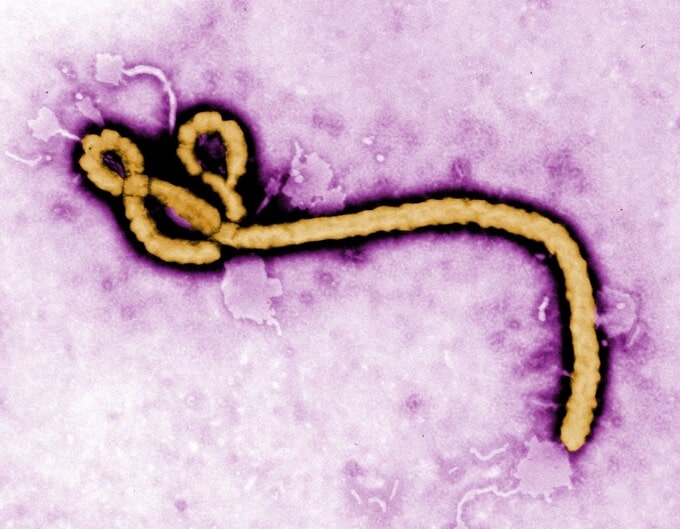
When Ebola virus enters the body, it deploys a nearly perfect molecular disguise. The virus coats itself in a thick shield of sugar molecules that hide its vulnerable spots from immune cells—like a burglar wearing camouflage that shifts patterns. Scientists at Scripps Research have now engineered a way to strip away that disguise and present a clearer target to the immune system.
Their approach, published December 12 in Nature Communications, centers on redesigned viral proteins mounted on engineered nanoparticles. In mouse studies, these vaccine candidates triggered robust antibody responses across multiple filovirus strains, including Ebola, Sudan, and Marburg viruses. The particles stayed in lymph nodes for eight weeks—112 times longer than loose proteins—creating sustained immune activation.
The core innovation involves locking Ebola’s surface glycoproteins into a specific shape that immune cells can recognize more easily. Lead researcher Jiang Zhu explains that filoviruses are naturally unstable, constantly changing their surface configuration to evade detection. His team used strategic mutations to freeze these proteins in their pre-infection form, then displayed them on virus-sized spherical particles.
Engineering Better Recognition
The challenge with filovirus vaccines goes beyond just presenting viral proteins to immune cells. These pathogens, which include some of the deadliest viruses known to science, have evolved sophisticated evasion mechanisms. Their surface proteins are buried under what researchers call a “glycan cap”—dense layers of sugar molecules that act like molecular camouflage.
“Locking the antigen into its pre-fusion form gets you maybe 60% of the way there,” Zhu explains. “But many viruses are covered by a dense glycan shield. If the immune system can’t see through that shield, even the best-designed vaccine won’t achieve full protection.”
Previous Ebola vaccines have relied primarily on viral vectors—using other viruses to deliver Ebola proteins. While two such vaccines are currently approved, they provide limited protection against the broader filovirus family. The new nanoparticle approach offers a different path forward, one that could potentially address multiple virus strains with a single shot.
In the laboratory, these engineered particles demonstrated remarkable staying power. Unlike soluble proteins that disappeared from lymph nodes within 48 hours, the nanoparticles remained active for the entire eight-week study period. This extended presence led to stronger germinal center reactions—the specialized immune structures where antibodies mature and improve their virus-fighting capabilities.
From Lab Bench to Broader Protection
The research reveals an unexpected twist in vaccine design: sometimes more sugar coating works better than less. When the team tested versions with different glycan modifications, vaccines enriched with oligomannose-type sugars consistently outperformed those with trimmed glycans. This contradicts findings from HIV and influenza vaccine research, where removing sugars typically improves immune responses.
Mouse studies showed the nanoparticle vaccines generated neutralizing antibodies against multiple filovirus species. The Sudan virus vaccine, for instance, elicited antibodies that could also block Ebola and Bundibugyo viruses. More intriguingly, a Marburg virus construct showed signs of cross-genus protection—potentially offering immunity across the entire filovirus family.
The team tested their vaccines using both traditional protein trimers and the new nanoparticle format. While both approaches generated antibodies, the particles accelerated immune responses and required fewer doses to reach peak protection. In practical terms, this could translate to faster protection during outbreaks and potentially broader immunity against emerging filovirus variants.
Zhu’s group is now extending this structure-guided approach to other high-risk pathogens, including Lassa and Nipah viruses. Their ultimate goal: creating a universal design framework that could rapidly generate vaccines against new pandemic threats. As global disease surveillance improves and new viruses emerge from wildlife reservoirs, having such platforms ready for deployment could prove critical for outbreak response.