

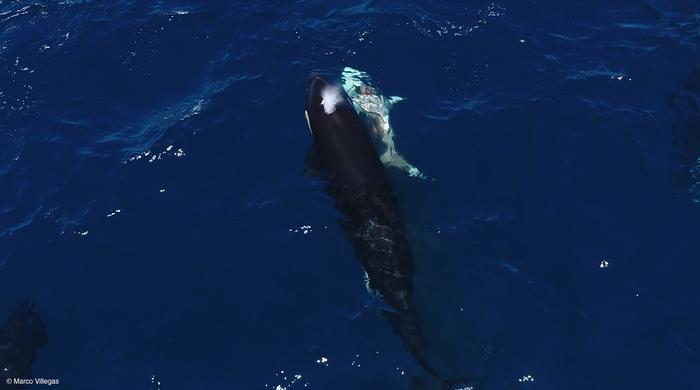
On video, the ocean turns suddenly surgical. In the Gulf of California, a tight knit orca pod flips young great white sharks onto their backs, then extracts the energy rich liver with chilling precision. New observations by researchers in Mexico and the United States, published today in Frontiers in Marine Science, document two hunts that killed three juvenile white sharks and point to a specialized technique, tonic immobility, that leaves the prey paralyzed and easy to dismember.
The scientists, led by Erick Higuera Rivas of Conexiones Terramar and Pelagic Life, identified the culprits as Moctezuma’s pod, a group already famous locally for stalking rays and other sharks. In August 2020 and again in August 2022, five orcas corralled juvenile white sharks, rolled them belly up at the surface, and reappeared with pale lobes of liver in their mouths. Birds gathered, tissue floated, and the rest of each carcass was abandoned. It is grisly, but it is also methodical.
The method matters. Turning a shark upside down can trigger tonic immobility, a temporary, cataleptic state that disrupts a shark’s sensorimotor control. That tactic would neutralize the threat from even a small white shark’s bite, which can be powerful enough to injure an attacker. The team reports consistent maneuvers across events, suggesting learned, repeatable behavior within the pod.
A Pod With A Playbook
Moctezuma’s pod has form. Prior studies in the region have documented the same group targeting Munk’s pygmy devil rays by plucking individuals from the edge of schools and stunning pelagic stingrays with tail slaps. Here, the orcas appear to apply a different script to white sharks: invert, immobilize, extract, then share. In one 2020 sequence, researchers filmed the two lobes of a shark liver being passed between at least three pod members, including females, while a curious sea lion was kept at bay by forceful bubble exhalations.
A vivid detail stands out from the team’s videos and images. After a coordinated push, a juvenile white shark rises, bleeding from the gills, its mouth agape, pectoral fins visible like flags. Moments later, a pink sheen of tissue surfaces as the orcas trade mouth holds. It reads like predation by design rather than opportunism.
“This temporary state renders the shark defenseless, allowing the orcas to extract its nutrient-rich liver and likely consume other organs as well, before abandoning the rest of the carcass,” explained Higuera.
Critically, the victims here are juveniles, not the subadults and adults more commonly associated with well publicized white shark exoduses when orcas arrive. That distinction may carry ecological weight. Adult white sharks are known to evacuate aggregation sites for months after orca encounters, a behavioral risk response that can limit predation success. Juveniles, by contrast, may not yet recognize orcas as a categorical threat.
“Adult white sharks react quickly to hunting orcas, completely evacuating their seasonal gathering areas and not returning for months.”
The authors caution that two observed hunts do not establish a new rule. Still, they note that both events occurred in the same general area in late summer, two years apart, and involved a similar number of orcas using near identical tactics. That pattern hints at seasonal targeting and social transmission of technique inside the pod, consistent with what is known about orca cultures elsewhere.
Climate Shifts, Shifting Targets
Why juveniles, and why here. The study points to ocean warming and climate variability, including El Niño and marine heat waves, that are altering nursery zones and redistributing cohorts of young white sharks along the eastern Pacific. Reports of juveniles in the Gulf of California have increased in recent years, potentially placing naive sharks within reach of resident or regularly visiting orcas.
There is also a metabolic logic. Shark liver is rich in lipids, a compact package of calories and micronutrients that can be shared within a pod and, in other parts of the world, appears to be the prize in similar orca on shark predation. For a generalist predator with culturally inherited tactics, a reliable seasonal supply of juvenile livers would be hard to ignore.
Still, the researchers are careful about extrapolation. They call for year round surveys of the Gulf of California orca population, diet analyses to confirm how often white sharks are taken, and behavioral studies to test whether juvenile white sharks learn the same rapid flight response seen in adults. Fieldwork is costly, and the hunts are unpredictable, but the stakes include understanding how two apex predators negotiate shifting seascapes and how climate driven range changes can rewire who eats whom.
For now, the picture is stark and memorable. Five black and white bodies, a flash of a crescent tail, a brief stillness when the world turns upside down, then pink tissue shared among kin. It is a reminder that intelligence at sea often wears a predator’s grin.