

Key Takeaways
- Citrus farming in California faces issues due to uneven soil conditions, leading to inaccurate irrigation.
- Elia Scudiero developed a robotic system using apparent electrical conductivity to measure soil moisture precisely.
- The Jackal robot performs surveys, logging conductivity data to estimate water content in individual trees.
- Current farming practices often rely on limited soil moisture sensors, resulting in unreliable watering decisions.
- The new approach promises better water management, helping growers optimize irrigation while preventing environmental impact.
Water an entire orchard and you would reckon the trees are getting more or less the same deal. Same sprinklers, same run time, same delivery rate across hundreds of rows. This is the assumption that has governed citrus farming in California for generations, and it is, in a rather fundamental way, wrong. The soil beneath those trees is not uniform: it shifts in texture, porosity, and salt content from one spot to the next, sometimes dramatically, sometimes within the span of a few metres. Two trees standing side by side can be experiencing entirely different conditions underground, one perhaps waterlogged, the other quietly stressed. Growers, until now, have had almost no way of knowing which is which.
That gap between what farmers apply and what their trees actually receive is the problem that Elia Scudiero, an associate professor of precision agriculture at the University of California, Riverside, has spent roughly fifteen years working towards closing. The answer, it turns out, involves a small wheeled robot, a sensor borrowed from geophysics, and a statistical calibration model that needs surprisingly few reference points to work.
The system, published this year in Computers and Electronics in Agriculture, works by exploiting a soil property called apparent electrical conductivity. Pass an electromagnetic signal through the ground and the ease with which current flows will tell you something about what the soil is made of: its clay fraction, its salt content, its temperature, and, crucially, how wet it is. The technique has been used in agricultural research for decades, but mounting the required sensor on a small autonomous robot and driving it along the tree lines of a micro-irrigated orchard is newer territory, and the engineering involved is less straightforward than it sounds. Position the sensor too close to the robot’s own metal chassis and it picks up noise; too far and the vehicle becomes unwieldy. The team found a workable compromise at 35 centimetres of offset, which is a rather specific kind of problem to have solved.
Conventional buried soil moisture sensors are expensive to install and maintain, so most commercial orchards rely on just one or two per field. But soil conditions vary dramatically from tree to tree, meaning a single sensor tells you almost nothing about conditions elsewhere in the orchard. Research at UC Riverside found that using a single sensor produced unreliable moisture estimates roughly 64 percent of the time. The robot-based approach gets around this by using a small number of sensors purely for calibration, while a mobile platform collects thousands of readings across the entire field.
Electricity moves through soil via water films that coat soil particles and fill pore spaces, so wetter soil generally conducts better than dry soil. But the relationship is complicated by other factors, including clay content, salinity, and temperature, which is why the team needed those buried reference sensors to calibrate their model for each specific orchard. Once calibrated, the system can translate conductivity maps into moisture estimates with useful accuracy at the scale of individual trees.
Yes, and the problem is often invisible. Waterlogged soil pushes oxygen out of pore spaces, depriving roots of the air they need to function properly. Some soilborne fungal pathogens, including Phytophthora, also thrive in wet conditions and can cause serious disease even when surface symptoms are slow to appear. Meanwhile, excess water carries fertiliser below the root zone, wasting money and contaminating groundwater. Trees can look fine while quietly underperforming, which is part of what makes uniform irrigation so hard to evaluate.
Possibly, though the researchers are careful to note that their results come from two navel orange orchards in Riverside, California, with specific soil types and micro-sprinkler irrigation. The electromagnetic induction technique itself is well established across a range of soils and crops, but the calibration approach would need testing in different conditions, including row crops, vineyards, and orchards with different canopy structures. The team has flagged this as a priority for future research.
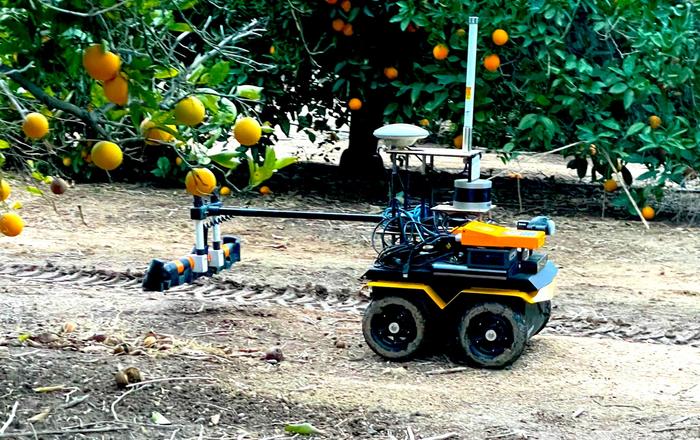
The robot itself is a Jackal, a compact wheeled platform from Clearpath Robotics, fitted with a lightweight electromagnetic induction sensor weighing under half a kilogram. During surveys, it rolls slowly along tree lines at the UCR Citrus Research Center, measuring conductivity at a rate of once per second and logging GPS position as it goes. The surveys are timed around solar noon, which turns out to matter: soil temperature rises through the morning and changes how the sensor reads, so finishing quickly, in under ninety minutes, limits thermal drift in the data.
On their own, conductivity readings are ambiguous. Clay-heavy soils conduct well whether they’re wet or dry; sandy soils conduct poorly regardless. To translate conductivity into actual moisture content, the team uses a small number of conventional soil moisture sensors buried at fixed points across each orchard, between four and six per field, as calibration anchors. A statistical model then links the robot’s conductivity map to those reference readings, producing estimates of volumetric water content at the scale of individual trees. The researchers tested the approach across two navel orange orchards over several months, running the numbers 10,000 times with randomly shuffled calibration sets to check how much the results varied. The accuracy, measured by root mean square error, came in consistently at around 0.04 cubic metres per cubic metre, which puts it in the range the paper classes as good to fair, by the benchmarks used for NASA’s soil moisture satellites.
Scudiero says growers will be able to do something with this that current systems simply cannot offer: “water specific trees if they’re dry.” That sounds almost trivially obvious as an ambition, but existing commercial practice in California’s micro-irrigated orchards typically involves one soil moisture sensor per field, a single point of data being used to infer conditions across hundreds or thousands of trees. As the paper documents, that approach produces unreliable results about 64 percent of the time.
The consequences of getting it wrong run in both directions. A tree that is too dry becomes stressed, more susceptible to fungal pathogens and to pest damage, and its fruit quality suffers in ways that can persist across multiple seasons. Overwatered roots, on the other hand, lose access to oxygen as soil pores fill with water rather than air, stunting growth in a different and equally insidious way. Finding the sweet spot matters enormously, and in California it carries an additional layer of pressure: groundwater regulations are tightening, water costs are rising, and growers who cannot demonstrate more efficient use of their allocation may eventually face reduced access or outright curtailment. For many orchardists, the arithmetic is blunt. Retire trees, or figure out how to grow the same crop on less water.
There is also a downstream pollution angle that rarely gets discussed in irrigation coverage. When fields are overwatered, applied fertiliser washes below the root zone into groundwater. Applying only what the trees can actually use keeps those nutrients in the system, and out of the aquifer.
The current version of the robot requires a human operator with a joystick, which limits how fast surveys can be scaled up. Semi-autonomous navigation algorithms capable of routing the Jackal around an orchard unaided have already been demonstrated at the same research site, though, and the team has filed a patent related to how the robot’s sensor interacts with the fixed moisture sensors in the ground without disrupting their readings. Commercial partnerships to ruggedise the system for all-weather farm use, and to extend it to different crop types and soil conditions, are the likely next step.
What is perhaps most interesting about the calibration finding is how little ground truth turns out to be necessary. The accuracy improvement from using twelve calibration points rather than six was, statistically speaking, negligible. Monitoring thousands of commercial trees with a robot that needs only a handful of buried reference sensors to calibrate itself is a rather different proposition from deploying the dense, expensive sensor networks that precision agriculture has often seemed to require. The question of what growers will actually be able to afford to do with that information, and how irrigation control systems would need to change to act on tree-level data, remains genuinely open.
“More crop per drop,” Scudiero offered, and while the phrase has a bumper-sticker quality to it, the underlying ambition is serious: California agriculture cannot keep operating on the assumption that water applied is water absorbed, and the gap between those two things may be considerably larger than most growers currently know.