

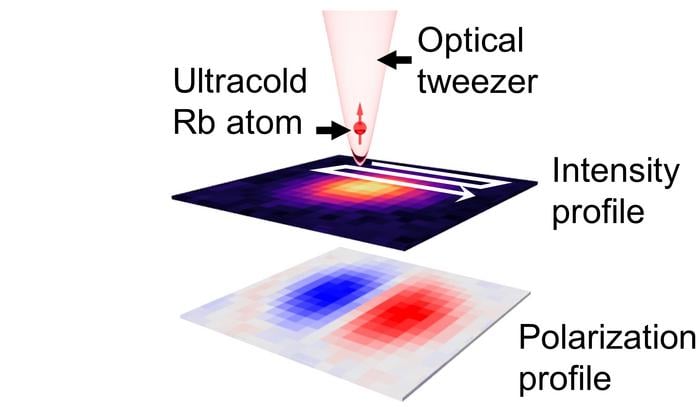
The best camera for photographing light turns out to be a single atom, frozen until it barely moves, and dragged through the beam one nanometer-sized step after another. No lens. No sensor in the usual sense. Just one rubidium atom, held in a pinch of laser light, reporting back on the light around it.
That is the gist of a technique a Japanese group has named the Atom Camera, reported this week in Nature Communications. Working at the Institute for Molecular Science, part of the National Institutes of Natural Sciences, the team used a lone ultracold atom to map the fine structure of laser beams at a scale below 100 nanometers, well under the wavelength of the light being studied.
Below the wavelength is the interesting part. Conventional optical microscopes hit a hard ceiling called the diffraction limit, a consequence of light being a wave rather than any shortcoming of glass or engineering. You cannot use light to resolve something much finer than the light’s own wavelength, a few hundred nanometers for the near-infrared beams in question here. Sharper detail than that has long demanded clever workarounds. The Atom Camera’s workaround is to throw out the lens altogether and probe the beam with something smaller than a wavelength: an atom.
The Reason to Photograph a Beam
There is a reason anyone would want to do this, and it lives in the quantum computers now being assembled in labs around the world.
One promising design holds individual neutral atoms in tightly focused dots of laser light, optical tweezers, lining them up as quantum bits. How well those qubits behave depends with surprising sensitivity on the precise shape of the trapping light, on its intensity and, less obviously, on its polarization, the orientation of the light wave’s electric field. A poorly shaped beam means a flaky qubit. But checking the beam where it actually does its work, deep inside a vacuum chamber, has been awkward at best. Drop a camera in alongside the atoms and you spoil their delicate quantum states; image from outside through a window and lens, and the optics add distortions of their own.
Takafumi Tomita, Kenji Ohmori and their colleagues sidestepped both problems. Rather than bring a camera to the light, they let the atom that already sits in the beam serve as the detector.
Reading the Light Through Spin
The recipe runs something like this. Lasers cool a single rubidium-87 atom into the quietest motional state available inside its optical tweezer, leaving its position smeared out by only about 25 nanometers, the quantum jitter of the atom’s wavefunction. That smear is the ultimate grain of the image; nothing can be resolved more sharply than the probe itself is fuzzy. The atom is then stepped across the light pattern being studied. At each stop, the light tweaks the energy of the atom’s internal spin states by a whisper, and measuring that tweak, position by position, assembles a map of the light. What makes the method sing is the choice to read those spin states through the atom’s long-lived hyperfine levels with a technique called Ramsey interferometry, instead of the short-lived optical transitions used by earlier single-atom probes. Because the hyperfine states hold their quantum coherence for as long as a second, the readout comes out about ten times more sensitive than before.
Then comes the part the team is keenest on. Take a beam of plain linearly polarized light and focus it tightly, and near the focus it quietly develops a twist of circular polarization, an effect nobody can photograph with an ordinary camera. The atom can feel it. Circularly polarized light acts on the atom’s spin like an imaginary magnetic field, and by tracking that, the researchers drew out the hidden polarization map of a tweezer beam roughly a micrometer wide. The pattern they recovered lined up with what vector diffraction theory says should be there.
None of this is quick. A single pixel takes about 40 seconds, a whole image runs to hours, and across those hours the atom and the beam slowly wander apart by tens of nanometers, a drift uncomfortably similar in size to the resolution they are chasing.
A Narrow but Useful Eye
And the camera is fussy about what it will look at. It responds only to light at wavelengths near the atom’s own resonances, so it is no all-purpose instrument; it is a tool built for, and largely confined to, cold-atom physics. The polarization map it produces is partial, too, catching one slice of the full picture rather than the whole thing.
For its intended users, though, that narrowness hardly dents the value. A way to measure both the intensity and polarization of a trapping beam in place, without nudging the atoms, is exactly what neutral-atom engineers have been missing. It offers a route to diagnosing why a stubborn qubit underperforms, whether the culprit is stray light bleeding between control beams or that polarization twist lurking near the focus. The same atom might be turned to sensing genuine magnetic fields, or, if promoted to a high Rydberg state, static electric ones, all without leaving the chamber. And the sluggishness could yield to numbers: scatter many atoms across the beam and each one photographs its own little region simultaneously.
What the Atom Camera delivers, for the moment, is a slow and stubbornly specialized portrait, and a rather beautiful one at that: a beam of light caught mid-focus, recorded by the smallest observer physics has so far put to work.
https://doi.org/10.1038/s41467-026-73348-x
Frequently Asked Questions
How does an atom end up working as a camera?
The atom is stepped through a light beam, and at each position the surrounding light slightly shifts the energy of its internal spin states. Recording that shift at point after point builds up an image of the light. Cooling the atom until its position blurs by only about 25 nanometers turns it into a remarkably fine probe.
Is this really sharper than a normal microscope?
Yes, in a specific sense. Ordinary optical microscopes are limited by diffraction, an inescapable result of light behaving as a wave, which prevents them from resolving features much smaller than the light’s wavelength. By probing the beam with an atom rather than focusing it through a lens, the Atom Camera reaches resolutions below 100 nanometers.
What is so important about the polarization of a laser beam?
Atoms used as qubits in neutral-atom quantum computers react to both the brightness and the polarization of the laser light holding them. When a beam is tightly focused, it develops a subtle swirl of circular polarization near its focus that can undermine qubit quality, and there was previously no good way to observe this in situ.
What is stopping this from becoming a faster, broader tool?
Two things mainly. The atomic probe only senses light near its own resonant wavelengths, so it suits cold-atom experiments rather than general imaging, and a full picture currently takes hours to record. Running many atoms in parallel could cut that time, with each atom imaging its own patch of the beam at once.