

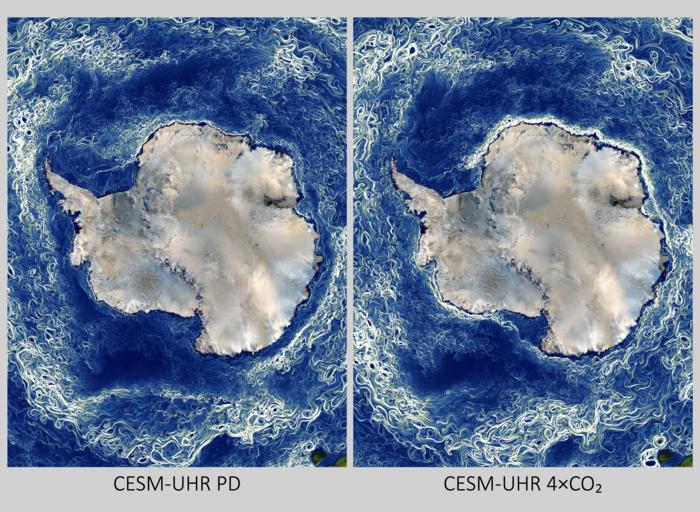
It starts with a picture: a satellite view of the Arctic smeared with bright filaments, like cream swirled into dark coffee. Those threads mark a kind of invisible mixing, the ocean stretching and folding itself until heat, salt, and life get shuffled across wide distances. A new ultra high resolution climate study says those filaments are about to grow brighter and more common as the planet warms and polar sea ice retreats.
Researchers at the Institute for Basic Science used a fully coupled Earth system model with ocean grid cells as fine as one tenth of a degree to examine mesoscale horizontal stirring, or MHS, across the Arctic and the Southern Ocean. Instead of relying on coarse averages, they tracked how close-by parcels of water pull apart, a diagnostic called the finite-size Lyapunov exponent, or FSLE. In simple terms, higher FSLE means faster separation and more vigorous horizontal stirring.
The team ran present-day, doubled-CO2, and quadrupled-CO2 simulations. Then they crunched daily data over a decade for each case, a computational task hefty enough to make most laptops weep. The result: a clear, statistically significant shift toward stronger surface stirring in both polar oceans. In the Arctic, the change is especially sharp as ice loss removes a physical brake on winds transferring momentum into the sea, energizing currents and eddies. Around Antarctica, the mechanism differs; coastal freshening steepens density gradients and strengthens the Antarctic Slope Current, which boosts eddy activity and stirring along the continent’s edge.
Why stronger stirring matters above and below the surface
Stirring is not just a physics curiosity. It shapes where heat and carbon go, how nutrients are delivered, where phytoplankton bloom, and how fish larvae disperse. Stronger stirring can connect ecosystems by ferrying microscopic life from one region to another; it can also tear communities apart by exporting nutrients offshore or shuttling larvae into hostile waters. In the model world presented here, polar MHS ramps up because both the mean flow and the eddy field intensify, a one-two punch visible in the study’s kinetic energy maps.
One of the most striking aspects of the work is methodological. Using FSLE exposes fine-scale filaments and spirals that standard, Eulerian viewpoints tend to blur. The authors also tested how much the mean flow versus the eddies matter by filtering currents and recomputing FSLE. The eddy-only calculation most closely matched the full picture, underscoring the central role of mesoscale turbulence even as robust mean currents guide the overall pattern.
As for the biological stakes, the authors do not sugarcoat the uncertainty. High resolution physics is only one piece; truly credible ecosystem projections will need equally detailed representations of plankton, fish, and their feedbacks with climate. Still, the direction of travel is hard to miss: fewer ice lids, more energy in the surface ocean, and faster lateral transport. If you care about where warmth, carbon, larvae, and even microplastics travel, stronger stirring changes the map.
“The contrast between the Arctic Ocean, which is enclosed by surrounding continents, and the Southern Ocean, where the continent is encircled by ocean, creates different physical conditions for ocean stirring.”
I paused over that line while reading the paper, because it captures both the simplicity and the subtlety here. Geography sets the stage, but warming rewrites the script in two acts that end similarly: more stirring. The model’s Arctic shows a beefed-up Beaufort Gyre and livelier meanders, while the Antarctic periphery features a quickened slope current hugging the coast. Different drivers; convergent outcomes.
From wind and melt to filaments and fronts
Mechanistically, the Arctic story is almost tactile. Remove the roughness of sea ice and the wind’s grip on the surface tightens; the ocean spins up, eddies pinch and roll, and FSLE filaments multiply. In the south, the invisible hand is freshwater. As sea ice wanes, near-shore freshening lightens coastal water, sharpening the cross-shore density contrast. The gradient acts like a stretched rubber band for the Antarctic Slope Current, storing energy that eddies happily release as swirls and jets.
There is a practical takeaway, beyond the eye candy of FSLE maps. Seasonal navigation, fisheries planning, and pollution response in newly ice-light polar seas will unfold on a background that is not just warmer, but more dynamically restless. That means more rapid lateral spreading of tracers, sharper fronts, and possibly bigger swings in ecological fortunes from one season to the next. The authors argue for the obvious next step: embed high resolution biology into equally sharp climate models so we can forecast living consequences with the same clarity we now apply to physics.
“Horizontal stirring is a crucial factor for fish larval transport across the ocean. For moderate values, this process connects populations and habitats geographically, increasing their genetic exchange.”
In other words, a little stirring can be a bridge; too much can be a rip current. As sea ice recedes and the filaments brighten, deciding which is which will demand more than a pretty map. It will require models that let physics and life talk to each other at the scales where both actually operate.