

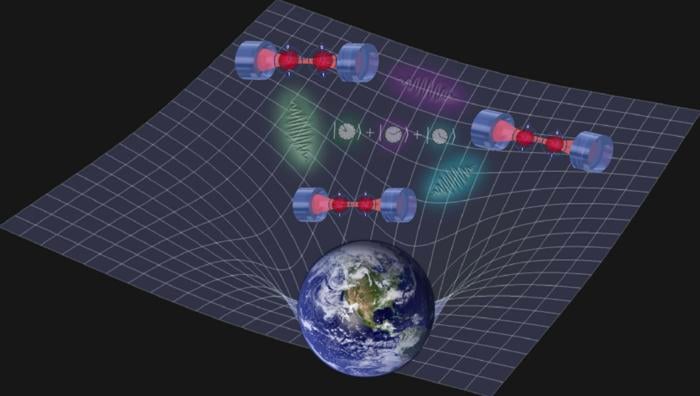
In a pioneering twist on quantum networking, physicists have proposed using entangled atomic clocks to probe how gravity’s bending of space-time affects the quantum world. The work—led by researchers from Stevens Institute of Technology, the University of Illinois at Urbana-Champaign, and Harvard University—details a method for testing quantum theory under the influence of curved space-time, a regime where Einstein’s and Schrödinger’s legacies finally collide.
Entanglement meets Einstein
Einstein showed that time ticks slower in stronger gravitational fields. Quantum theory, meanwhile, thrives on superpositions—particles existing in multiple states or places at once. But what happens when a quantum clock exists in a superposition across regions with different gravitational time flows?
This is exactly what Igor Pikovski and colleagues aim to find out. Their study, published in PRX Quantum, proposes creating a distributed quantum clock—essentially one “delocalized” clock spread across three elevations on Earth using entangled atomic nodes. By observing how these nodes accumulate time differently and interfere quantum-mechanically, the team hopes to spot effects that could hint at limits or modifications to quantum theory.
How it works: Clocks in superposition
The protocol uses three atomic clocks built from arrays of ytterbium-171 atoms. Instead of physically moving a single clock, the researchers create a quantum W-state—a special kind of entanglement—in which one clock is shared across three distant nodes. This state enables the “clock” to simultaneously exist in three gravitational potentials.
As each clock ticks slightly differently due to Earth’s gravity, their differences accumulate as measurable quantum interference. The resulting signal contains:
- Three distinct “beat notes” from time dilation at different altitudes
- Frequency shifts directly linked to general relativistic curvature
- Loss and revival patterns in interference visibility—signatures of time evolution in superposition
More than a thought experiment
By combining quantum teleportation, entangled Bell pairs, and optical atomic clocks, the proposed experiment stays grounded in current technology. The study even models how using 100-atom GHZ “superatoms” can enhance sensitivity by amplifying the relativistic phase shifts, making the measurement feasible within 500 seconds of evolution time.
“We assume quantum theory holds everywhere…”
“But we really don’t know if this is true,” said Igor Pikovski, one of the study’s authors. “It might be that gravity changes how quantum mechanics works.”
The setup also opens the door to test whether the probabilistic nature of quantum mechanics—the so-called Born rule—holds under space-time curvature. If unexpected patterns emerge, physicists may finally glimpse where today’s theories start to fray.
Quantum networks beyond the internet
While quantum networks are being built to revolutionize communication and computing, this work highlights a different frontier: using entanglement not just to send data, but to ask nature deep questions. Are our most cherished physical laws still intact when space bends and time flows unevenly? Thanks to a quantum clock spread across altitudes, we may soon find out.
Journal: PRX Quantum
DOI: 10.1103/q188-b1cr