

Imagine your body as a vast factory, one where proteins are the essential workers keeping everything running. They build your muscles, ferry messages between cells, and guard against infection. Then imagine some of those workers start malfunctioning: misfolding into toxic tangles, multiplying out of control, or simply lodging where they shouldn’t be. That’s when things get dangerous. Dementia. Cancer. Autoimmune collapse.
For decades, pharmaceutical companies have tried to stop these rogue proteins with conventional drugs, only to discover something maddening: many disease-causing proteins simply won’t cooperate. They lack the binding pockets that drugs are designed to attack. They’re, quite literally, undruggable.
Now a radical new approach is turning this problem upside down. Rather than trying to poison these troublemakers, researchers are teaching the body to recycle them. And the tool they’re using is almost laughably small: nanoparticles so tiny that millions could fit on a pinhead. When engineered with the right biological handles, these particles can grab hold of virtually any disease protein, haul it to the cell’s recycling centres, and let nature’s own demolition crew do the work.
The technology, described in a new perspective in Nature Nanotechnology this month, could unlock treatments for diseases that medicine has long considered untreatable. It’s already attracted the attention of drug giants, with the targeted protein degradation market expected to surpass $10 billion by 2030. But what makes this approach different (what makes it revolutionary, in the careful language of science) is something subtler: it represents a fundamental rethinking of how we weaponise medicine at the nanoscale.
“Proteins are essential for nearly every function in the body,” explains Bingyang Shi, a nanomedicine specialist at the University of Technology Sydney, “but when they become mutated, misfolded, overproduced, or build up in the wrong place, they can disrupt normal cell processes and trigger disease.” Shi has spent years studying what goes wrong at the molecular level. What’s striking about his work is how it bridges two worlds: the traditional pharmaceutical approach of targeting disease mechanisms, and a newer, stranger strategy that turns biology against itself.
The problem proteins are everywhere. They drive cancer, where mutated growth signals run wild. They accumulate in Alzheimer’s disease, where amyloid proteins tangle into plaques. They malfunction in autoimmune disorders, where the body’s own defences go haywire. And many of them share one infuriating characteristic: they simply can’t be grabbed by conventional drugs. “Many conditions, including cancer, dementia and autoimmune disorders, are driven by abnormal proteins, and some have shapes or behaviours that make them particularly resistant to drug treatments,” Shi notes. This resistance has been a brick wall in drug discovery: not because researchers don’t understand the proteins, but because the proteins’ structures offer no obvious place for a drug molecule to bind.
The field of targeted protein degradation emerged to solve this problem, beginning around 2015 when researchers discovered that specially designed molecules called PROTACs could trick the cell into degrading proteins. These molecules work like molecular matchmakers, bringing the disease protein together with the cell’s own recycling machinery. The cell recognises the pair and tags the protein for destruction.
But PROTACs have a serious limitation. They’re complex chemistry: two drug molecules connected by a linker, requiring months of labour-intensive synthesis for each new target. They struggle to penetrate solid tumours or cross the blood-brain barrier. And they hit a wall when you need tissue-specific targeting; designing a molecule that reaches your brain without getting stuck in your liver is fiendishly difficult.
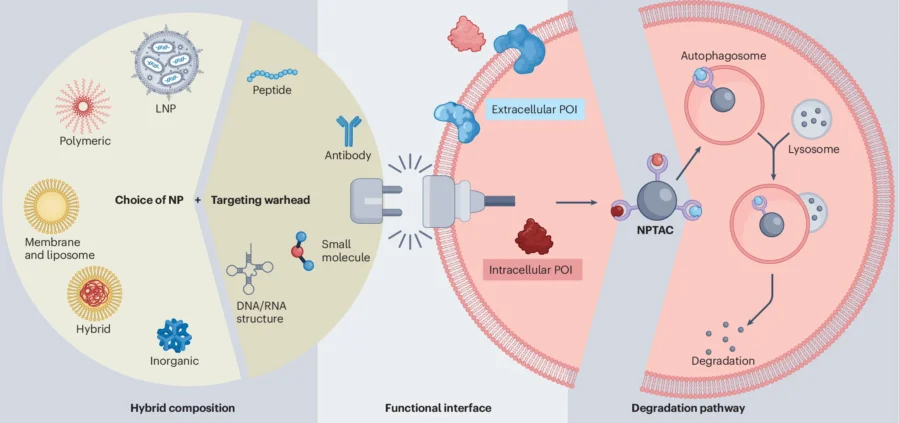
Enter the nanoparticles. Over the past few years, Shi and his collaborators discovered something unexpected: ligand-modified nanoparticles (particles engineered with targeting molecules on their surface) can also trigger protein degradation. They don’t need the architectural complexity of PROTACs. They don’t need custom synthesis. They can be assembled in a modular, mix-and-match fashion, like snapping together building blocks.
“We have developed an efficient and flexible method to guide disease-causing proteins, whether inside or outside the cell, into the body’s natural recycling system, where they can be broken down and removed,” Shi says. The elegance here is profound. Rather than designing a bespoke molecule for each disease protein, researchers can take an off-the-shelf nanoparticle, attach a targeting molecule to its surface, and watch it go to work. Polymeric nanoparticles, lipid-based particles, even gold nanoparticles: all can serve as platforms. A particle designed for cancer proteins this month can become a dementia fighter next month with a simple molecular swap.
The advantages cascade outward. Because nanoparticles are larger than small molecules, they interact with cells differently. They traffic through cellular compartments that drug molecules can’t easily reach. They can be programmed to dissolve inside lysosomes (the cell’s recycling factories), releasing their cargo directly where degradation happens. They penetrate tumour tissue more effectively. They cross biological barriers that have stopped conventional drugs cold. And because they’re made from materials already approved by the FDA for other therapies, the path to clinical trials looks considerably shorter than designing an entirely new chemical entity.
The core insight reshapes how scientists think about nanoparticles altogether. For years, the narrative has been one of delivery: nanoparticles as Trojan horses, smuggling drugs past defences, escorting cargo to its destination. “This progress paves the way for applications in oncology, neurology and immunology,” Shi explains. “It changes how we think about nanoparticles – not only as delivery tools but also as active therapeutic agents.” The particles themselves become the medicine, not merely the vehicles.
Preclinical work has already demonstrated the concept’s viability. The team has shown that these nanoparticle-mediated targeting chimeras (NPTACs, for those who must acronymise everything) can degrade tumour biomarkers like EGFR and PD-L1, proteins that cancer cells use to hide from the immune system. They’ve shown the technology works on intracellular proteins too, pulling off the relatively rare feat of degrading mutant p53, a protein at the heart of many cancers. The particles seem to be platform-agnostic; the degradation machinery of the cell doesn’t care what kind of nanoparticle is doing the hauling, as long as something shows up with the right package.
What makes this different from the early PROTAC excitement is replicability at scale. “Our nanoparticle-based strategy overcomes these bottlenecks,” Shi says, referring to the synthesis complexity and tissue-penetration problems that have frustrated the field. With NPTACs, there’s no bespoke synthesis for each new target. The chemistry is standardised. The assembly is streamlined. A chemistry lab doesn’t need to reinvent the wheel every time a new disease protein needs degradation.
The timeline for clinical translation remains uncertain: early PROTAC candidates took years to reach human trials, and surprises always lurk in the gap between the lab and the clinic. The pharmaceutical industry is watching closely, though. Arvinas, a company built around PROTAC technology, has raised over a billion dollars and struck multi-billion-dollar partnerships with Pfizer, Bayer, and Roche. These companies are hungry for new degradation platforms. “With the targeted protein degradation market expected to surpass $10 billion USD by 2030,” Shi observes, “NPTACs provide a powerful platform for the next generation of smart, precision therapies.”
The real challenge now is the patient heterogeneity problem. Even if NPTACs work brilliantly in the lab, tumours in real people express proteins at wildly different levels. Mutations vary. The body’s chemistry isn’t a test tube. Designing therapies that work reliably across this spectrum requires understanding not just how NPTACs work in isolation, but how they behave in the lived complexity of disease. The research team has identified this as crucial: matching ligand affinity with tissue-specific targeting, understanding how nanoparticles navigate heterogeneous tissues, accounting for individual variation in drug metabolism.
Shi’s team is actively seeking pharmaceutical partners to move NPTACs toward clinical development. There’s every reason to believe they’ll find willing collaborators. The core technology works. The manufacturing pathway exists. The market is primed. “We are now seeking strategic industry partners to accelerate clinical development, license applications across therapeutic fields, and prepare for regulatory approval,” he says.
What’s genuinely intriguing about NPTACs isn’t that they’re flashier or more innovative than other degradation strategies: it’s that they’re simpler. They take the complex machinery of targeted degradation and, through the alchemy of nanotechnology, make it less laborious, more flexible, more accessible. In a field that’s run on expensive, custom chemistry, that’s almost revolutionary.
The undruggable proteins that have haunted pharmaceutical companies for decades are beginning to look vulnerable. Not because we’ve finally cracked their codes, but because we’ve realised we don’t need to. We just need to teach the cell to take out its own trash.
Study link: https://www.nature.com/articles/s41565-025-02081-1