
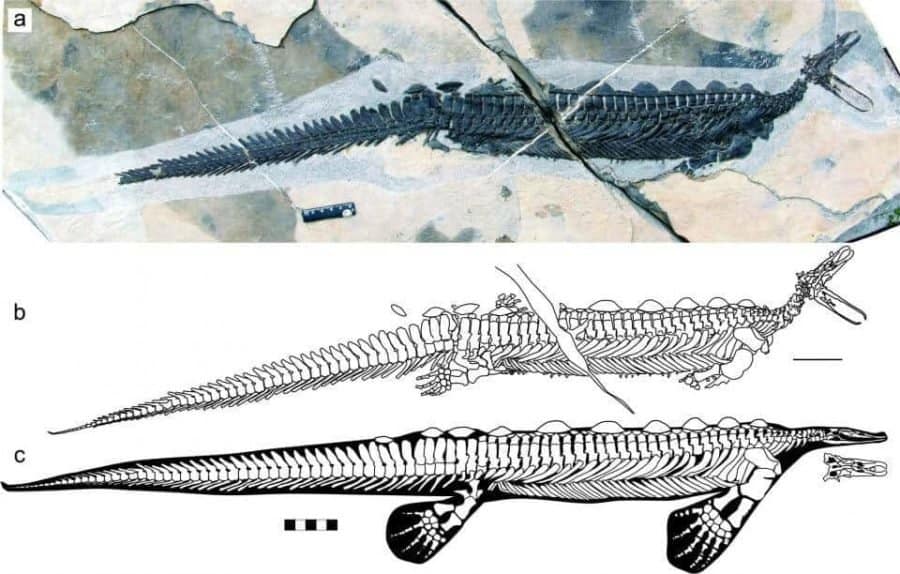
No animal alive today looks quite like a duck-billed platypus, a semi-aquatic, egg-laying mammal hailing from eastern Australia. But about 250 million years ago, something very similar swam the shallow seas in what is now China, finding prey by touch with a cartilaginous bill. The newly discovered marine reptile Eretmorhipis carrolldongi from the lower Triassic period is described in the journal Scientific Reports Jan. 24.
Apart from its platypus-like bill, Eretmorhipis was about 70 centimeters long with a long, rigid body, small head and tiny eyes, and four flippers for swimming and steering. Bony plates ran down the animal’s back.
Eretmorhipis was previously known only from partial fossils without a head, said Professor Ryosuke Motani, a paleontologist at the University of California, Davis, Department of Earth and Planetary Sciences and co-author on the paper.
“This is a very strange animal,” Motani said. “When I started thinking about the biology I was really puzzled.”
Hunting by touch
The two new fossils show the animal’s skull had bones that would have supported a bill of cartilage. Like the modern platypus, there is a large hole in the bones in the middle of the bill. In the platypus, the bill is filled with receptors that allow it to hunt by touch in muddy streams.
In the early Triassic, the area was covered by a shallow sea, about a meter deep, over a carbonate platform extending for hundreds of miles. Eretmorhipis fossils were found at what were deeper holes, or lagoons, in the platform. There are no fossils to show what Eretmorhipis ate, but it likely fed on shrimp, worms and other small invertebrates, Motani said.
Its long, bony body means that Eretmorhipis was probably a poor swimmer, Motani said.
“It wouldn’t survive in the modern world, but it didn’t have any rivals at the time,” he said.
Related to the dolphinlike ichthyosaurs, Eretmorhipis evolved in a world devastated by the mass extinction event at the end of the Permian era. The fossil provides more evidence of rapid evolution occurring during the early Triassic, Motani said.
Co-authors on the study are Long Cheng and Chun-bo Yan, Wuhan Centre of China Geological Survey, Wuhan; Da-yong Jiang, Peking University; Andrea Tintori, Università degli Studi di Milano, Italy; and Olivier Rieppel, The Field Museum, Chicago. The work was supported by grants from the China Geological Survey, the National Natural Science Foundation of China and the Ministry of Science and Technology.
ScienceBlog.com has no paywalls, no sponsored content, and no agenda beyond getting the science right. Every story here is written to inform, not to impress an advertiser or push a point of view.
Good science journalism takes time — reading the papers, checking the claims, finding researchers who can put findings in context. We do that work because we think it matters.
If you find this site useful, consider supporting it with a donation. Even a few dollars a month helps keep the coverage independent and free for everyone.