
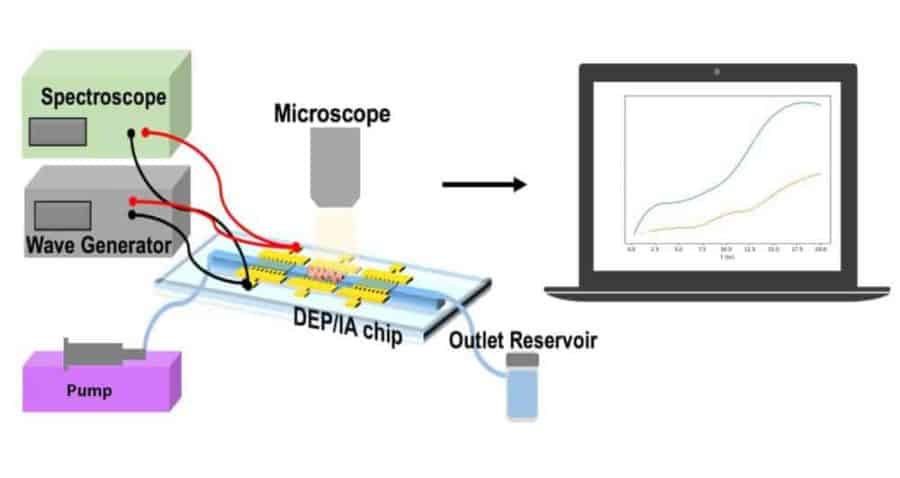
UCI researchers and collaborators have developed a “lab on a chip” platform to facilitate continuous, inexpensive, rapid and personalized drug screening. The technology is capable of evaluating the effectiveness of treatments on cancer cells without bulky readout equipment or requiring the shipment of samples to labs. The scientists’ work is the subject of a new study published in the America Chemical Society journal Analytical Chemistry. “There is an ever-present need for simplified and low-cost identification of a patient’s personal cancer resistance and medication efficacy before and throughout treatment,” said senior author Rahim Esfandyarpour, UCI assistant professor of electrical engineering & computer science, as well as biomedical engineering. “We envision our work as another step toward potentially enabling the personalized screening of drug efficacy on individual patients’ samples, possibly leading us to a better understanding of drug resistance and the optimization of patients’ treatments.” He said that most current approaches to drug efficacy testing require expensive imaging, lab work and large-scale cell culture experiments. “Our platform is an initial prototype that we hope to further develop in the future into a personalized medicine tool for cancer patients facing drug resistance,” said co-author Vanessa Velasco, a Stanford University postdoctoral researcher. The lab-on-a-chip technology employs advanced electrical and electrochemical techniques to precisely manipulate cancer cells of interest in parallel with the continuous characterization of the potential effectiveness of therapeutic agents custom-made for patients. The end result should greatly reduce the time and cost associated with treating cancer.
ScienceBlog.com has no paywalls, no sponsored content, and no agenda beyond getting the science right. Every story here is written to inform, not to impress an advertiser or push a point of view.
Good science journalism takes time — reading the papers, checking the claims, finding researchers who can put findings in context. We do that work because we think it matters.
If you find this site useful, consider supporting it with a donation. Even a few dollars a month helps keep the coverage independent and free for everyone.