
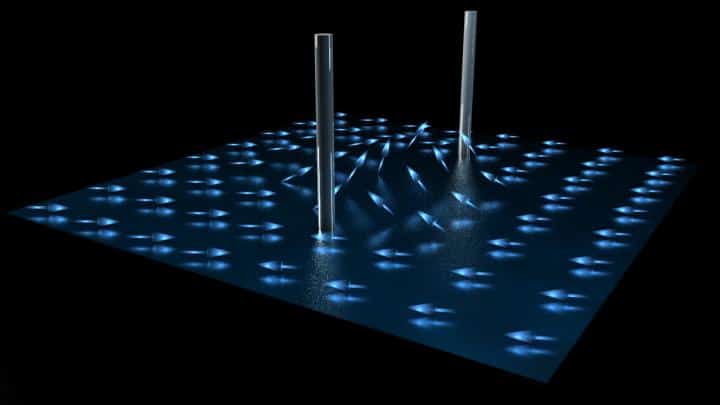
Researchers in Aalto University, Finland, and P.L. Kapitza Institute in Moscow have discovered half-quantum vortices in superfluid helium. This vortex is a topological defect, exhibited in superfluids and superconductors, which carries a fixed amount of circulating current.
‘This discovery of half-quantum vortices culminates a long search for these objects originally predicted to exist in superfluid helium in 1976,’ says Samuli Autti, Doctoral Candidate at Aalto University in Finland.
‘In the future, our discovery will provide access to the cores of half-quantum vortices, hosting isolated Majorana modes, exotic solitary particles. Understanding these modes is essential for the progress of quantum information processing, building a quantum computer,’ Autti continues.
Macroscopic coherence in quantum systems such as superfluids and superconductors provides many possibilities, and some central limitations. For instance, the strength of circulating currents in these systems is limited to certain discrete values by the laws of quantum mechanics. A half-quantum vortex overcomes that limitation using the non-trivial topology of the underlying material, a topic directly related to the 2016 Nobel Prize in physics.
Among the emerging properties is one analogous to the so-called Alice string in high-energy physics, where a particle on a route around the string flips the sign of its charge. In general the quantum character of these systems is already utilized in ultra-sensitive SQUID amplifiers and other important quantum devices.
The article Observation of Half-Quantum Vortices in Topological Superfluid 3He has been published today in the online version of Physical Review Letters. Experiments were done in the Low Temperature Laboratory at Aalto University.
ScienceBlog.com has no paywalls, no sponsored content, and no agenda beyond getting the science right. Every story here is written to inform, not to impress an advertiser or push a point of view.
Good science journalism takes time — reading the papers, checking the claims, finding researchers who can put findings in context. We do that work because we think it matters.
If you find this site useful, consider supporting it with a donation. Even a few dollars a month helps keep the coverage independent and free for everyone.