

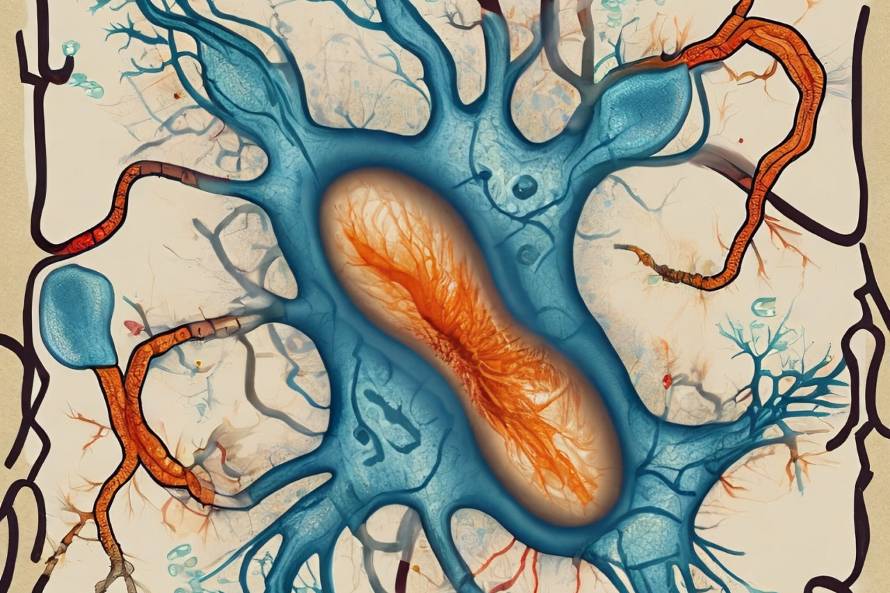
Deep inside the brain’s dopamine-producing cells, a toxic encounter is playing out. Alpha-synuclein, the protein that clumps into the hallmark tangles of Parkinson’s disease, isn’t just piling up. It’s hijacking a crucial cellular guardian.
The target is ClpP, a protein that normally keeps the cell’s energy factories running smoothly. When alpha-synuclein latches onto ClpP through a specific docking site, it drags the protease into harmful clumps. This cripples the mitochondria and speeds up the neuron’s death.
Roughly 1 million Americans live with Parkinson’s. Another 90,000 get diagnosed each year. Current treatments offer only short-term symptom relief.
But researchers at Case Western Reserve University have uncovered this harmful protein interaction. And they’ve done something rather clever about it. Instead of trying to stop alpha-synuclein clumping directly (a notoriously difficult target), they’ve designed a molecular decoy. The peptide, called CS2, tricks alpha-synuclein into binding with it rather than with ClpP. This breaks the harmful cycle at its source. In mice, human brain tissue, and neurons from Parkinson’s patients, CS2 restored energy production and reversed multiple signs of disease.
How the Proteins Interact
The discovery hinges on protein geography. ClpP lives in the mitochondrial matrix, where it acts like a cellular recycling bin. It breaks down misfolded proteins before they cause trouble. Alpha-synuclein, meanwhile, contains a hidden targeting sequence that allows some of it to slip inside mitochondria. Once there, a sticky region of the protein binds directly to ClpP. The team showed that removing this sticky region eliminated the interaction completely.
When alpha-synuclein suppresses ClpP, misfolded proteins accumulate inside mitochondria. This triggers oxidative stress and energy failure. The cell’s powerhouses sputter and die.
The Molecular Decoy
Xin Qi led the research. He explains the approach: “We’ve uncovered a harmful interaction between proteins that damages the brain’s cellular powerhouses, called mitochondria. More importantly, we’ve developed a targeted approach that can block this interaction and restore healthy brain cell function.”
The CS2 peptide was designed by comparing sequences between ClpP and alpha-synuclein. The team identified regions where the proteins might dock. Two candidate peptides emerged, CS1 and CS2, but only CS2 showed activity. It binds alpha-synuclein’s sticky region with enough strength to interfere with the harmful ClpP interaction without being so tight it might cause problems elsewhere.
The Evidence
The peptide’s effects were striking across multiple test systems. In neurons exposed to alpha-synuclein clumps, a standard model that mimics protein aggregation, CS2 reduced harmful protein forms and restored proteins needed for brain cell communication.
In dopamine neurons made from patient stem cells carrying a familial Parkinson’s mutation, CS2 rescued cell structure and mitochondrial function.
The real test came in mice.
The mThy1-hSNCA transgenic line produces too much human alpha-synuclein. These mice develop progressive motor and cognitive problems that resemble Parkinson’s disease. Mice received CS2 or control peptide via pump under the skin for six months, starting at 4 months old. By 10 months, the treated animals showed improved performance on motor coordination tests and spatial memory tasks. Their brains told the story: ClpP levels, which had plummeted in disease, bounced back toward normal. Harmful alpha-synuclein clumps decreased. Brain inflammation, measured by activated immune cells, dropped markedly.
Di Hu, the paper’s first author, frames it this way: “This represents a fundamentally new approach to treating Parkinson’s disease. Instead of just treating the symptoms, we’re targeting one of the root causes of the disease itself.”
Looking Forward
There’s a broader implication here. If mitochondrial breakdown and protein clumping fuel each other through specific protein interactions, blocking those interactions could break the cycle. The team is now working to optimize CS2 for human use, identify molecular markers, and move toward clinical trials within five years.
Qi is optimistic but measured in his outlook. “One day, we hope to develop mitochondria-targeted therapies that will enable people to regain normal function and quality of life, transforming Parkinson’s from a crippling, progressive condition into a manageable or resolved one.”
The approach might extend beyond Parkinson’s to other conditions where alpha-synuclein goes rogue in different brain regions.