

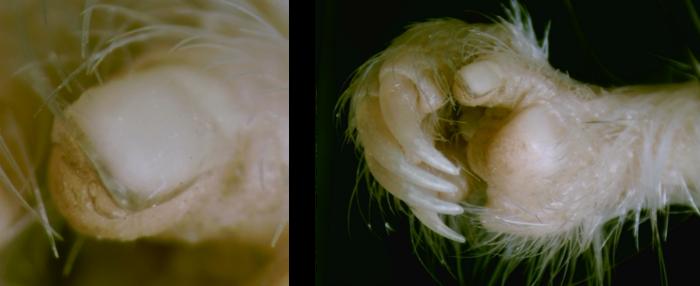
Picture a squirrel cracking an acorn. Not with its teeth, not with brute force, but with its hands. More precisely, its thumbs. Those stumpy digits end not in sharp claws but in smooth, flat nails—thumbnails. A small detail, but one that scientists now argue could help explain how rodents became one of the most successful animal groups on the planet.
In a study published September 4 in Science, researchers at the Field Museum and their collaborators examined more than 400 rodent genera across the mammal family tree. Their conclusion was startling: about 86 percent of rodent groups possess thumbnails rather than claws. The finding suggests that thumbnails, though easy to overlook, may have provided rodents with a decisive evolutionary edge.
“When I talk with people about this research, I always start by asking, ‘Did you know rodents have thumbnails?'” said Rafaela Missagia, a Field Museum research associate and professor at the University of São Paulo. “Most people don’t. I didn’t. I had studied rodents for years, and I didn’t know anything about their nails until I started working on this project.”
The project began in the museum’s cavernous collections, where drawers hold preserved skins of nearly every rodent imaginable. Gordon Shepherd, a Northwestern University neuroscientist, teamed with museum curators to systematically inspect their thumbs. “Before we did the research, we knew that some had nails, some had claws, and some had no thumbs at all,” he explained. “There were hints that the rodents that have thumbnails also use their thumbs to hold their food.”
The Grip That Changed Everything
The study revealed a clear pattern: rodents that wield thumbnails—squirrels, mice, rats, and many others—tend to grasp food with their hands. Those lacking thumbnails, like guinea pigs, rely on their mouths alone. By mapping these traits onto the rodent family tree, the researchers reconstructed an ancient ancestor, likely thumbnail-equipped, that set the stage for the group’s global takeover.
“Nuts are a very high-energy resource, but opening and eating them requires good manual dexterity that a lot of other animals don’t have,” said Anderson Feijó, the Field Museum’s curator of mammals. “Maybe rodents’ thumbnails allowed them to exploit this unique resource and then diversify broadly, because they were not competing with other animals for this food.”
That dexterity went beyond diet. Missagia noted that rodents with thumbnails were more often found aboveground or in trees, while subterranean diggers tended to retain claws. The implication is that nails shaped not only how rodents ate, but also where they lived and how they spread.
Parallel to Primates
Humans and other primates, of course, also sport thumbnails. But this similarity is not evidence of shared ancestry. Instead, the two groups evolved nails independently—a case of convergent evolution. That rodents share this trait with primates underscores its adaptive value.
The buried lede in all this? Rodents may have beaten out earlier mammal competitors, the multituberculates, precisely because their thumbnails enabled better food handling. If true, that tiny sliver of keratin on the thumb may have tipped the balance of evolutionary history.
As Feijó put it: “Museum collections are an endless source of discoveries. For all of the rodents that were used in this study, I bet none of the collectors would have imagined that someone someday would be studying those rodents’ thumbnails.”
Journal: Science
DOI: 10.1126/science.ads7926