

Key Takeaways
- The James Webb Space Telescope observed Saturn’s northern lights and trihydrogen cation, revealing a feedback loop in its atmosphere.
- Inaccurate measurements of Saturn’s rotation stemmed from radio signals generated by atmospheric currents, not the planet’s spin.
- Research indicates that Saturn’s aurora drives its atmosphere, creating winds that sustain a self-contained system, likened to a heat pump.
- This discovery aligns with decade-old models, demonstrating that Saturn’s auroral heating impacts atmospheric dynamics continuously.
- The implications could extend beyond Saturn, suggesting similar processes might exist on other planets with ionospheres and magnetospheres.
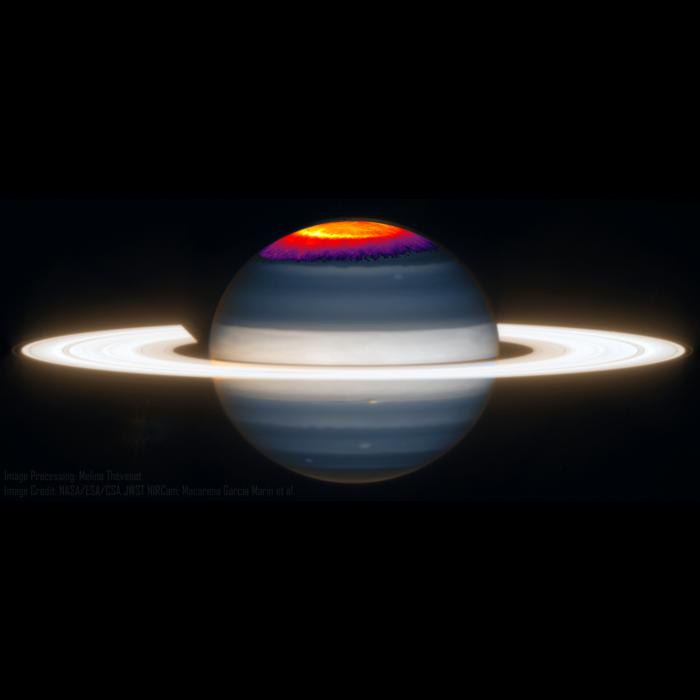
On the night of November 29, 2024, the James Webb Space Telescope turned toward Saturn and held its gaze for the better part of a Saturnian day, roughly ten Earth hours, staring at the planet’s north pole. What the telescope was recording wasn’t Saturn itself, not quite, but a faint infrared glow seeping from a molecule called trihydrogen cation: three hydrogen atoms sharing two electrons, formed in the planet’s upper atmosphere wherever energetic particles rain down from the magnetosphere. The molecule is unstable, fleeting, and extraordinarily useful. Heat it and it glows more brightly. Cool it and the glow fades. It is, in effect, a thermometer embedded in Saturn’s sky, and the readings it was sending back that night were about to close a loop that planetary scientists had been chasing for more than twenty years.
The puzzle started with a straightforward measurement that turned out to be anything but. When NASA’s Cassini spacecraft arrived at Saturn in 2004, it began timing the radio pulses that the planet emits, a standard method for clocking a gas giant’s rotation rate. The problem was that the rate kept changing. Not by a little. Measurably, systematically, in a way that seemed to suggest the planet itself was speeding up and slowing down, which is, physically, more or less impossible. Planets don’t just change their spin.
A 2021 study led by Tom Stallard, Professor of Planetary Astronomy at Northumbria University, showed that the radio measurements weren’t tracking Saturn’s bulk rotation at all. They were picking up electrical currents in the upper atmosphere, currents driven by winds moving through that layer of ionized gas. Those winds, Stallard’s team found, were producing auroral signals that mimicked a changing spin rate. Which answered one question and immediately posed another: where were the winds coming from?
The confusion came from how scientists tried to measure Saturn’s spin. Unlike rocky planets, Saturn lacks a solid surface, so researchers used the radio pulses emitted by the planet as a proxy for rotation. Those pulses, it turned out, were being generated by electrical currents in Saturn’s upper atmosphere rather than by the planet’s deep interior. Because the currents were being driven by winds that varied over time, the radio signal appeared to shift, giving the false impression that the planet itself was speeding up or slowing down.
Trihydrogen cation is a molecule made of three hydrogen atoms sharing two electrons. It forms in Saturn’s upper atmosphere wherever charged particles from the magnetosphere rain down, and it glows in infrared light in a way that varies predictably with temperature. This makes it essentially a natural thermometer. By mapping how brightly it glows across different parts of Saturn’s auroral region, researchers can reconstruct the temperature and particle density structure of the ionosphere in detail that would otherwise be impossible to measure from Earth.
Saturn’s aurora delivers energy to the upper atmosphere in a concentrated location rather than spreading it evenly. That localized heating drives atmospheric winds, the same basic process that generates weather systems here on Earth. Those winds move through Saturn’s ionosphere, a layer of electrically charged gas, and in doing so they generate electrical currents. Those currents, flowing along Saturn’s magnetic field lines, produce the aurora. The aurora then heats the atmosphere at the same spot again. Energy is slowly drawn from the surrounding magnetosphere to keep the cycle going, but no external trigger is needed to maintain it.
The key was spatial resolution combined with sensitivity in the infrared. Previous measurements of Saturn’s auroral ionosphere had temperature uncertainties of around 50 degrees Celsius, which was roughly the same size as the temperature differences the researchers were trying to detect. JWST’s NIRSpec instrument achieved resolution below 500 kilometers per pixel across Saturn’s polar region, an improvement of roughly ten times compared to what was available before. That was enough to map the alternating warm and cool regions that the feedback loop produces, and to match them against decade-old theoretical predictions for the first time.
Quite possibly. Saturn’s aurora was already unusual because it appeared to be driven partly by atmospheric winds rather than purely by the external magnetospheric processes that generate auroras on Jupiter. If the feedback loop documented here turns out to be a general mechanism rather than something specific to Saturn, it might operate wherever a planet has both an ionosphere and a magnetosphere. Whether that includes planets orbiting other stars is genuinely open: exoplanet ionospheres are currently beyond direct observation, but some researchers think the atmospheric signatures detectable in transmission spectroscopy might eventually carry indirect clues about conditions in the surrounding space environment.
The new JWST observations, published in the Journal of Geophysical Research: Space Physics, give the first direct evidence of an answer. And the answer is, roughly, that Saturn’s aurora is creating its own weather.
The key is where the aurora heats the atmosphere. It doesn’t heat it evenly, the way the sun heats a planet’s surface. The particle precipitation that generates the northern lights enters at specific locations, and when Stallard and colleagues mapped the temperature and ion density structure across Saturn’s auroral region at sub-500-kilometer resolution (roughly ten times finer than any previous measurement had achieved), they found that the heating is strongly concentrated exactly where those particles enter. Previous observations had measurement errors of around 50 degrees Celsius, which is, somewhat unfortunately, about the same size as the temperature differences they were trying to detect. JWST eliminated that problem almost entirely.
The result is a localized hot spot. And a localized hot spot in an atmosphere drives winds, just as a warm patch of ocean drives air currents here on Earth. Those atmospheric winds, blowing through the ionized gas of Saturn’s ionosphere, generate the electrical currents that produce the aurora. The aurora then heats the atmosphere at the same location. The location stays warm. The winds keep blowing.
“What we are seeing is essentially a planetary heat pump. Saturn’s aurora heats its atmosphere, the atmosphere drives winds, the winds produce currents that power the aurora, and so it goes on,” Stallard said. He noted that the whole system sustains itself without needing any external input to keep going, draining energy slowly from the surrounding magnetosphere but otherwise self-contained, like a perpetual motion machine that doesn’t actually violate thermodynamics.
What makes the finding particularly satisfying, at least for theorists, is that the observed patterns match remarkably well with computer models published more than a decade ago. Those models predicted that if the heating source was placed at the main auroral emission entry point, you’d see exactly these kinds of alternating regions of heating and cooling arranged around the pole. The models were right. Scientists just couldn’t verify that at the resolution available from Earth-based telescopes or even from Cassini, which was measuring broad, blurred averages across the auroral region rather than the fine-grained structure. JWST changed what was measurable.
The feedback loop also helps explain something that had seemed puzzling about the aurora’s behavior over time: why the effect is so stable. If it required some external driver, some seasonal forcing or occasional magnetospheric disturbance, you’d expect it to fluctuate. The self-sustaining nature of the system means it persists more or less continuously, which is why it produced such a consistent (if misleading) radio signal for Cassini to detect over years of observation.
The implications reach beyond Saturn. Stallard’s team argues that the connection they’ve mapped, atmosphere driving currents that extend into the surrounding space environment, may be operating in some form on other planets too, including worlds orbiting other stars. Jupiter has an aurora and an ionosphere; so do Uranus and Neptune, though both are less well observed. If the atmosphere-magnetosphere feedback they’ve documented at Saturn turns out to be a general phenomenon rather than a Saturn-specific quirk, then the upper atmospheric chemistry of exoplanets might hold information about their broader space environments that no one has yet known to look for. Possibly. The extrapolation is a long way from proven, and exoplanet ionospheres are not exactly straightforward to observe. But it’s the sort of implication that tends to generate proposals.
For now, the more immediate result is that a decades-old measurement oddity has a complete explanation. Cassini wasn’t detecting a spinning planet. It was detecting a heat pump, one that Saturn has presumably been running, quietly and continuously, for as long as it has had an aurora at all.
DOI / Source: https://doi.org/10.1029/2025JA034578