

Cancer might be giving itself away through an invisible trail of chemical scents long before tumors become detectable through traditional screening methods. A new study from Chinese researchers suggests that analyzing volatile organic compounds (VOCs), the chemical signatures our bodies constantly emit, could transform how doctors hunt for multiple types of cancer simultaneously.
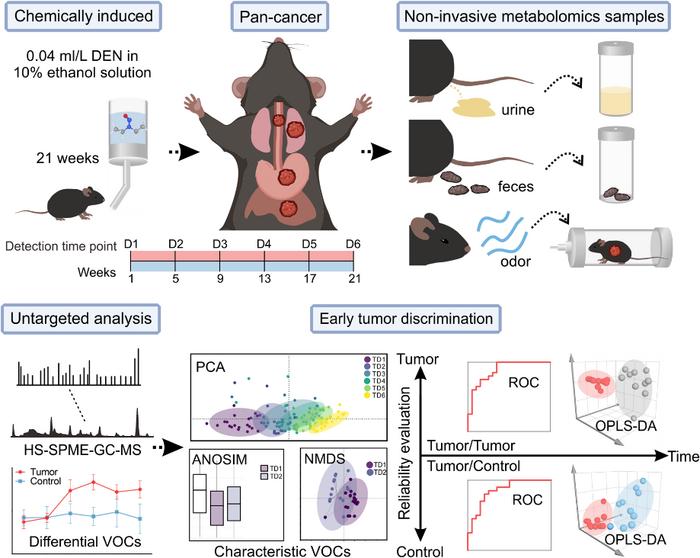
The research, led by Prof. Yannan Chu at the Hefei Institutes of Physical Science, tracked chemical changes in laboratory mice as tumors developed across different organs over 21 weeks. What they discovered challenges the current approach to cancer screening, which typically focuses on one type of cancer at a time and often requires invasive procedures.
“Early tumor signals were detectable in urine at week 5, in odor at week 13, and in feces at week 17, well before advanced tumor development,” the researchers reported.
The team created what they call a “pan-cancer mouse model” by chemically inducing tumors in organs including the lungs, stomach, liver, and esophagus. Using sophisticated analytical equipment, they collected and analyzed urine, feces, and odor samples from both healthy mice and those developing tumors at six different time points.
The Chemical Trail of Disease
The concept isn’t entirely new: dogs have been known to detect cancer through scent for decades, and some medical professionals have reported unusual odors associated with certain diseases. But this study provides concrete scientific evidence that measurable chemical changes occur during the earliest stages of cancer development.
The researchers identified three distinct sets of tumor-associated VOCs that not only reflected metabolic changes as cancer progressed but also successfully distinguished between healthy and tumor-bearing mice. These chemical fingerprints appeared weeks before tumors would typically be detected through conventional means.
Current cancer screening protocols face significant limitations. Mammograms, colonoscopies, and other standard tests target specific organs and often require uncomfortable or invasive procedures. Many cancers go undetected until symptoms appear, by which point treatment becomes more challenging and survival rates drop dramatically.
“This study provides a valuable experimental foundation for exploring VOC biomarkers in pan-cancer research,” according to the team.
From Laboratory to Clinical Reality
The implications extend beyond simple convenience. Pan-cancer screening (the ability to test for multiple cancer types simultaneously) represents a fundamental shift in how we might approach early detection. Instead of scheduling separate screenings for different organs, a single test analyzing breath, urine, or other bodily samples could potentially flag the presence of tumors across multiple body systems.
However, significant hurdles remain before this technology reaches clinical practice. The study was conducted in laboratory mice under controlled conditions, and human metabolism is considerably more complex. Environmental factors, diet, medications, and other variables could potentially interfere with VOC detection in real-world applications.
The research also raises questions about specificity: whether the identified chemical signatures can distinguish between different types of cancer or merely indicate the presence of some form of malignancy. For clinical applications, doctors would need to know not just that cancer might be present, but where to look for it.
Still, the work adds to a growing body of research suggesting that cancer fundamentally alters cellular metabolism in ways that might be detectable through non-invasive methods. Other research groups have explored similar approaches using breath analysis and electronic “nose” devices, though none have yet achieved the reliability needed for routine clinical use.
The study’s longitudinal approach (tracking the same animals over months as tumors developed) provides particularly valuable insight into how chemical signatures evolve during cancer progression. This timeline information could prove crucial for determining optimal screening intervals and understanding how early detection might actually be possible.
For now, the research represents another step toward what some scientists envision as the future of medical diagnostics: simple, non-invasive tests that can detect disease long before symptoms appear. Whether analyzing chemical scents will prove practical for widespread cancer screening remains to be seen, but the fundamental concept that our bodies betray disease through invisible chemical signals continues to gain scientific support.