

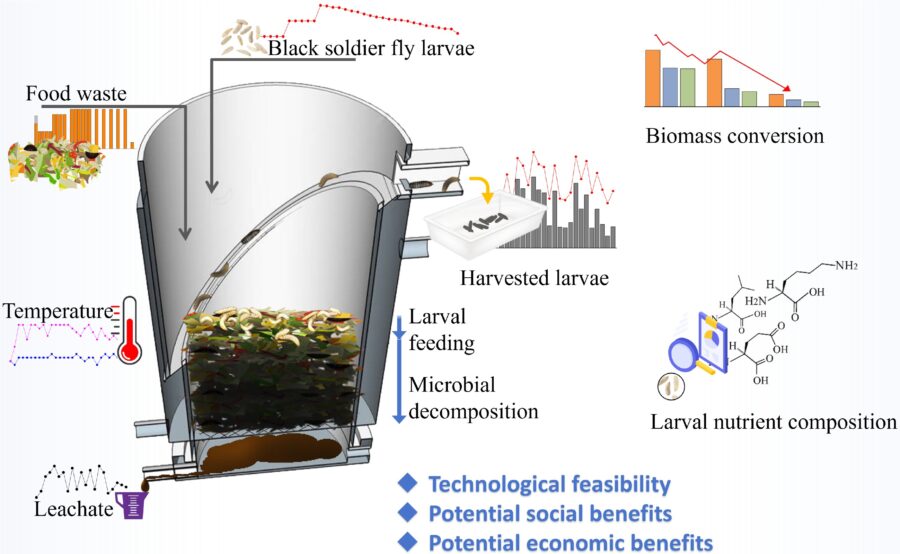
In a cluttered research lab in eastern China, a new kind of garbage disposal sits humming quietly. It doesn’t grind or incinerate. Instead, it farms millions of writhing black soldier fly larvae that consume rural food waste and transform themselves into high-protein animal feed. The contraption might sound like something from a science fiction novel, but it addresses a very real problem: what to do with the mountains of improperly sorted garbage piling up in China’s countryside.
Researchers at Zhejiang University spent a full year studying rural food waste before designing what they call a “continuous self-separation reactor.” The device tackles a challenge that has frustrated waste management efforts in agricultural areas, where mixed garbage often contains materials too tough for larvae to break down efficiently. Previous attempts to use black soldier fly larvae for waste treatment worked well in controlled urban settings but stumbled when confronted with the messier reality of rural refuse.
A System That Runs Itself
The reactor’s innovation lies in its automation. Adult flies naturally separate themselves from the system, eliminating the need for manual sorting. The design maintains optimal heat, collects liquid runoff, and allows continuous feeding without interruption. More importantly, it introduces beneficial microorganisms that work alongside the larvae to tackle stubborn organic materials the insects can’t handle alone.
During testing, the single-batch operation mode ran for 10 days and reduced food waste wet weight by nearly 40%, while producing over 80 grams of larval biomass per kilogram of waste processed. The researchers then pushed further with a multi-batch continuous mode that operated for 32 days. As one team member noted in the published study:
Operation for 32 d led to a 56.6% reduction in the wet weight of food waste, with a larval biomass yield of 64.7 g/kg.
Those numbers might seem modest, but they represent consistent performance under real-world conditions with unsorted, difficult material. The larvae produced weren’t just waste reducers either. Analysis showed they contained high levels of both crude protein and crude fat, the exact nutritional profile needed for quality animal feed. In essence, the system converts garbage into a commodity.
Microbes Make The Difference
A separate 24-hour consumption experiment revealed something the researchers hadn’t initially anticipated. The degradation of organic matter wasn’t solely the work of hungry larvae. Microorganisms played a significant collaborative role, breaking down materials the insects couldn’t tackle independently. This symbiotic relationship proved essential for processing the mixed, contaminated waste typical of rural areas.
The findings matter beyond waste reduction. Rural China faces a dual challenge: managing increasing garbage volumes while simultaneously seeking sustainable protein sources for livestock. Traditional feed imports carry environmental costs and supply chain vulnerabilities. Black soldier fly larvae offer a circular economy solution, turning a disposal problem into a resource stream.
The reactor’s space efficiency stands out as particularly relevant for village-scale implementation. Unlike composting operations that require extensive land area, this system operates in a compact footprint. The automated separation feature addresses labor constraints common in rural settings, where younger residents have largely migrated to cities.
Similar systems have emerged globally as interest grows in insect-based waste processing and alternative proteins. However, most commercial operations focus on pre-sorted urban organic waste. The Zhejiang design specifically targets the messy, inconsistent material found in agricultural communities, where waste segregation infrastructure lags behind urban areas.
The study authors suggest their reactor provides “key insights into the use of BSFL for food waste management,” though they stop short of declaring it a complete solution. Scaling challenges remain, particularly around maintaining optimal conditions across different climates and waste compositions. The microorganism component requires further research to understand which bacterial strains work best under varying conditions.
Still, the research demonstrates that biological waste processing can function effectively outside controlled laboratory environments. As rural areas worldwide grapple with waste management, systems that harness natural processes rather than energy-intensive industrial solutions gain appeal. Whether maggot reactors become commonplace in Chinese villages remains to be seen, but the underlying principle proves sound: sometimes the best way to handle garbage is to let nature do what it does best, just with better engineering.
Frontiers of Environmental Science & Engineering: 10.1007/s11783-025-1963-1