

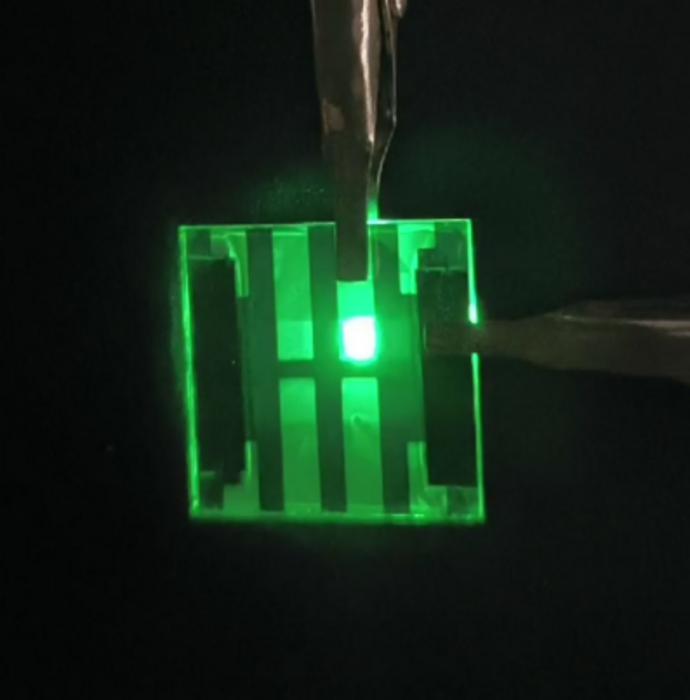
Light bulbs have changed a lot since Edison, yet few could be mistaken for wallpaper. Now, researchers in China have engineered a light-emitting diode (LED) so thin it could roll onto your wall like a sticker—and it glows with a sunlike warmth. The breakthrough, published in ACS Applied Materials & Interfaces, could transform how we think about indoor lighting, from soothing home illumination to eye-friendly displays.
Making Light That Feels Like Daylight
The challenge, as the team saw it, was to reproduce the full color spectrum of natural sunlight in a form that is flexible, efficient, and incredibly thin. Typical LEDs can be bright but often skew too blue, disturbing circadian rhythms. The group led by Lei Chen and Xianghua Wang turned to quantum dots—nanoscale semiconductors known for their tunable colors—to solve this problem.
They synthesized red, yellow-green, and blue quantum dots, each coated with multiple zinc-sulfur shells to stabilize performance. The mixture produced a white light remarkably close to the sun’s own emission pattern. Layers of these dots were stacked with conductive materials just tens of nanometers thick, building up a full device thinner than a human hair. It emits light with a color rendering index above 92, meaning objects appear in near-true colors under its glow.
“This work demonstrates the feasibility of ultra-thin, large-area quantum dot LEDs that closely match the solar spectrum,” says Xianghua Wang. “These devices could enable next-generation eye-friendly displays, adaptive indoor lighting, and even wavelength-tunable sources for horticulture or well-being applications.”
Unlike many experimental LEDs that require high voltage, the team’s prototypes achieved optimal brightness at only 8 to 11.5 volts. At those settings, the white light leaned slightly toward red wavelengths, softening the overall hue—a feature known to improve sleep and reduce eye strain. Even more impressive, 80 percent of the 26 tested devices exceeded the brightness threshold typical for commercial computer monitors.
Lighting the Future of Design and Health
The implications stretch far beyond technical novelty. Ultra-thin, warm LEDs could be woven into architectural surfaces or flexible electronics, illuminating spaces without visible fixtures. Imagine ceilings, furniture, or even curved screens that emit daylight-quality light at the flick of a switch. The researchers emphasize that the technology can also be tuned to different wavelengths, potentially aiding plant growth or human mood regulation.
Though the idea of “sunlight on your wall” might sound poetic, the physics is rigorous. The team’s Cu(In,Ga)S2 quantum dots coated with triple ZnS shells achieved up to 91.7 percent spectral similarity to sunlight in the key 450–700 nanometer range. That fidelity places these quantum dot LEDs among the most natural-looking artificial light sources ever produced.
“The WLED emits warm white light with a color temperature of 3000 K, chromaticity CIE (0.4228, 0.4287), and color rendering index (CRI) Ra 92.4,” the authors write. “Its similarity to the solar spectrum reaches 91.7% in the wavelength region of 450–700 nm.”
As solid-state lighting continues to evolve, the team envisions scalable manufacturing methods for commercial and industrial uses. If realized, this could mark the beginning of a new era in lighting—one where paper-thin panels bring sunlight indoors without heat, glare, or fatigue. In a world increasingly lit by screens and LEDs, a return to something that feels like the sun may be the most human upgrade yet.