

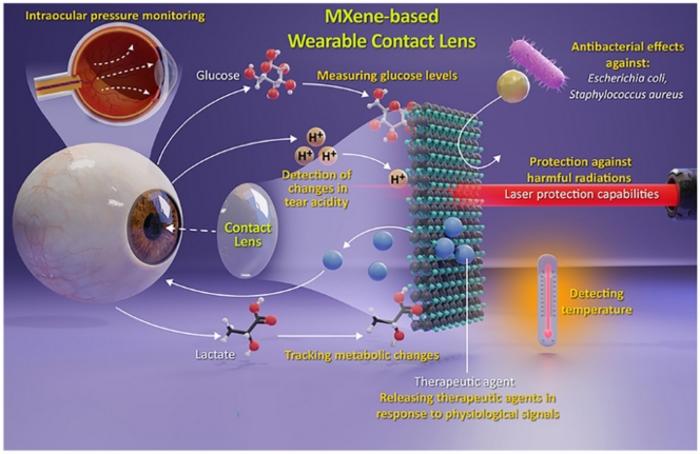
Scientists have developed contact lenses that do far more than correct vision. These experimental devices can track eye pressure, detect glucose levels in tears, kill bacteria on contact, and even deliver heat therapy directly to the eye. The secret ingredient: a class of two-dimensional materials called MXenes, which are essentially atomically thin sheets of metal carbides that conduct electricity while remaining transparent enough to see through.
The technology represents a significant departure from conventional contact lenses. While traditional lenses simply refract light to sharpen your view of the world, these MXene-coated versions transform the eye’s surface into a diagnostic platform. Researchers from Istanbul Okan University and Istinye University recently reviewed the current state of this technology in Nano-Micro Letters, cataloging both the impressive capabilities demonstrated so far and the substantial hurdles that remain before anyone might actually wear these devices daily.
From Vision Correction to Health Monitor
The core innovation involves applying ultra-thin films of materials like titanium carbide (Ti3C2Tx) onto standard contact lens substrates. These films measure just nanometers thick, but they fundamentally alter what a contact lens can do. In laboratory tests, MXene-coated lenses have achieved sensitivity levels of 0.014 mmHg-1 when measuring intraocular pressure, the key metric for tracking glaucoma risk. Some experimental designs pushed that sensitivity even higher, reaching 33.21 mV mmHg-1 by incorporating carbon nanotubes alongside the MXene layers.
What makes this particularly intriguing is the mechanical principle at work. As pressure inside the eye fluctuates, the cornea deforms slightly. A contact lens sitting on that cornea deforms with it. MXene films, being both flexible and electrically conductive, change their resistance in response to that strain. Wire that resistance change to a tiny circuit, and you have a sensor that can track pressure continuously without piercing the eye.
One research team took the concept further by building what they called a “neuroprosthetic contact lens” that combined pressure sensors with temperature monitors. In tests on rabbits, the system not only tracked intraocular pressure in real time but also triggered alerts when readings strayed outside normal ranges. The device even demonstrated the ability to stimulate motor responses in rats when pressure thresholds were breached, suggesting potential applications in closed-loop therapeutic systems.
“MXene-based smart contact lenses seamlessly combine real-time biosensing, therapeutic functions, and enhanced user comfort, revolutionizing ocular health monitoring and treatment,” the researchers write in their review.
Therapy on Your Eyeball
Beyond sensing, these lenses show promise as treatment devices. MXenes absorb near-infrared light efficiently and convert it to heat, a property researchers have exploited for photothermal therapy. In experiments using rabbit eyes, contact lenses coated with Ti3C2Tx MXene and exposed to infrared light increased blood flow in the front portion of the eye, potentially accelerating healing after injury or surgery. The same lenses also demonstrated antimicrobial activity: bacterial cultures of Staphylococcus aureus and Escherichia coli showed no growth when exposed to the MXene-coated surfaces.
Another MXene variant, vanadium carbide (V2C), was tested for its ability to prevent the accumulation of proteins and bacteria that plague conventional contact lens wearers. The material’s anti-fouling properties kept lens surfaces cleaner in laboratory conditions, while also showing anti-inflammatory effects that could reduce irritation during extended wear. The team applied the V2C coating using a water transfer printing method, leveraging surface tension effects to create uniform films without compromising the lens transparency needed for clear vision.
Perhaps most surprisingly, MXene coatings appear to offer protection against electromagnetic radiation. When researchers exposed porcine eyes to microwave energy (170 watts for 30 seconds), those fitted with MXene-coated lenses showed smaller temperature increases compared to eyes wearing standard commercial lenses. The MXene layer itself heated up, absorbing the electromagnetic energy that would otherwise penetrate deeper into ocular tissues.
“The use of transparent MXene films enables features like photothermal therapy, antimicrobial protection, and dehydration resistance, significantly improving eye protection and disease management,” according to the study authors.
For patients recovering from cataract surgery, MXenes might address one of the procedure’s persistent complications. After the natural lens is removed and replaced with an intraocular implant, remaining lens cells sometimes undergo changes that cause scarring on the capsule holding the new lens in place. This posterior capsule opacification clouds vision again, requiring additional laser treatment. Early tests suggest that Ti3C2Tx MXene coatings on intraocular lenses suppress the inflammatory signals that trigger this scarring process, potentially reducing the need for follow-up procedures.
What Stands Between Lab and Eyeball
Despite these demonstrations, significant obstacles separate proof-of-concept devices from products anyone could purchase. MXenes oxidize when exposed to air and moisture, degrading their electrical properties over time. For a contact lens worn all day in the tear film, that instability poses obvious problems. Researchers are exploring protective coatings and alternative synthesis methods that might produce more stable variants, but no clear solution has emerged yet.
The materials also carry potential safety concerns. Most MXenes are synthesized using hydrofluoric acid, which etches away layers from a parent compound to leave behind the desired two-dimensional sheets. Residual fluoride ions can linger on the material’s surface, raising questions about cytotoxicity when the lens contacts living tissue. Alternative production methods that avoid fluorine entirely are under development, including electrochemical etching and alkali-based hydrothermal processes, but these remain largely confined to research laboratories.
Manufacturing presents another hurdle. Current MXene production yields small quantities suitable for laboratory testing but not for mass production of consumer devices. Scaling up synthesis while maintaining consistent material properties across batches requires solving engineering problems that have stymied commercialization of other nanomaterials. The contact lens industry operates on thin profit margins with strict quality standards, leaving little room for expensive or unpredictable manufacturing processes.
Then there is the question of power and data transmission. Most of the sensing applications demonstrated so far require electrical connections to external devices. While some researchers have integrated tiny batteries or built self-powered systems using micro-supercapacitors, truly wireless operation remains elusive. For a contact lens to report glucose levels to a smartphone without wires or batteries, it needs both a power source and a radio transmitter small enough to fit on a curved, transparent surface less than a millimeter thick. That is a formidable miniaturization challenge.
Biocompatibility testing offers mixed signals. Short-term studies in cell cultures and animal models generally show acceptable safety profiles at low MXene concentrations, but long-term effects remain poorly characterized. Some research indicates that MXenes can alter metabolic functions or trigger immune responses at higher doses, though surface modifications like polymer coatings appear to mitigate these effects. Before any MXene-based lens touches a human eye, extensive clinical trials will need to confirm that months or years of exposure cause no lasting damage to corneal cells, tear film chemistry, or overall ocular health.
The technology also raises data privacy questions that accompany any health monitoring device. Contact lenses that continuously measure physiological parameters and transmit that information wirelessly create new vectors for unauthorized access to medical data. While encryption and secure data storage can address some concerns, the intimate nature of ocular monitoring, combined with the potential for integration with facial recognition or other biometric systems, introduces ethical dimensions that purely technical solutions cannot fully resolve.
For all these challenges, the researchers remain optimistic about the long-term trajectory. They note that similar obstacles once faced other wearable technologies that have since reached the market, from continuous glucose monitors to smart watches. As synthesis methods improve, production costs decline, and regulatory pathways clarify, MXene-based contact lenses may gradually transition from laboratory curiosity to clinical tool to consumer product. Whether that timeline spans five years or twenty remains an open question, but the fundamental capabilities demonstrated so far suggest the technology deserves continued investigation.
The convergence of materials science, microelectronics, and ophthalmic medicine represented by these devices hints at a broader shift in how we might approach health monitoring. Rather than episodic measurements taken during clinic visits, continuous data streams from unobtrusive wearables could enable earlier detection of disease progression and more nuanced treatment adjustments. If contact lenses prove a viable platform for that vision, the eyes may indeed become windows not just to the soul but to the body’s metabolic state.