

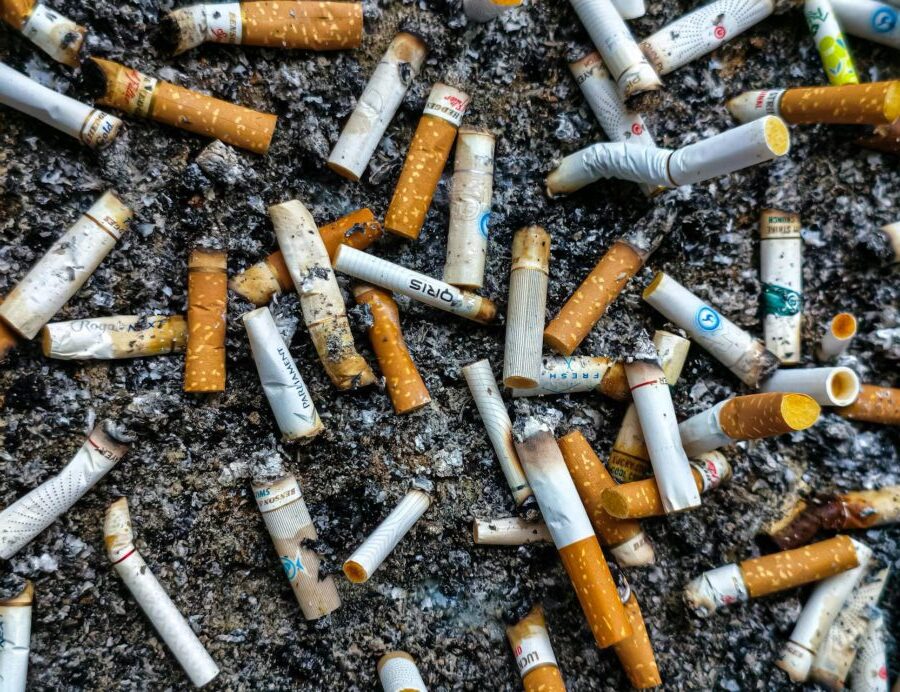
Eight million tonnes of cigarette butts are tossed onto streets and into bins worldwide each year. Most decompose glacially slowly, leaching toxins as they go. But what if this ubiquitous waste could power your phone?
Researchers in China have transformed discarded cigarette filters into carbon supercapacitors with performance that rivals commercial activated carbon. The trick lies in the filters themselves, which consist of cellulose acetate – a polymer that, when properly treated, can be converted into a porous carbon material riddled with microscopic channels perfect for storing electrical charge.
“Our work shows that cigarette butts are not just a pollution problem, but also a valuable carbon resource,” says Leichang Cao at Henan University in Kaifeng. By converting them into functional porous carbon materials, we can address waste management while supporting clean energy technologies, he reckons.
The process starts with hydrothermal carbonisation. Cigarette butts are heated with water and urea at 250°C, creating carbon spheres doped with nitrogen. These spheres are then activated with potassium hydroxide at temperatures ranging from 600 to 900°C, which etches a network of pores throughout the material. The result? A hierarchical structure of interconnected cavities, some just nanometres wide, others spanning micrometres.
This architecture is critical. The micropores store electrical charge, whilst the larger mesopores provide highways for ions to diffuse rapidly through the material. It’s rather like a car park where the spaces store vehicles, and the access roads let traffic flow smoothly. The nitrogen and oxygen atoms incorporated during processing add another advantage – they enhance conductivity and provide sites for additional charge storage through chemical reactions.
The team tested carbon materials produced at different temperatures and with varying amounts of activating agent. The winner, produced at 700°C with a 4:1 ratio of potassium hydroxide to carbon, had a specific surface area exceeding 2,100 square metres per gram. When fashioned into electrodes and tested in a potassium hydroxide electrolyte, the material achieved a specific capacitance of nearly 345 farads per gram at a current density of 1 amp per gram. Perhaps more impressively, after 10,000 charge-discharge cycles at high current, the material retained more than 95 per cent of its original capacity.
“These results are remarkable for a carbon material derived entirely from waste,” says co-author Jinglai Zhang, also at Henan University. The combination of rich porosity and nitrogen-oxygen functional groups gives the electrode excellent conductivity, stability, and energy storage capability. When assembled into a full symmetric supercapacitor device, the cigarette butt electrodes delivered an energy density of over 24 watt-hours per kilogram. That’s competitive with other biomass-derived carbons and better than some nitrogen-doped carbons from agricultural waste like peanut shells or buckwheat cores.
Supercapacitors sit somewhere between batteries and conventional capacitors. They store less energy than lithium-ion batteries but can charge and discharge far more rapidly, making them attractive for applications requiring bursts of power – think regenerative braking in electric vehicles or smoothing fluctuations in renewable energy systems. The devices are also more stable over many cycles than batteries.
Beyond performance, the approach offers environmental advantages. Cigarette butts are widely available, inexpensive, and currently costly to manage as waste. They’re composed primarily of cellulose acetate fibres that can persist in the environment for years, releasing heavy metals, polycyclic aromatic hydrocarbons, and other nasties as they slowly break down. Converting them into high-value energy materials could reduce environmental contamination whilst lowering the cost and carbon footprint of electrode production.
Still, questions remain about scalability. Collecting and sorting cigarette butts on an industrial scale would require infrastructure that doesn’t currently exist. The research team collected their butts from roadsides in Kaifeng, removing tobacco residues and impurities by hand. That approach works for laboratory demonstrations but scaling to millions of tonnes annually is another matter entirely. There’s also the question of contamination – butts collected from different sources might contain varying levels of additives or residues that could affect the final material’s properties.
“This study highlights a circular solution where an environmental liability becomes a technological asset,” Cao says. It opens new possibilities for turning everyday waste into materials that support sustainable energy systems. As the demand for efficient energy storage continues to grow, transforming discarded cigarette butts into high-performance supercapacitor materials may offer an unexpected but powerful path forward. Whether smokers’ cast-offs will power tomorrow’s devices remains to be seen, but the chemistry, at least, looks promising.