

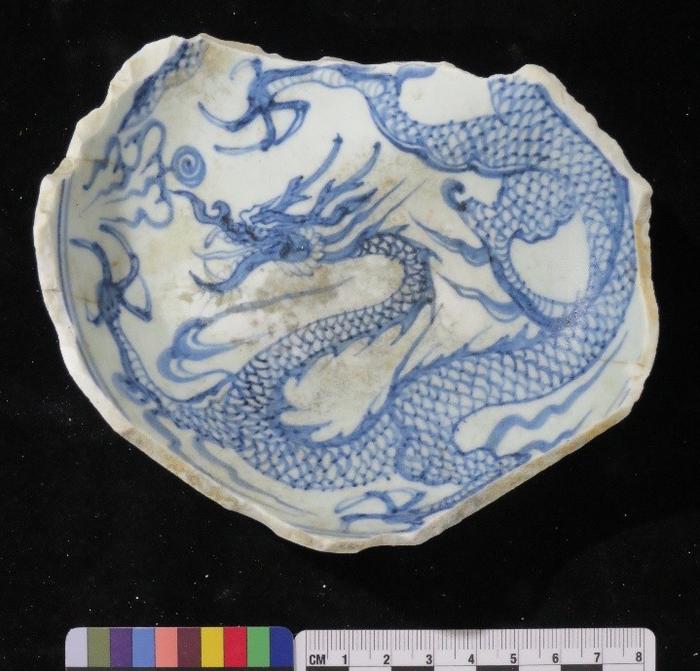
The ship itself is gone. Teredo worms saw to that — centuries of boring through waterlogged timber until every plank, every rib, every trace of the hull dissolved into the seabed at the eastern mouth of the Singapore Strait. What the worms couldn’t eat was the cargo. And what a cargo it turned out to be.
Between 2016 and 2019, archaeologists from the ISEAS Yusof Ishak Institute hauled roughly 3.5 tonnes of ceramic shards from the wreck site, along with a handful of intact pieces. The find is the first ancient shipwreck ever recovered in Singapore’s waters, according to Michael Flecker at HeritageSG, a subsidiary of Singapore’s National Heritage Board. But it’s the nature of what was onboard that has ceramics specialists paying close attention. The vessel was carrying more Yuan dynasty blue-and-white porcelain than any other documented shipwreck anywhere in the world.
Blue-and-white from this era — we’re talking the mid-14th century, when the Mongol-led Yuan dynasty was lurching towards collapse — is extraordinarily rare. The technique had only been developed at the Jingdezhen kilns a decade or two earlier, probably in the late 1320s to early 1330s. The Temasek Wreck (named for the ancient port that preceded modern Singapore) yielded around 136 kilograms of the stuff: over 2350 shards plus several intact objects, making up about 3.9 per cent of the total ceramic cargo by weight. That might not sound like much proportionally, but for Yuan blue-and-white, it’s an astonishing quantity.
The bowls are what dominate — at least 300 of them in varying sizes, accounting for more than 71 per cent of the blue-and-white by weight. And the decoration is striking. By far the most popular motif shows mandarin ducks swimming through a lotus pond, a design known as manchijiao, or “Pond Brimming with Charming Beauty.” There’s a political story woven into that motif. Water birds in a lotus pond were the signature design of the Wenzong Emperor, reserved for his exclusive use between 1328 and 1332. When the Shundi Emperor took full control in 1340, those restrictions likely fell away, and private kilns began churning out export wares decorated with the once-imperial pattern. The dating narrows things considerably: the wreck probably went down sometime between 1340 and 1352, when the Red Turban Army’s rebellion shut down the Jingdezhen kilns. Even the most conservative estimate puts it no later than 1371, when the first Ming emperor banned commercial overseas trade altogether.
So we’re looking at a very specific window — perhaps as tight as twelve years — during which this ship loaded its cargo and set sail.
Beyond the blue-and-white, the hold was packed with Longquan celadon from Zhejiang (44.5 per cent of the cargo by weight), split between large moulded dishes with scalloped edges and medium bowls stamped with lotus or chrysanthemum designs. There were bluish-white qingbai wares and shufu (“Privy Council”) pieces from Jingdezhen too, making up 12.2 per cent of the total. That proportion is telling. Shufu ware takes its name from characters linked to the Chinese ministry of military affairs, and scholars have long debated whether it was produced exclusively for official or imperial use. Finding it in bulk aboard a commercial vessel bound for Southeast Asia rather undermines that theory. Stoneware storage jars from Cizao in Fujian — probably filled with wine rather than the mercury once speculated — rounded out most of the rest, along with small quantities of Dehua whiteware and crude provincial greenware.
Flecker describes the overall ceramic quality as “superlative,” which for an academic paper is practically gushing. The blue-and-white pieces feature dragons, phoenixes, hares, peonies, and morning glory blossoms, all painted in vibrant, multi-hued blues. Some carry anhua decoration — literally “hidden design” — patterns pressed into the clay that only reveal themselves when the light catches them at the right angle.
Where was all this heading? That question turns out to be one of the wreck’s more intriguing puzzles. The famous historical collections of Yuan blue-and-white in Turkey, the Middle East and India are dominated by enormous dishes, 40 to 50 centimetres across. The Temasek Wreck carried almost none of those. Its largest dishes measure less than 35cm. Meanwhile, many of the wreck’s ceramics have direct parallels in objects dug up from terrestrial sites around Singapore — the same blue-and-white motifs, the same celadon forms, even dark-blue glass beads and scraps of gold foil matching finds from Fort Canning. The implication is that the ship wasn’t bound for the Indian Ocean trade at all. It was heading for Temasek itself, the thriving entrepôt that sat at the crossroads of maritime Southeast Asia during precisely this period.
Some of that blue-and-white was probably destined for wealthy local residents; the sheer volume suggests a portion was also meant for redistribution to other regional ports. Either way, the cargo offers a snapshot — frozen in a twelve-year window — of what was flowing into one of Southeast Asia’s most important 14th-century trading hubs.
No hull survives to confirm the vessel’s origin, but the circumstantial evidence points strongly to a Chinese junk. The non-ceramic artefacts recovered — an ink stone, copper alloy spoons, lead disks, a glass bangle that elemental analysis tentatively links to India — are overwhelmingly consistent with a Chinese crew. Other shipwrecks of the period carrying Chinese cargo on non-Chinese vessels always turn up foreign personal possessions. Here, there are essentially none. Flecker proposes the ship most likely loaded at Quanzhou, the long-established trade centre in Fujian province, drawing ceramics from kilns across Fujian, Zhejiang and Jiangxi via the region’s extensive river and coastal networks.
Because the entire assemblage dates from one narrow moment in the 14th century, the wreck now serves as something like a reference library for specialists working with less precisely dated collections elsewhere. And there is, perhaps, a certain poetry in the fact that Singapore’s first ancient shipwreck turns out to be contemporary with the island’s own golden age as a port — a vessel that almost certainly had Singapore as its destination, sinking within sight of where it was supposed to arrive.
Study link: https://www.sciencedirect.com/science/article/pii/S3050997125000132