Super-Earth Found in Habitable Zone Using New Method
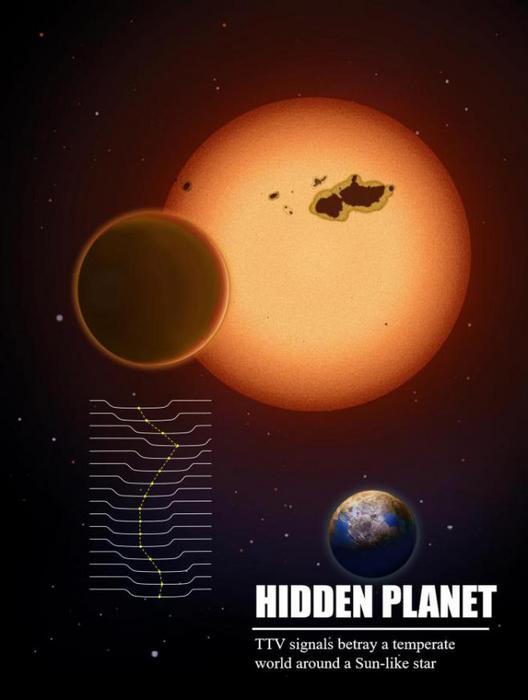
Astronomers have discovered a super-Earth planet ten times more massive than our world orbiting within the habitable zone of a Sun-like star, using an innovative detection technique that could revolutionize the search for "Earth 2.0." The planet, designated Kepler-725c, represents the first super-Earth found in a habitable zone using transit timing variations—a method that tracked tiny changes in another planet's orbit to reveal the hidden world. This technique opens new possibilities for finding potentially habitable planets that traditional methods might miss, particularly around Sun-like stars where Earth-sized worlds could support liquid water. A Hidden World Revealed by Gravitational Tugs The discovery emerged from careful analysis of Kepler-725b, a gas giant planet that researchers noticed wasn't keeping perfect time in its orbit. These subtle timing variations, lasting about 10 minutes, revealed the gravitational influence of an unseen companion. Located 758 light-years away, Kepler-725c completes one orbit every 207.5 days and receives roughly 1.4 times the solar radiation that Earth does. While this might seem too hot for life, the planet spends part of its eccentric orbit within the habitable zone where liquid water could theoretically exist on its surface. What makes this discovery particularly intriguing is that Kepler-725c represents a unique planetary arrangement. It's the only known low-mass planet within a habitable zone that orbits outside a gas giant—a configuration that raises fascinating questions about how such systems form and evolve. The TTV Technique: A New Window on Hidden Worlds Traditional planet-hunting methods face significant limitations when searching for Earth-like worlds around Sun-like stars. The transit method requires planets to cross directly in front of their stars from our perspective—a rare geometric alignment. Meanwhile, the radial velocity technique struggles with the faint signals produced by small, distant planets. The Transit Timing Variation (TTV) technique sidesteps these problems entirely. Instead of looking for planets directly, it measures how known planets deviate from clockwork precision in their orbits due to gravitational interactions with unseen companions. "Unlike the transit and RV methods, the TTV technique does not require the planet's orbit to be edge-on or rely on high-precision RV measurements of the host star," the research team explained. "This makes the TTV technique particularly well-suited for detecting small, long-period, non-transiting habitable planets that are otherwise difficult to discover using these other two methods." A Perfect Storm of Detection Conditions The Kepler-725 system provided ideal conditions for this discovery. The inner gas giant planet, Kepler-725b, orbits every 39.64 days in what researchers determined to be a 1:5 resonance with the outer super-Earth—meaning Kepler-725b completes five orbits for every one completed by Kepler-725c. This orbital resonance amplifies the gravitational interactions between the planets, creating detectable timing variations that might otherwise be too subtle to measure. The researchers analyzed data spanning about 1,470 days from the Kepler Space Telescope, tracking 21 individual transits to build their timing model. The discovery required sophisticated mathematical modeling to distinguish the true planetary signal from other potential causes of timing variations. The team tested both two-planet and three-planet scenarios, ultimately concluding that a single hidden super-Earth provided the best explanation for the observed data. Implications for Planetary Formation The research reveals important details about how planetary systems develop that weren't included in initial announcements. The study suggests two possible formation pathways for the Kepler-725 system, both involving dramatic early evolution. In one scenario, the super-Earth formed after the gas giant, with both planets initially orbiting much farther from their star before migrating inward. The gas giant may have acted as a "dynamical barrier," preventing smaller planetary embryos from spiraling into the star and allowing them to accumulate in the outer regions. Alternatively, the system may have originally contained multiple small planets closer to the star. Gravitational interactions with the gas giant could have destabilized these inner worlds, scattering them into new orbits or ejecting them entirely from the system. A New Era of Planet Detection The success with Kepler-725c demonstrates that TTV analysis can detect Earth-sized worlds in habitable zones that remain invisible to other techniques. This capability becomes especially important for Sun-like stars, where stellar activity and instrumental limitations make traditional methods less effective. The research team identified specific conditions where TTV detection becomes particularly powerful. When inner gas giants orbit in resonance with outer terrestrial planets, the timing variations can become enormous—potentially lasting days rather than minutes. However, these large variations create a double-edged sword. While they make hidden planets easier to detect through timing analysis, they also severely distort the transit signals of any outer planets that might cross in front of their stars, making them harder to find through traditional transit surveys. Future Missions and Earth 2.0 The timing couldn't be better for this discovery. Several upcoming space missions are specifically designed to search for Earth-like planets around Sun-like stars, including the European PLATO mission and China's "Earth 2.0" mission. These missions will monitor thousands of stars with the precision needed to detect subtle timing variations. The TTV technique could prove especially valuable for finding planets that don't transit from our perspective—a significant limitation of current surveys. "Based on the results of this study, once the European PLATO mission and Chinese ET ('Earth 2.0') mission are operational, the TTV method is expected to greatly enhance the ability to detect a second Earth," the researchers noted. Is Kepler-725c Habitable? While Kepler-725c orbits within its star's habitable zone, its potential for supporting life remains an open question. With ten times Earth's mass, it likely represents a "super-Earth" or "mini-Neptune"—planetary types that don't exist in our solar system. The planet's estimated surface temperature of about 268 Kelvin (roughly -5°C or 23°F) assumes an Earth-like atmosphere and reflectivity. However, if Kepler-725c possesses a thick hydrogen atmosphere like a mini-Neptune, it might experience a runaway greenhouse effect that prevents surface liquid water. Alternatively, the planet could represent a "Hycean world"—a new category of potentially habitable planets with hydrogen-rich atmospheres and vast oceans. These exotic worlds could support life under conditions very different from Earth. The discovery of Kepler-725c marks a significant milestone in the search for worlds beyond our solar system. By demonstrating the power of gravitational detective work, astronomers have added a powerful new tool to their planet-hunting arsenal—one that could finally help answer whether Earth-like worlds are common or rare in our galaxy.  

Astronomers have discovered a super-Earth planet ten times more massive than our world orbiting within the habitable zone of a Sun-like star, using an innovative detection technique that could revolutionize the search for “Earth 2.0.” The planet, designated Kepler-725c, represents the first super-Earth found in a habitable zone using transit timing variations—a method that tracked … Read more
New Space Cloak Hides Satellites From Ground Detection

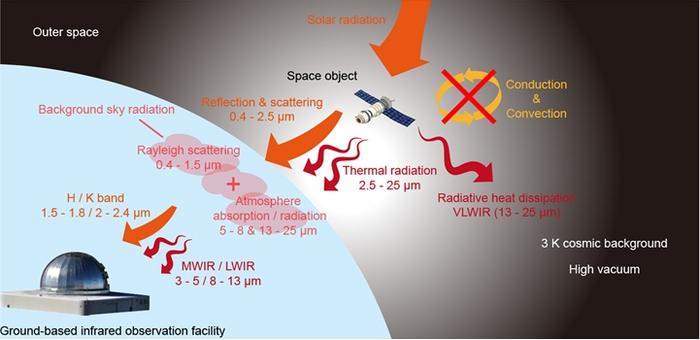
Principle for space-to-ground infrared camouflage with radiative heat dissipation.

Chinese researchers have developed a new camouflage technology that could make satellites virtually invisible to ground-based infrared detection systems while simultaneously keeping them cool in the harsh environment of space. The ultra-thin multilayer coating, just 4.25 micrometers thick, manipulates infrared radiation across multiple wavelength bands to hide spacecraft from Earth-based surveillance while preventing dangerous overheating. … Read more

Scientists Turn Immune Cells Into Light-Controlled Robots

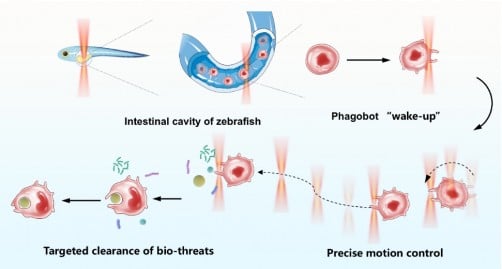
The phagobot’s “wake-up” program is triggered by localized optothermal stimulation of a resting macrophage using near-infrared (NIR) micro-irradiation. Once activated, the phagobot’s movement can be precisely guided through optical control of the macrophage’s extended filopodia. It can then be directed to carry out immune clearance tasks by phagocytosing a range of bio-threats of varying sizes, both in vitro and in vivo, within a living zebrafish.

Chinese researchers have developed a new type of microrobot that transforms ordinary immune cells into precision-guided warriors using nothing more than focused light beams. The “phagobots”—macrophage cells that can be awakened and steered with near-infrared laser light—represent a major advance in biomedical robotics by combining the natural power of immune cells with robotic controllability. Published … Read more

Contact Lenses Give Humans Infrared Superhuman Vision

red-headed woman puts on contact lens in mirror

Scientists have developed contact lenses that grant humans the ability to see infrared light, opening up a previously invisible world of thermal signatures and wavelengths beyond normal human perception. The breakthrough transparent lenses use upconversion nanoparticles to transform near-infrared radiation into visible light, allowing wearers to detect information that would normally require bulky night vision … Read more

New ‘Molecular Glue’ Pushes Perovskite Solar Cells Closer to Commercial Reality

ambient all-bladed perovskite solar cells

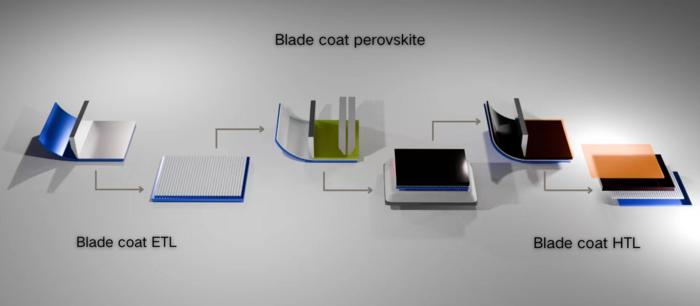
A simple industrial chemical acting as molecular “superglue” has helped Chinese researchers achieve record-breaking efficiency in large-scale, printable solar panels. The innovation addresses one of the final hurdles blocking perovskite solar technology from moving out of labs and onto rooftops worldwide. Scientists from the Dalian Institute of Chemical Physics have developed a technique using tetramethylammonium … Read more

Tire Chemicals Found to Cause Liver Damage and Brain Toxicity

Pile up old tires

A common chemical used in tires and its breakdown product accumulate in different organs and disrupt vital metabolic processes, according to new research that raises concerns about their environmental impact. The study reveals that even at concentrations typically found in urban runoff, these compounds can cause significant liver damage and behavioral changes in fish over … Read more

Scientists Find Protein That Could Upend Osteoporosis Treatment

Osteoporosis is a disease of bone where there is reduced bone mineral density (R), increasing the likelihood of fractures.

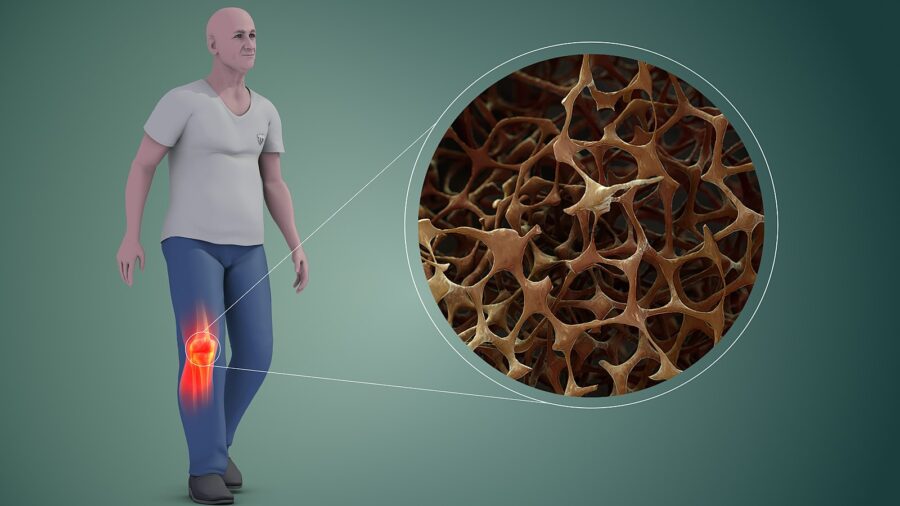
A protein previously known for its role in brain and reproductive function may offer new hope for millions suffering from osteoporosis, according to a groundbreaking study published in Bone Research last month. Scientists have discovered that Neural EGFL-like 2 (NELL2) plays a crucial role in maintaining bone health—potentially opening the door to a new generation … Read more

Innovative Water-Activated Face Mask Enhances Skincare with Built-in Power

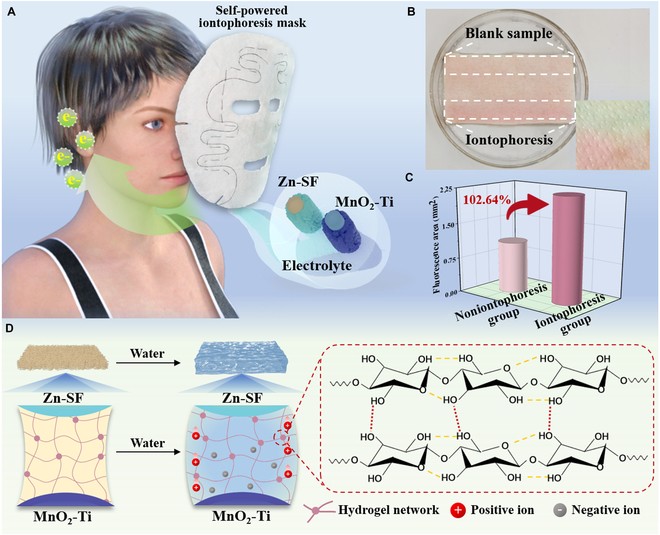
Fig. 1. Structural design and working mechanism of the self-powered iontophoresis mask. (A) Schematic of the self-powered iontophoresis mask. (B) Enhancement of drug penetration with mask use. (C) Comparison of drug penetration areas before and after mask application. (D) Gelation process of superabsorbent fibers (SAFs). Zn-SF: zinc-modified silver fiber anode; MnO₂-Ti: manganese dioxide–modified titanium wire cathode.

A self-powered face mask that activates with just a splash of water could transform at-home skincare by significantly improving how treatments penetrate the skin. Researchers at Qingdao University have developed a wearable iontophoresis mask that creates its own gentle microcurrent to drive skincare ingredients deeper into the skin, potentially doubling treatment effectiveness without requiring batteries … Read more

Ancient Poems Reveal Dramatic Decline of China’s “Smiling” River Porpoise

A close-up of a "smiling" Yangtze finless porpoise at the Baiji Dolphinarium of the Institute of Hydrobiology, Chinese Academy of Sciences.

Poetry from China’s imperial dynasties has unveiled the stark reality of habitat loss for the critically endangered Yangtze finless porpoise, according to new research published Monday in Current Biology. Scientists analyzed 724 ancient poems mentioning the iconic “smiling” porpoise, documenting a 65% range contraction over the past 1,400 years – with most of this decline … Read more

Antarctic Ice Sheet Records Surprising Mass Gain After Decade of Accelerated Loss

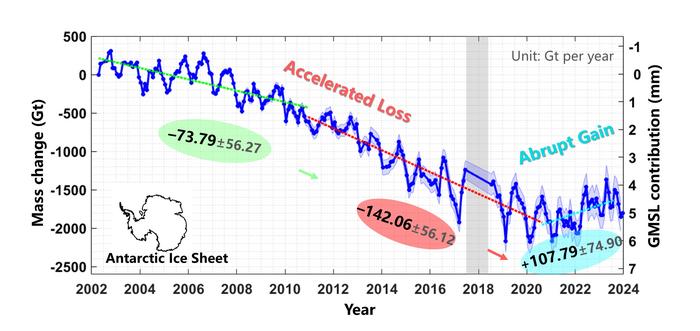
Antarctic Ice Sheet mass change (April 2002–December 2023), based on GRACE and GRACE-FO satellite gravimetry. Ellipses highlight changes in mass loss rates during specific periods, while the grey shading marks the data gap between the two satellite missions.

A comprehensive new study reveals the Antarctic Ice Sheet (AIS) experienced unexpected mass gain between 2021-2023, temporarily reversing a two-decade trend of accelerating ice loss that had been contributing significantly to global sea level rise. This remarkable shift comes after analysis of 22 years of satellite gravimetry data showing pronounced mass loss acceleration in several … Read more

SciChi

Tracking Chinese Research

Skip to content ↓