

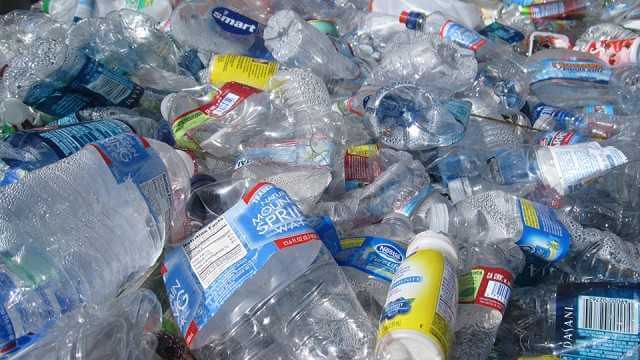
Every year, humans toss out more than 500 billion plastic water bottles. Most end up in landfills or oceans, stubbornly resisting decomposition for centuries. But what if those discarded bottles could store electricity instead?
Researchers at Michigan Technological University have figured out how to transform used PET water bottles into high-performance supercapacitors (devices that charge faster than batteries and can withstand thousands more charge cycles). The twist? Nearly every component comes from upcycled plastic, even the separator film that typically requires specialized glass fiber.
Lead researcher Yun Hang Hu and his team didn’t just recycle the plastic. They fundamentally reimagined it. By heating tiny plastic grains with calcium hydroxide to nearly 1,300 degrees Fahrenheit in a vacuum, they created a porous, electrically conductive carbon powder: the heart of their electrode material.
From Bottle to Battery Component
The process sounds almost medieval in its simplicity. Cut plastic bottles into couscous-sized grains. Add calcium hydroxide. Apply intense heat. What emerges is something entirely different: a carbon material riddled with microscopic pores, perfect for storing electrical charge.
For the separator (the perforated film that keeps the electrodes from touching while allowing current to flow), the team took an even more direct approach. They flattened small plastic pieces and poked strategic holes using hot needles. No fancy manufacturing required.
PET-derived supercapacitors hold great potential for diverse applications in transportation and automotive systems, electronics and consumer devices, as well as industrial and specialized sectors.
The resulting all-plastic supercapacitor retained 79% of its storage capacity under high-speed charging conditions. A comparable device using traditional glass fiber separator? Just 78%. The difference is modest but meaningful. The upcycled version matched or exceeded conventional technology while costing less to produce.
The Economics of Upcycling
What makes this approach particularly intriguing isn’t just the environmental angle. The team’s electrochemical analysis revealed that surface area determines how much charge the device can store at low speeds, while larger pore structures improve performance during rapid charging. That’s useful knowledge for anyone trying to optimize supercapacitor design, regardless of material source.
The perforated PET separator showed impressive mechanical strength (57 megapascals) along with excellent heat resistance and adjustable ionic conductivity depending on how many holes you poke in it. More perforations meant better conductivity, up to 2.79 × 10^-2 siemens per centimeter.
Perhaps most importantly, the entire device is recyclable. When it reaches end of life, it can theoretically be processed again into new supercapacitor components, creating a genuine circular economy for energy storage.
Hu estimates that with further refinement, PET-derived supercapacitors could transition from lab prototypes to commercial products within five to ten years, particularly as demand grows for sustainable energy storage. The timeline seems optimistic given how quickly the renewable energy sector is expanding.
With further optimization, PET-derived supercapacitors might realistically transition from laboratory prototypes to market-ready devices within the next five to 10 years, especially as demand grows for sustainable, recyclable energy storage technologies.
The research appears in Energy & Fuels, published by the American Chemical Society. While the study focuses specifically on PET bottles, the underlying principle (using thermal processing to convert waste plastics into functional electronic components) could potentially extend to other polymer waste streams. That’s the kind of materials science that might actually make a dent in our plastic problem, one water bottle at a time.