

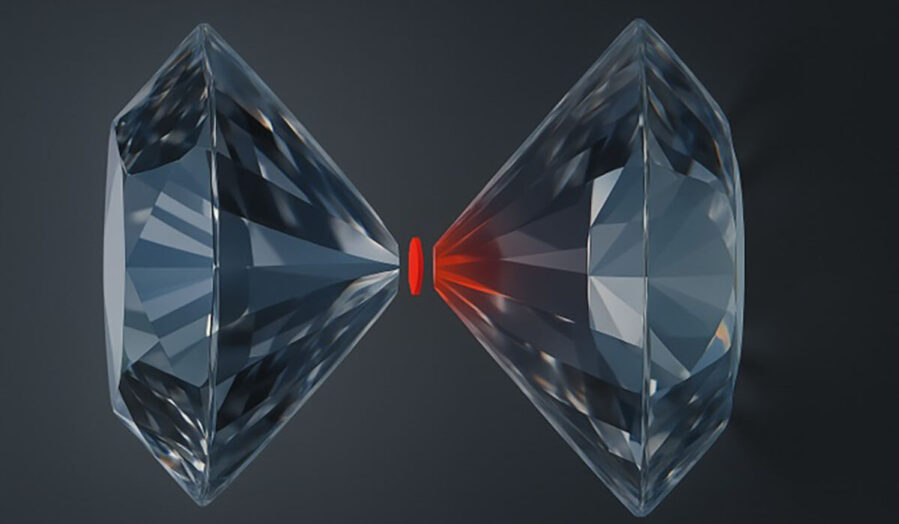
What happens when you crush the quantum world under 30,000 times atmospheric pressure? Until now, nobody could reliably find out. The problem wasn’t theoretical, it was practical. Building sensors delicate enough to detect quantum effects while tough enough to survive pressures that would flatten most materials has proven nearly impossible.
But a team at Washington University in St. Louis has cracked this paradox by embedding quantum sensors directly into sheets of crystallized boron nitride thinner than a human hair. These sensors can measure stress and magnetism in materials under extreme pressure, opening new windows into phenomena that occur deep inside planets, during geological events, and in the search for room-temperature superconductors.
“We’re the first ones to develop this sort of high-pressure sensor,” said Chong Zu, an assistant professor of physics at WashU and member of the Center for Quantum Leaps.
The breakthrough, published in Nature Communications, represents a significant advance over existing quantum sensing technology. Previous approaches relied on diamond-embedded sensors, which worked well but had a critical limitation: they couldn’t get close enough to the materials being studied.
Atomic-Scale Proximity Gives New Powers
The magic lies in the two-dimensional nature of boron nitride. While diamond sensors are trapped within three-dimensional crystal structures, these new sensors exist in sheets less than 100 nanometers thick—about 1,000 times thinner than a human hair. This allows them to sit mere billionths of a meter away from target materials.
Creating the sensors requires a surprisingly violent process. The team uses neutron radiation beams to knock boron atoms out of the boron nitride sheets, creating tiny vacancies that immediately trap electrons. These trapped electrons become exquisitely sensitive to their surroundings, changing their quantum spin energies based on magnetism, stress, temperature, and other properties of nearby materials.
The sensors proved their worth in two critical tests. First, they mapped stress distributions inside high-pressure chambers, revealing how materials experience uneven forces as pressure increases. At low pressures, stress remains uniform across samples. But above 1 GPa (about 10,000 times atmospheric pressure), significant stress gradients develop—a finding that could help researchers better understand how materials behave under extreme conditions.
Tracking Magnetic Transformations Under Pressure
The sensors also demonstrated their magnetic sensing capabilities by monitoring a van der Waals ferromagnet called Cr1+δTe2 as pressure mounted. At room temperature, this material maintains strong magnetic properties. But as pressure reached 0.5 GPa, something remarkable happened: the magnetism vanished entirely.
“With this sort of sensor, we can collect the necessary data to end the debate,” said graduate student Ruotian Gong, referring to controversial claims about room-temperature superconductors.
The magnetic transition occurs because increasing pressure forces atoms closer together, altering how their electrons interact and weakening the magnetic exchange that normally keeps the material ferromagnetic. When pressure was released, magnetism returned—but with a completely different spatial pattern, suggesting the material’s magnetic domains had reorganized.
This capability to simultaneously track both stress and magnetism under extreme conditions could prove invaluable for superconductivity research. Many proposed room-temperature superconductors require crushing pressures to function, and determining whether they’re genuinely superconducting or just exhibiting other electrical phenomena remains contentious. These sensors could provide the definitive measurements needed to settle such debates.
The research team tested their sensors up to 3.5 GPa—roughly 35,000 times atmospheric pressure—though they believe much higher pressures should be achievable with better pressure-transmitting media. For perspective, pressures inside Earth’s mantle range from 3 to 127 GPa, so these sensors could eventually probe conditions similar to those hundreds of miles underground.
Looking ahead, the researchers plan to test rock samples under conditions mimicking Earth’s core, potentially providing new insights into earthquake mechanisms and other large-scale geological processes. The sensors could also advance materials science by enabling detailed studies of how crystal structures change under pressure, or how new phases of matter emerge in extreme environments.
The work demonstrates the value of interdisciplinary collaboration, supported in part by a National Science Foundation Research Traineeship grant that allowed graduate student Guanghui He to spend six months at Harvard University working with physicist Norman Yao. Such partnerships may prove essential as quantum sensing technology continues expanding into new domains where conventional measurement techniques fail.