

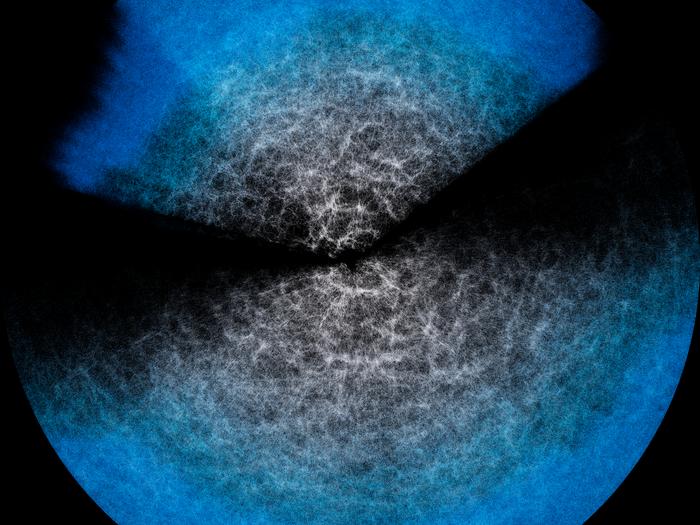
Researchers have created a powerful new computational tool that can map the large-scale structure of the cosmos thousands of times faster than existing methods, potentially accelerating our understanding of dark energy and the universe’s evolution.
From Supercomputers to Laptops in Minutes
The new emulator, called Effort.jl, represents a significant leap forward in cosmological computing. Where traditional analysis pipelines require supercomputers running for hours, this tool delivers the same accuracy in just minutes on a standard laptop.
“Imagine wanting to study the contents of a glass of water at the level of its microscopic components, the individual atoms, or even smaller: in theory you can. But if we wanted to describe in detail what happens when the water moves, the explosive growth of the required calculations makes it practically impossible.”
Marco Bonici from the University of Waterloo, lead author of the study published in the Journal of Cosmology and Astroparticle Physics, explains how their approach tackles this computational challenge by encoding microscopic properties to observe their effects at larger scales.
The cosmic web – the vast network of galaxies, clusters, and filaments that forms the universe’s skeleton – has long challenged scientists attempting to model its complex structure. Traditional theoretical models like the Effective Field Theory of Large-Scale Structure (EFTofLSS) provide accurate descriptions but demand enormous computational resources as astronomical datasets grow exponentially.
Neural Networks Meet Physics
Effort.jl employs neural networks trained to mimic how established physics models respond to different inputs, but operates dramatically faster. The tool doesn’t understand the underlying physics itself – instead, it has learned the theoretical model’s responses exceptionally well and can predict outputs for new parameter combinations.
The emulator’s innovation lies in its preprocessing strategy. Rather than making neural networks relearn known physics relationships, the researchers built this knowledge directly into the algorithm. They also incorporated gradients – precise measurements of how predictions change when parameters are slightly adjusted – allowing the system to learn from fewer examples and run on smaller machines.
“This is why we now turn to emulators like ours, which can drastically cut time and resources.”
Bonici notes that extensive validation was crucial since the emulator shortcuts traditional physics calculations. Their published study demonstrates that Effort.jl’s accuracy closely matches established models on both simulated and real astronomical data.
The tool’s compatibility with automatic differentiation systems enables integration with advanced sampling techniques like Hamiltonian Monte Carlo, offering substantial improvements over traditional methods for exploring complex parameter spaces in cosmological analyses.
Testing on large-volume simulations and data from the Baryon Oscillation Spectroscopic Survey (BOSS) confirmed excellent agreement between Effort.jl results and those from conventional analysis pipelines. The researchers found deviations consistent with expected statistical noise, validating the emulator’s reliability for scientific applications.
Looking ahead, Effort.jl promises to accelerate analysis of upcoming datasets from major surveys like the Dark Energy Spectroscopic Instrument (DESI) and the Euclid space mission. These next-generation observations will probe the universe’s structure with unprecedented precision, potentially requiring the computational efficiency that tools like Effort.jl provide.
The emulator represents part of a broader trend toward machine learning-accelerated cosmology, where researchers combine traditional physics understanding with modern computational techniques to handle increasingly complex datasets. As surveys map ever-larger portions of the observable universe, such hybrid approaches may prove essential for extracting scientific insights from the wealth of incoming data.
Journal of Cosmology and Astroparticle Physics: 10.1088/1475-7516/2025/09/044