

Deep inside our cells, scientists have discovered a previously unknown structure that could reshape our understanding of how cellular machinery works.
The organelle, dubbed a “hemifusome,” acts like a specialized loading dock where cellular delivery trucks connect and transfer cargo—a process critical to keeping cells healthy and functioning properly.
The discovery, published in Nature Communications, emerged from advanced cryo-electron tomography imaging that “freezes” cells in time, allowing researchers to observe structures that traditional microscopy techniques missed. What they found challenges decades of assumptions about cellular architecture and opens new avenues for treating genetic diseases.
A Cellular Loading Dock
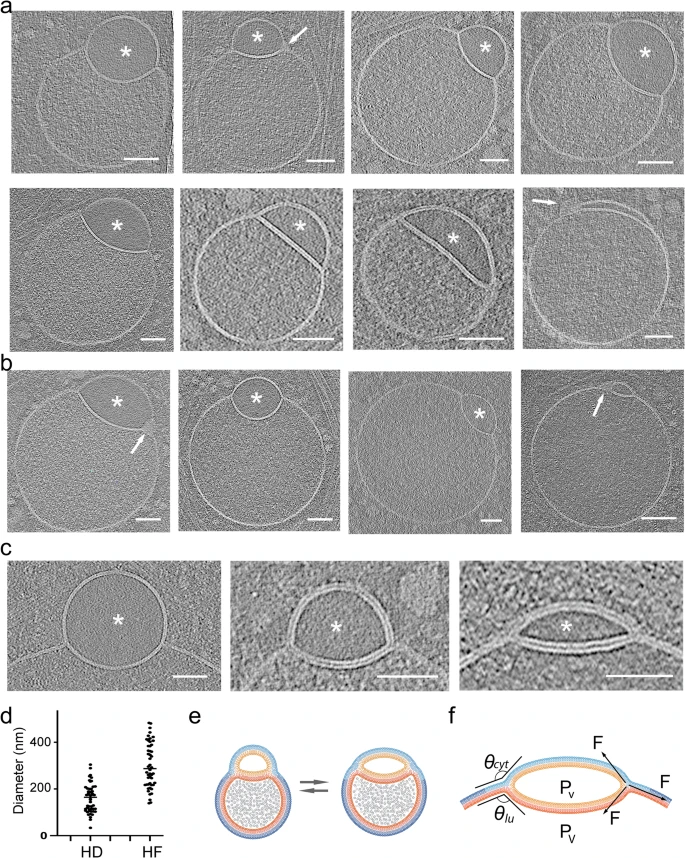
Hemifusomes represent something entirely unexpected in cell biology: stable structures formed when two different types of vesicles partially fuse together, sharing a membrane barrier called a hemifusion diaphragm. Until now, such partial fusion was thought to last mere milliseconds during normal cellular processes.
“This is like discovering a new recycling center inside the cell,” explained researcher Seham Ebrahim of the University of Virginia’s Department of Molecular Physiology and Biological Physics. The structures persist far longer than theoretical models predicted, with hemifusion diaphragms averaging 158 nanometers in diameter—roughly 15 times larger than previously observed fusion intermediates.
Perhaps most intriguingly, each hemifusome contains a 42-nanometer protein-lipid droplet positioned precisely at the junction where the two vesicles meet. These proteolipid nanodroplets (PNDs) appear to orchestrate the entire process, potentially serving as assembly hubs for new vesicle formation.
Two Faces of the Same Structure
The research team, working across four different mammalian cell lines, identified hemifusomes in two distinct configurations:
- Direct hemifusomes: Where a smaller vesicle fuses to the outer surface of a larger one
- Flipped hemifusomes: Where the smaller vesicle appears inside the larger one, potentially forming internal cargo compartments
- Compound hemifusomes: Complex structures where multiple vesicles connect in branching networks
These variations suggest hemifusomes aren’t just static structures but dynamic platforms capable of generating the multivesicular bodies that cells use for protein sorting and waste disposal. Up to 10% of membrane-bound organelles at cell edges showed hemifusome characteristics, indicating they’re far more common than anyone suspected.
Rewriting the Rulebook
The discovery challenges the prevailing ESCRT model of how cells create internal vesicles. Rather than budding inward from existing membranes, hemifusomes appear to generate new compartments through an entirely different mechanism involving those mysterious nanodroplets.
When researchers traced cellular uptake using gold nanoparticles, they found something remarkable: while the particles appeared in normal endosomes and other cellular compartments, they never entered hemifusomes. This suggests these structures operate outside conventional trafficking pathways, potentially representing an alternative cellular sorting system.
The team observed vesicles with the same translucent, protein-free content as hemifusome components only in one other location: inside multivesicular bodies. This connection hints that hemifusomes might serve as assembly platforms for these critical cellular structures.
Disease Connections
The implications extend beyond basic cell biology. Disrupted cellular cargo handling underlies numerous genetic disorders, including Hermansky-Pudlak syndrome—a rare condition causing albinism, vision problems, lung disease, and bleeding disorders.
“We think the hemifusome helps manage how cells package and process material, and when this goes wrong, it may contribute to diseases that affect many systems in the body,” Ebrahim noted.
Understanding hemifusome function could illuminate why certain genetic mutations cause such diverse symptoms and potentially reveal new therapeutic targets for conditions where cellular housekeeping breaks down.
Hidden in Plain Sight
Why did these structures escape detection for so long? Traditional electron microscopy requires chemical fixation and dehydration that likely destabilized hemifusomes or altered their appearance. The cryo-electron tomography approach used here preserves cellular structures in near-native states, revealing details invisible to conventional techniques.
The research team minimized sample manipulation, transferring cells from culture medium to the freezing apparatus in just 2-3 seconds before vitrification. This gentle approach preserved structures that might otherwise be lost to preparation artifacts.
“Finding something truly new inside cells is rare—and it gives us a whole new path to explore,” Ebrahim concluded. “Now that we know hemifusomes exist, we can start asking how they behave in healthy cells and what happens when things go wrong.”
The discovery adds another layer to the intricate machinery that keeps our cells running, demonstrating that even after decades of research, cellular architecture still holds surprises. As researchers delve deeper into hemifusome biology, these hidden organelles may unlock new strategies for treating complex genetic diseases rooted in cellular dysfunction.