

A discovery about how magnetic fields can trap and control quantum particles could accelerate the development of next-generation quantum computers and sensors. Researchers from the University of Regensburg and University of Michigan have demonstrated how a crystal material can use magnetism to confine quantum information carriers to a single dimension, potentially extending the lifespan of quantum information.
The study, published in Nature Materials, reveals how chromium sulfide bromide, a layered crystal material, can trap quantum particles called excitons within single atomic sheets using magnetic fields. This control mechanism could prove crucial for future quantum technologies.
A Quantum Swiss Army Knife
“The long-term vision is, you could potentially build quantum machines or devices that use these three or even all four of these properties: photons to transfer information, electrons to process information through their interactions, magnetism to store information, and phonons to modulate and transduce information to new frequencies,” explains Mackillo Kira, professor of electrical and computer engineering at the University of Michigan.
The Power of Confinement
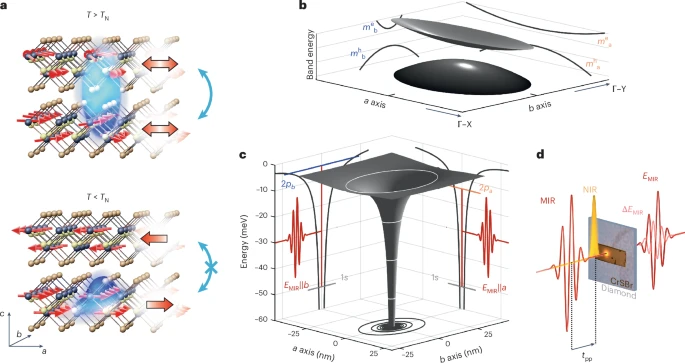
The material’s unique properties emerge from its layered structure, similar to molecular phyllo pastry. Below -222 degrees Fahrenheit (132 Kelvin), these layers develop alternating magnetic fields, creating what scientists call an antiferromagnetic structure. This magnetic arrangement forces excitons – pairs of electrons and electron “holes” – to remain confined within single atomic layers.
“The magnetic order is a new tuning knob for shaping excitons and their interactions. This could be a game changer for future electronics and information technology,” says Rupert Huber, professor of physics at the University of Regensburg.
Precise Measurements
The research team used ultra-fast infrared laser pulses lasting just 20 quadrillionths of a second to create and study these confined excitons. Their experiments revealed that the excitons exhibit two distinct energy states – a phenomenon known as fine structure – which can be controlled by changing the material’s magnetic state through temperature or external magnetic fields.
“Since the electronic, photonic and spin degrees of freedom are strongly intertwined, switching between a magnetized and a nonmagnetized state could serve as an extremely fast way to convert photon and spin-based quantum information,” notes Matthias Florian, research investigator at the University of Michigan and co-first author of the study.
Future Applications
The discovery opens new possibilities for quantum computing and information processing. When confined to a single dimension, quantum information carriers are less likely to collide with each other and lose their stored information, potentially leading to more stable quantum systems.
The research team plans to investigate whether these confined excitons can be converted into magnetic excitations, which could provide a crucial link between different types of quantum information carriers – photons, excitons, and electron spins.
The study represents a collaboration between researchers from the University of Regensburg, University of Michigan, University of Chemistry and Technology Prague, and Dresden University of Technology. The research received support from the German Research Foundation, National Science Foundation, and Air Force Office of Scientific Research.
