Skip to content
ScienceBlog.com
  • Featured Blogs
    • EU Horizon Blog
    • ESA Tracker
    • Experimental Frontiers
    • Josh Mitteldorf’s Aging Matters
    • Dr. Lu Zhang’s Gondwanaland
    • NeuroEdge
    • NIAAA
    • SciChi
    • The Poetry of Science
    • Wild Science
  • Topics
    • Brain & Behavior
    • Earth, Energy & Environment
    • Health
    • Life & Non-humans
    • Physics & Mathematics
    • Social Sciences
    • Space
    • Technology
  • Our Substack
  • Follow Us!
    • Bluesky
    • Threads
    • FaceBook
    • Google News
    • Twitter/X
  • Contribute/Contact

Quantum Computing

By building a unique, advanced machine, Rutgers scientists have created a structure with quantum qualities. The green window (right) is the main growth chamber where synthesis of the quantum "sandwiches" occurs. Within the amber window (left) are advanced characterization tools that uncover chemical and electronic properties of the grown quantum thin films without exposing them to air.

Scientists Merge Two “Impossible” Materials Into New Artificial Structure

Researchers developed a new interconnect that can support scalable, all-to-all communication between a series of superconducting quantum processors, enabling an information-carrying photon to travel between processors in a user-defined direction. The concept is illustrated here.

Device enables direct communication among multiple quantum processors

Majorana chip

Microsoft’s ‘Quantum Transistor’ Brings Million-Qubit Computing Within Reach

Researchers found that they can control how tightly bound excitons (electron-hole pairs) are in a magnetic material by changing its magnetic state, which could lead to new ways to switch materials' properties for future technologies like spintronics.

Scientists Unlock Magnetic ‘Light Switch’ for Next-Generation Quantum Computers

This artist's concept shows a quantum refrigerator based on superconducting circuits. The device cools qubits to extremely low temperatures using three qubits: a hot qubit (top right), a cold qubit (bottom right), and a target qubit (bottom left). Heat from a nearby hot environment powers the process, allowing the refrigerator to extract thermal energy from the target qubit and release it into a cold environment. This brings the target qubit to a low-error ground state, ideal for quantum computing. The device was developed at the Myfab nanofabrication lab, Chalmers University of Technology, Sweden.

Self-Powered Quantum Refrigerator Sets New Cold Record for Computing

The researchers built a system (circuit diagram on the left) that can be controlled by microwave pulses (wiggly arrow) to turn on or off different operations. This system creates a special quantum state (cubic phase state) useful for fixing errors in quantum computers. The blue areas on the right show a unique property (Wigner negative regions) that proves this state is truly quantum.

New Quantum Circuit Design Could Make Computing Far More Energy Efficient

quantum computing illustration

Scientists Race to Protect Computing Systems from Future Quantum Threats

An illustration of a quantum system that was simulated by both classical and quantum computers. The highlighted sections show how the influence of the system’s components is confined to nearby neighbors.

The surprising reason a classical computer beat a quantum computer at its own game

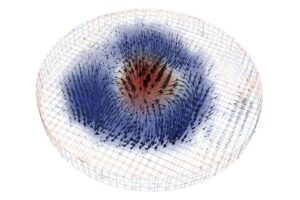
A 3D reconstruction of a skyrmion derived from X-ray images.

Scientists Capture First 3D X-ray Images of Mysterious Magnetic Skyrmions

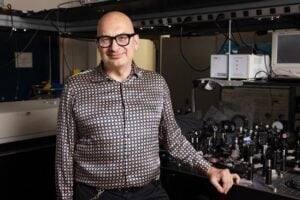
Professor Roberto Morandotti

Scientists Create Light-Based System to Supercharge Quantum Computers

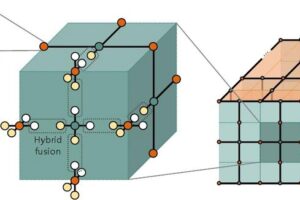
Fault-tolerant quantum computing architecture using hybrid qubits / Fault-tolerant quantum computing architecture based on hybrid qubits that utilize both DV and CV qubits simultaneously. It utilizes hybrid fusion techniques to connect hybrid qubits to form an error-correcting lattice structure.

Hybrid Quantum Error Correction Breakthrough Advances Quantum Computing

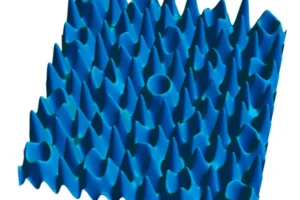
The quasiperiodic landscape in which the new Bose glass forms, similar to a Penrose tiling.

New Phase of Matter Discovered in 2D: Bose Glass Challenges Statistical Mechanics

Engineering atom interactions inside an artificial quantum material resulted in a new quantum state: the higher-order topological magnet.

New Quantum Magnet Could Revolutionize Quantum Computing

This new algorithm requires fewer quantum building blocks, and has a higher tolerance to quantum noise, which could make it more feasible to implement in practice.

MIT Scientists Unveil Quantum Leap Towards Cracking Unbreakable Codes

Older posts
Page1 Page2 … Page4 Next →
Substack subscription form sign up

Comments

  • Karoly Mirnics on Common Prescription Drugs May Disrupt Cholesterol Pathways in the Womb and Raise Autism Risk
  • Aizen on Laziness helped lead to extinction of Homo erectus
  • Norwood johnson on Electrons in New Crystals Behave as If They Live in Four Dimensions
  • ScienceBlog.com on Hidden Geometry Could Finally Fix Quantum Computers
  • Theo Prinse on America Is Going Back to the Moon. This Time, It Plans to Stay
© 2026 ScienceBlog.com | Follow our RSS / XML feed