

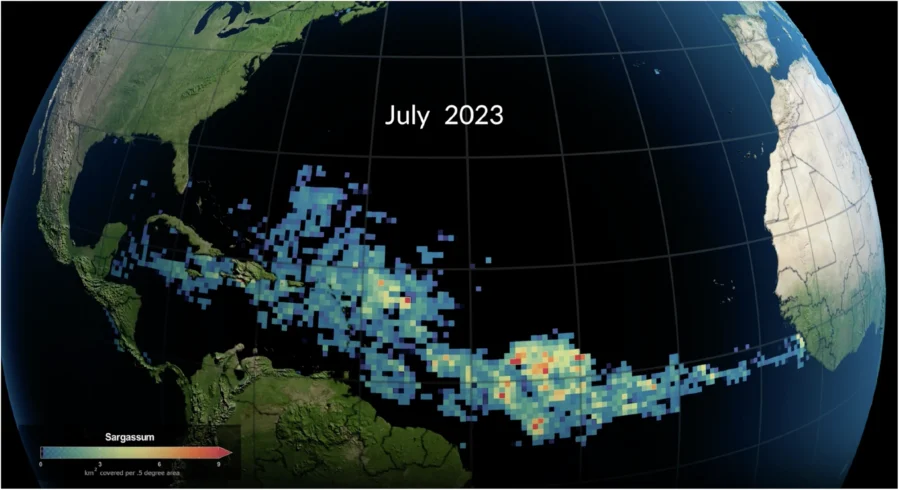
In the summer of 2011, something odd turned up in the satellite data. A mass of floating brown seaweed, historically confined to the relatively quiet waters of the Sargasso Sea, had spread into the tropical Atlantic in quantities no one had seen before. It stretched south of the Caribbean, east toward West Africa, eventually covering thousands of kilometres of open ocean. Oceanographers assumed it was a fluke, some weather-driven anomaly that would correct itself. It did not correct itself. By 2025, the so-called Great Atlantic Sargassum Belt weighed more than 37 million tons, and it is still growing.
Understanding why has taken the better part of fifteen years. Now, a team led by Annalisa Bracco at Georgia Tech and the CMCC Foundation think they’ve cracked it, and the answer is weirder than anyone expected.
The initial explanation seemed straightforward enough. An unusually prolonged negative phase of the North Atlantic Oscillation during 2009 and 2010 kicked up stronger-than-normal winter winds across the tropical Atlantic. Those winds deepened what oceanographers call the mixed layer, the zone of surface water that churns under wave action, and as it deepened it dragged nutrient-rich water up from below. Sargassum, which is essentially a floating farm if you give it enough nitrogen and phosphorus, responded predictably. It grew. The puzzle was why it kept growing for a decade, and kept accelerating, even after the anomalous winds died back.
The Seaweed That Feeds Itself
Bracco’s team built a regression model using satellite data and oceanographic records stretching from 2011 to 2022, then tested it by predicting Sargassum concentrations for 2023 and 2024. The model works reasonably well. But the most striking thing it revealed isn’t the prediction; it’s what the prediction requires. From about 2020 onwards, the dominant term in the equation is no longer wind, or mixed-layer depth, or anything to do with climate variability. It’s the Sargassum itself.
Specifically, it’s what lives in the Sargassum. The mats support a dense community of organisms: shrimp, crabs, small fish, amphipods, a whole floating menagerie. These animals feed on phytoplankton swept in from the surrounding ocean, and then they excrete. Right there, inside the mat. The nitrogen in those excretions, it turns out, is in exactly the chemical form Sargassum prefers to absorb. The seaweed, in other words, is farming its own residents. Or the residents are farming the ocean on the seaweed’s behalf. Either way, the mat has become a self-fertilising system, largely independent of what the atmosphere and the deep ocean are doing.
The team confirmed this using isotope analysis. Nitrogen comes in different atomic weights, and the ratio between them acts as a kind of signature, letting you trace where the nitrogen in a living organism came from. When researchers collected Sargassum and its resident crabs and shrimp from waters near St. Thomas in the US Virgin Islands last year, the isotopic fingerprint matched: the animals were excreting nitrogen with a signature light enough to account for what the seaweed was absorbing. “It’s a striking example of how the ocean can reorganize itself very quickly,” Bracco says. “What started as a wind-driven event has become a self-sustaining biological system.”
From Plague to Possibly Useful
This matters partly because it settles a fifteen-year argument about what was feeding all that seaweed. River runoff from the Amazon, atmospheric dust from the Sahara, equatorial upwelling of phosphorus: all of these had been proposed, all had their advocates, none quite accounted for the numbers. The Sargassumsphere hypothesis, as Bracco’s group calls it, explains why the belt kept growing even as ocean stratification increased and other external nutrient sources stayed flat or declined.
It also means the belt is, for practical purposes, permanent. Natural decline, at this point, looks unlikely. The system has crossed into a self-reinforcing regime, and no one is going to reverse the decade of biological reorganisation that produced it.
Which is where the economic and climate angle comes in, and where it gets genuinely complicated. Sargassum, when it washes ashore, is a catastrophe. The mats smother coral reefs, suffocate seagrass beds, close beaches and decimate tourism revenues across the Caribbean and down the West African coast. As they rot in the heat, they release hydrogen sulphide gas, which is both toxic and notably unpleasant, and they leach arsenic into nearshore water. Cleanup costs run into hundreds of millions of dollars a year. Affected countries, many of them small island states with limited resources, bear the costs of a problem they did not create.
But offshore, floating in the open Atlantic, the same seaweed represents an enormous stock of captured carbon. Sargassum absorbs CO2 as it grows, and roughly 27 to 30 per cent of its dry weight is carbon. “The key challenge is that when it reaches the coast and decomposes, much of that carbon is released back into the atmosphere,” Bracco says. “If we can intervene before this happens, this system could instead be part of the solution.” Harvesting the Sargassum at sea, before it beaches, could in principle allow that carbon to be locked away, converted into biofuels, or processed into materials. Several conversion routes exist: pyrolysis into bio-oil, anaerobic digestion to produce methane, torrefaction into charcoal, or compression into fuel pellets. Whether any of these are economically viable at the scale of tens of millions of tons per year is another question entirely.
Predictable, at Least
What the new model enables, though, is planning. The team showed that knowing last year’s Sargassum concentrations and the current mixed-layer depth is enough to predict, with reasonable accuracy, what the belt will look like three months from now. That lead time is, arguably, long enough to position harvesting vessels. And there are existing models that can translate Sargassum concentrations into beaching forecasts, predicting which coastlines will be hit and when.
The researchers are careful to note that harvesting can’t simply strip the belt bare; the Sargassumsphere is itself an ecosystem, home to juvenile sea turtles, flying fish larvae, and hundreds of other species that use the floating mats as their only available habitat in the open ocean. Sustainable extraction, whatever that looks like for a floating ecosystem measured in millions of tons, is the condition on which any climate benefit depends. But the shift from crisis to opportunity, if it happens at all, starts with the kind of forecast that makes large-scale logistics conceivable. For fifteen years, no one could reliably predict when the seaweed would arrive. Now, perhaps, they can.
https://doi.org/10.1038/s41467-026-72183-4
Frequently Asked Questions
Why is the Great Atlantic Sargassum Belt getting bigger every year instead of dying back?
The short answer is that the seaweed has essentially learned to fertilise itself. A community of crabs, shrimp, and small fish lives within the floating mats, feeding on plankton from the surrounding ocean and excreting nitrogen directly into the seaweed. That recycled nutrient supply has become the dominant driver of growth since around 2020, making the system self-sustaining rather than dependent on external events like wind anomalies or river runoff. The new research is the first to quantify this mechanism rigorously, using isotope analysis to trace the nitrogen’s origin.
Could the Sargassum actually help with carbon removal?
Potentially, though the logistics are daunting. Sargassum captures CO2 as it grows, and nearly a third of its dry weight is carbon. If harvested offshore before it reaches shore and decomposes, that carbon could in principle be converted into biofuels, biochar, or other materials rather than re-entering the atmosphere. The new model’s predictive capability matters here: knowing where large concentrations will accumulate three months in advance is the prerequisite for planning offshore harvesting operations at meaningful scale.
What actually started this whole belt back in 2011?
An unusually prolonged negative phase of the North Atlantic Oscillation during 2009 and 2010 generated stronger winter winds across the tropical Atlantic, which deepened the ocean mixed layer and brought nutrient-rich water to the surface. That initial pulse of nutrients triggered explosive Sargassum growth and pushed the seaweed out of its historical range in the Sargasso Sea. What researchers couldn’t explain until now was why the belt kept growing and intensifying long after those unusual winds returned to normal.
Is the Sargassum itself a habitat for anything?
It’s a significant one. The floating mats function as the only structure in hundreds of kilometres of open ocean, providing shelter for juvenile sea turtles, flying fish larvae, and a dense community of invertebrates. This is part of what makes blanket harvesting complicated: the same biological community that helps the seaweed fertilise itself is also ecologically important in its own right. Any viable management strategy would need to balance carbon or fuel recovery against the integrity of that open-ocean ecosystem.