

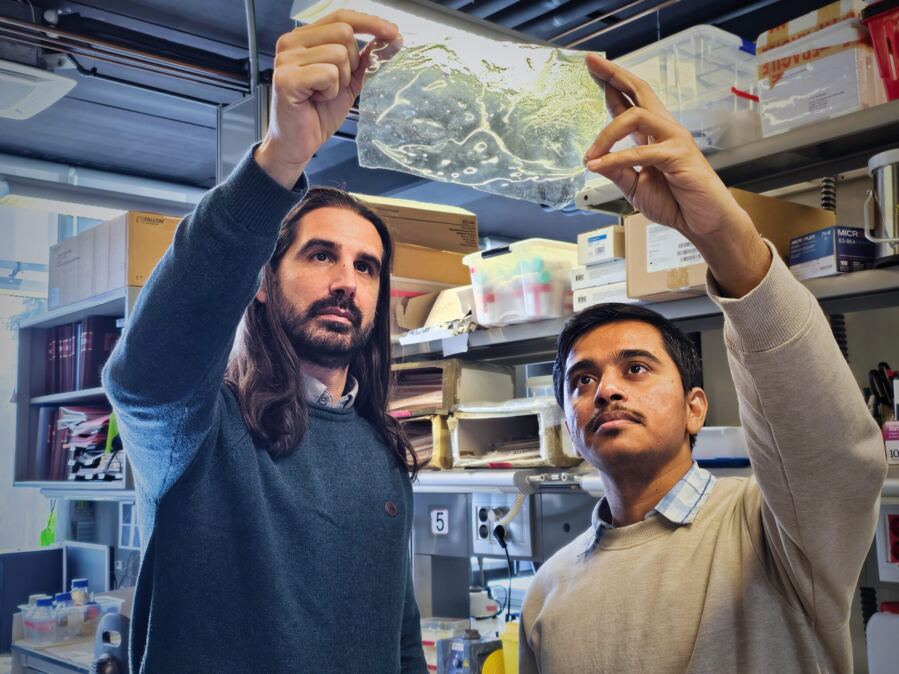
The worm had no idea it was upending materials science. Nereis virens, the common sandworm, builds its jaw from a tough biological composite laced with zinc ions. Researchers already knew this. What nobody had quite appreciated was what happens when you remove the zinc: the jaw softens almost immediately when placed in water. A structure that depends on metal for its integrity doesn’t just weaken without it, it becomes water-susceptible. The effect nagged at Javier G. Fernández, a materials engineer at the Institute for Bioengineering of Catalonia in Barcelona.
He had a hunch the principle might run in reverse. That you could, in theory, use metal ions to control how a biological material interacts with water, rather than fight the interaction or seal it out.
The result, published this week in Nature Communications, is a material made from discarded shrimp shells that does something no synthetic bioplastic has managed before: it gets stronger when wet. Substantially stronger, in fact. Thin films made from chitosan (a polymer derived from chitin, the structural molecule in crustacean shells) infused with trace amounts of nickel increase in tensile strength by roughly 50 per cent when immersed in water, reaching values that put them in the range of engineering plastics like polycarbonate. In dry conditions they’re already competitive with commodity plastics like polypropylene. The trick, once you understand it, has a certain elegant logic.
The problem with conventional plastics is well established. Water resistance is the property that makes them indispensable; it’s also what makes them a geological hazard. The world generates around 400 million tonnes of plastic waste every year, much of it designed specifically to perform in aquatic environments, which is exactly why it accumulates there. Bioplastics haven’t solved this. Most biological materials weaken when wet, so engineers compensate with chemical modifications or barrier coatings that undermine the whole point. You’ve fixed the degradability problem while creating another.
Fernández’s team took a different starting position. “For over a century, we have assumed that, in order to succeed in nature, materials must become inert,” he says. “This research shows the opposite: materials can thrive by interacting with their environment rather than isolating themselves from it.”
The specific mechanism involves nickel ions — a ubiquitous micronutrient, water-soluble, known to interact readily with chitin and chitosan — being incorporated into the chitosan structure during processing. When the resulting film is first immersed in water, about 87 per cent of the nickel leaches out; it turns out only a tiny fraction, roughly one ion per eight sugar rings in the polymer chain, does the actual structural work. What remains is a dynamic network of weak, reversible bonds between the nickel ions, the water molecules they attract, and the polymer chains surrounding them. This network continuously breaks and reforms. Stresses that would fracture a rigid structure are instead absorbed and redistributed. The material becomes, as Fernández puts it, “a material where being ‘soft’ at the molecular scale actually makes it stronger.”
What’s notable about this is how thoroughly it inverts conventional assumptions. Stiff engineering materials derive their strength from dense, permanent molecular bonds that exclude water. The chitosan-nickel composite does the opposite: it incorporates water as a functional structural component, using its presence to maintain a self-reorganising network. Comparable behaviour turns up in a few natural biological structures, but it has never been replicated artificially before. The researchers tried replacing nickel with zinc and copper ions under identical conditions; neither produced anything like the same effect, which suggests the phenomenon depends on the specific coordination chemistry of nickel rather than some generic divalent ion property.
The zero-waste angle matters almost as much as the mechanical properties. When nickel leaches from the first batch of films, the resulting liquid, now nickel-rich, becomes feedstock for the next batch. Essentially all the nickel introduced gets used eventually, with the material optimising itself on first immersion and the surplus cycling back into production. Akshayakumar Kompa, a postdoctoral researcher in Fernández’s group and the study’s first author, points to the underlying abundance of the raw material: “Each year, the world produces an estimated one hundred billion tonnes of chitin, equivalent to three centuries’ worth of plastic production.” Chitosan can be derived from shrimp and crab processing waste — the sheer scale of the global shellfish industry makes this a remarkably accessible feedstock — or extracted through the bioconversion of urban organic waste and fungal by-products. “The key is to adapt to local sources,” Kompa says. “Our goal is to integrate the production of these materials into the local ecosystem by using whatever form of chitosan is available nearby.”
In the lab, the team demonstrated the scalability fairly directly, fabricating films up to three square metres without running into processing problems. They also produced drinking cups and containers using a custom clinostat, a two-axis device that keeps a mould in constant motion during vitrification so the polymer solution maintains contact with internal walls. The resulting cups hold water. For days. Without leaking.
Near-term applications will probably be modest. Agricultural films, fishing gear and packaging — categories where there’s real demand for biodegradable materials that actually work in contact with water. Medical applications are at least plausible; both nickel and chitosan individually carry FDA approval for certain medical uses, though the combination hasn’t been evaluated in that context. “The material is still biologically pure in the eyes of nature; it remains essentially the same molecule found in insect shells or mushrooms,” Fernández notes, which matters for how it eventually degrades. The team’s soil burial tests found a half-life of around four months under typical environmental conditions. Standard chitosan without modification.
Nickel is probably not the only ion capable of producing the effect, the authors note — it was chosen as a proof of principle, and its particular coordination chemistry may not be uniquely suited. Finding other combinations, potentially ones with different properties or processing characteristics, is work that can now begin in earnest. “This is the first study,” says Fernández. “Now that we know this effect exists, we and others can search for new materials and new ways to achieve it.”
The sandworm, presumably, remains indifferent to all of this.
Study link: https://www.nature.com/articles/s41467-026-69037-4