

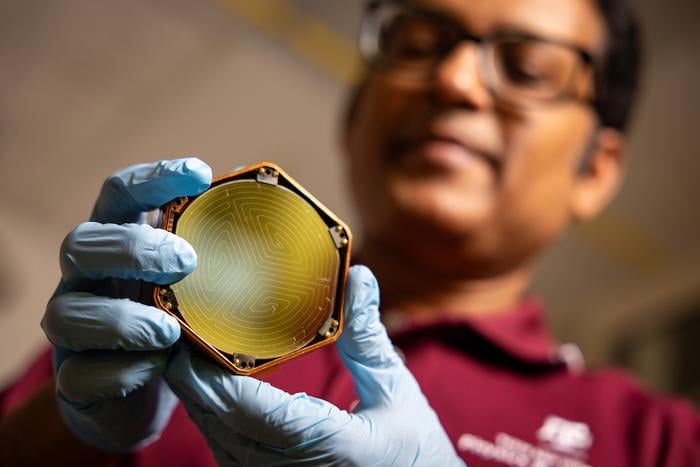
The detectors are supposed to be silent. Cooled to within a whisker of absolute zero, shielded deep underground, and isolated from cosmic rays, these ultra-sensitive instruments are designed to catch the universe’s most elusive particles. But researchers at Texas A&M University have discovered the crystals themselves won’t shut up. Spontaneous bursts of energy keep appearing in bulk silicon substrates, creating phantom signals that mimic exactly what scientists are looking for: dark matter.
The phenomenon, detailed in Applied Physics Letters, centers on athermal phonons, tiny packets of vibrational energy that silicon releases without any external trigger. These bursts poison the superconducting sensors, generating low-energy background noise that has plagued experiments like TESSERACT and SuperCDMS for years. What makes this particularly frustrating is that the interference looks nearly identical to the signal from a WIMP, or Weakly Interacting Massive Particle, one of the leading candidates for dark matter.
The noise that won’t go away
Experimental particle physicist Rupak Mahapatra, who leads the work, has spent decades refining cryogenic detectors capable of registering interactions that might occur once per decade. His team monitored phonon collection efficiency over several weeks as temperatures dropped from 20 millikelvin to 6 millikelvin, well below the 2.7 Kelvin background temperature of space itself. The bursts persisted. Even mechanical disturbances, something as mundane as thumping the refrigerator housing the detector, excited narrow resonance peaks in the data.
The silicon appears to be relaxing or shifting internally, possibly within the aluminum films deposited on its surface or in the crystal lattice itself. These localized energy releases create quasiparticle poisoning in the sensors, overwhelming the faint signals researchers are hunting. It’s like trying to hear a whisper in a room where the walls randomly creak and groan.
“The search needs extremely sensitive sensing technologies and it could lead to technologies we can’t even imagine today,” Mahapatra explains.
Dark matter and dark energy together account for roughly 95% of the universe, yet neither emits, absorbs, or reflects light. Scientists infer their presence through gravitational effects: dark matter acts as invisible scaffolding holding galaxies together, while dark energy drives the universe’s accelerating expansion. Mahapatra likens the challenge to describing an elephant by only touching its tail. Gravity tells us something massive exists, but direct observation remains out of reach.
When the instrument becomes the experiment
Identifying silicon’s internal noise is progress, even if it complicates the search. By understanding how substrates misbehave at extreme cold, researchers can develop cleaner materials or better shielding strategies. Mahapatra emphasized in earlier work that no single experiment will solve the dark matter puzzle. Direct detection must be combined with indirect astrophysical searches and collider-based approaches, each method compensating for the others’ blind spots.
The phonon burst discovery may have broader implications beyond cosmology. Technologies developed to suppress this noise could find applications in quantum computing, medical imaging, or any field requiring measurement at the edge of physical sensitivity. For now, though, the immediate task is distinguishing the universe’s whispers from the detectors’ own murmurs. When a real dark matter interaction finally registers, scientists need to be absolutely certain it isn’t just silicon talking to itself.