

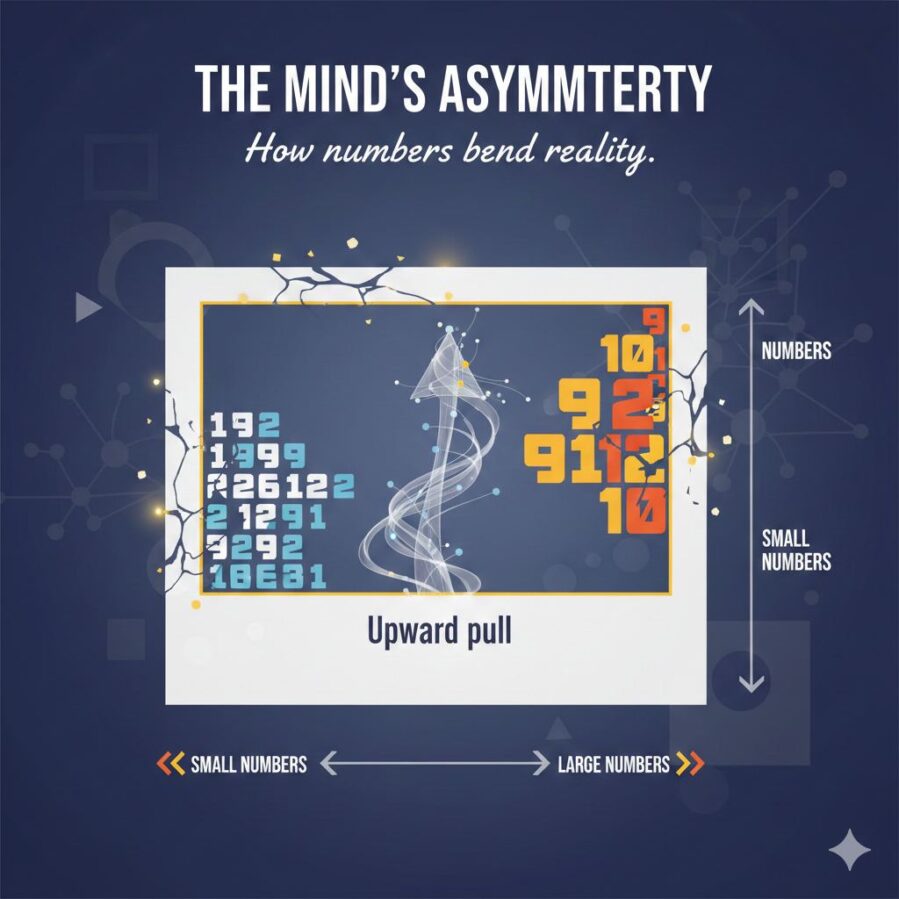
Try this: stare at a horizontal line made up of tiny ones and twos, then point to what you think is the exact center. Chances are, you’ll miss. Not by much, but consistently to the left. Now swap those small digits for eights and nines. Suddenly, your finger drifts rightward. Your eyes haven’t changed, but something in your brain just shifted its entire frame of reference.
This isn’t some optical illusion you’d find in a psychology textbook’s margin notes. It’s evidence of how deeply our minds wed abstract mathematics to physical space, even when we’re just trying to find the middle of a line. Researchers Ryo Hishiya and Masami Ishihara at Tokyo Metropolitan University have been poking at this phenomenon, and what they’ve found suggests our internal number system is far stranger than the neat left-to-right scale we imagine.
Scientists have known for years that people in cultures with left-to-right reading habits picture numbers spatially: small values hang out on the left, big ones on the right. It’s called the mental number line, and it feels intuitive enough. But Hishiya and Ishihara wanted to know what happens when you add a second dimension. What about vertical lines? What about squares?
When Up Becomes the New Small
The horizontal results played out as expected. Show someone a line made of ones, and they’ll mark the center too far left. Make it out of nines, and the center drifts right. Classic mental number line behavior. But flip that line vertical, and things get weird. Smaller numbers pushed people’s perceived midpoint upward, not downward as you’d expect if “small equals bottom” held true. The brain, it seems, doesn’t just rotate its number line 90 degrees and call it a day.
Then came the squares. When participants looked at two-dimensional grids filled with number strings, the numerical values themselves seemed to lose their magnetic pull. What mattered more was that the shapes contained recognizable symbols at all. Squares packed with numbers triggered a strong upward bias. Plain squares without numbers leaned more horizontal. It was as if the brain’s object-recognition circuitry had elbowed the math processor aside and taken over.
“The upward biases for the square stimuli with number strings may reflect the activation of object-based processing rather than the cognitive function of numerical processing.”
That’s Hishiya describing what neuroscientists call the ventral visual stream, the part of your brain responsible for recognizing what you’re looking at. When this system kicks in, it tends to bias attention upward in the visual field. The researchers think that when we see a dense cluster of digits, our brain treats it less like math and more like a thing, a visual object that demands identification. The “what is this?” reflex overpowers the “how much is this?” instinct.
A Trick Older Than Human Culture
Here’s where it gets culturally interesting. The team chose Japanese-speaking volunteers specifically because Japanese can be written both horizontally and vertically. If reading direction alone programmed these biases, you’d expect some serious confusion. But the left-right number bias stayed rock solid, suggesting something more hardwired might be at play.
That doesn’t mean culture is irrelevant. People who read Arabic or Hebrew, languages that flow right to left, show reversed mental number lines. The spatial mapping adapts to match the direction your eyes have been trained to scan since childhood. But the persistence of certain patterns across different reading orientations hints that some of these spatial associations might be baked deeper into human cognition than daily habits can fully explain.
In fact, this mental trick isn’t even unique to humans. Behavioral studies suggest chimpanzees, rhesus monkeys, and even bees show evidence of linking space to quantity. It’s a cognitive tool that evolution seems to have favored long before anyone invented written language or formal mathematics. And it extends beyond just numbers: our brains use similar spatial organizing principles for other types of magnitude, including brightness, pitch, loudness, and weight. Space, it turns out, is how the brain makes sense of “more” and “less” across nearly every domain.
The implications stretch beyond academic curiosity. Every time you glance at a price tag, a speed limit, or a clock, your brain is quietly mapping those digits onto an invisible spatial grid. That grid shifts depending on what else you’re looking at and how your visual system categorizes it. We like to think we see the world objectively, but these experiments reveal just how much our perception is colored by the abstract information we’re processing. The numbers don’t just sit there on the page. They pull, they push, they reshape the space around them in ways we never consciously notice.