

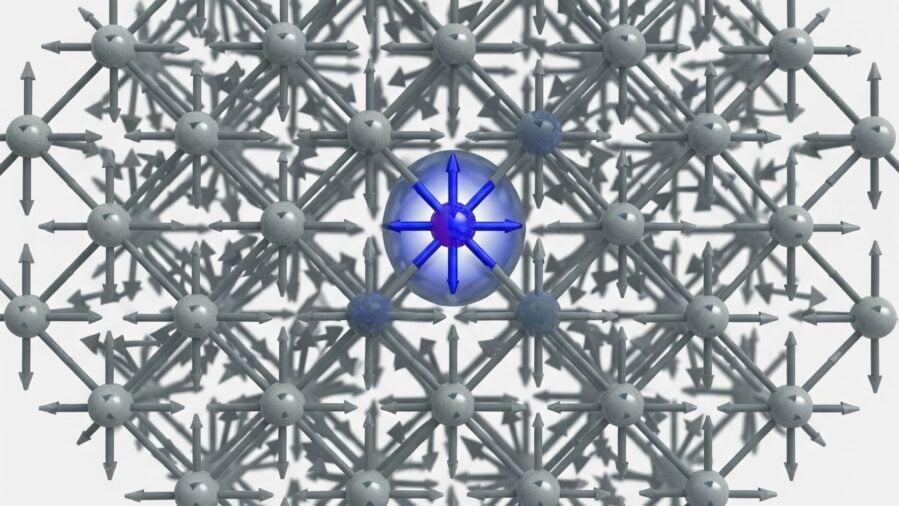
Researchers from the University of Warsaw and the University of British Columbia have made a significant stride in understanding the fundamental nature of magnetism, detailing how a peculiar quantum excitation known as a “lone spinon” can emerge.
This discovery, published in Physical Review Letters, deepens our grasp of quantum mechanics and could have implications for future technologies, from quantum computers to advanced magnetic materials.
Magnets, ubiquitous in modern life from computer memory to medical diagnostics, have a history stretching back to ancient times. Yet, their quantum underpinnings have long presented a challenge to scientists. It wasn’t until the advent of quantum mechanics in the 1920s that the electron’s spin, a fundamental property, was identified as key to understanding magnetic behavior.
Unraveling Quantum Spin
In 1931, Hans Bethe proposed a solution to the one-dimensional Heisenberg model, a core quantum model of magnetism. Decades later, in 1981, physicists Ludwig Faddeev and Leon Takhtajan observed a startling implication: an electron’s indivisible spin seemed to “split” into two more fundamental particles, dubbed spinons. While an electron’s spin changes by a unit of 1, these exotic spinons alter the total spin of a magnetic system by just 1/2. For years, spinons were thought to only exist in pairs, limiting their perceived “exoticism.”
So, what makes this new finding so compelling? The research team has now shown how a single, isolated spinon can be created. They accomplished this by:
- Adding one extra spin to the ground state of the one-dimensional Heisenberg model.
- Demonstrating the same effect using a simplified “valence-bond solid” (VBS) model, where spins are paired in an ordered way. Here, a spinon can be visualized as a single unpaired spin moving through a network of these paired spins.
This theoretical prediction gained swift validation when it was successfully confirmed experimentally in a recent paper by C. Zhao et al. in Nature Materials.
A Path to New Quantum Technologies
The existence of these “lonely” spinons provides a clearer picture of how quantum properties influence magnetic systems. Spinons themselves arise from strong electron interactions and quantum phenomena like quantum entanglement, a cornerstone of quantum computing. Could understanding these isolated spinons lead to new ways to control entanglement?
“Our research not only deepens our knowledge of magnets, but can also have far-reaching consequences in other areas of physics and technology,” states Professor Krzysztof Wohlfeld of the Faculty of Physics at the University of Warsaw. This work is a crucial step towards potentially unlocking novel features in magnetic materials and advancing the development of quantum technologies.
The research was supported by various grants, including those from the National Science Centre (Poland), the University of Warsaw Excellence Initiative, the Canada First Research Excellence Fund, and the Natural Sciences and Engineering Research Council of Canada.