

Stuff sponges into the walls of a plastic lattice, pump sound through it, and something deeply strange happens. The sound should die. Any reasonable accounting of the physics says it should attenuate, scatter, bleed away into vibration and heat the way noise does when you stuff acoustic foam into a recording studio. Instead, at specific frequencies, acoustic waves channelled along the edges of the structure propagate with almost no loss at all. Not because the sponges aren’t doing their job. They are. But topology, it turns out, doesn’t much care about that.
Physicists at Wuhan University have built a material that hosts what they call a higher-order Weyl exceptional ring semimetal, the first of its kind to be physically realised, and the experiment is forcing a rethink of how loss and robustness relate in complex quantum systems.
To understand why this is odd, you need to know something about the two separate traditions of topological physics that the Wuhan team has managed to fuse. Topology, in the materials context, concerns properties of a system that are protected against perturbation. Topological insulators, for instance, conduct electricity along their surfaces in ways that ordinary perturbations cannot disrupt. The protection isn’t mechanical. It’s mathematical, encoded in something called a topological invariant, a number characterising the global geometry of a material’s electronic band structure that cannot change unless the system undergoes a phase transition. These surface-conducting states persist even when the surface is imperfect, contaminated, roughened. The protection is, in a word, robust.
When Points Become Rings
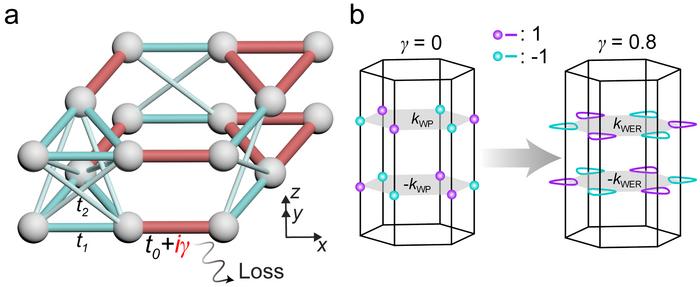
Weyl semimetals are a specific class of topological material in which electronic bands cross at isolated points in three-dimensional momentum space, the mathematical space describing how electrons move through a crystal. These Weyl points act like magnetic monopoles of a quantity called Berry curvature; they carry topological charges, and they give rise to exotic surface states called Fermi arcs that stretch between points of opposite charge. What happens when you introduce loss into such a system, say by coupling the lattice to a dissipative environment, is that each Weyl point blooms outward into a ring. An exceptional ring. This is where things leave familiar territory.
Exceptional points are degeneracies found only in non-Hermitian systems, which is to say systems where energy is not conserved, where gain or loss is present. At an exceptional point, two energy bands don’t merely cross; their eigenstates coalesce, becoming identical rather than simply equal in energy. It’s a more radical form of degeneracy than anything in conventional quantum mechanics, and it comes with its own topological character, a spectral winding number that has no equivalent in lossless systems. A Weyl exceptional ring carries both the original Chern number from its Weyl point ancestry and this new winding number. Dual charges. Two separate topological protections, which is probably why the surface states that emerge from such rings are so difficult to kill.
Higher-order topology adds another layer. In a standard first-order topological material, non-trivial physics lives on the two-dimensional surfaces. In higher-order materials, it retreats further: to one-dimensional hinges, the edges where surfaces meet. The topological hinge states the Wuhan team observed aren’t spread across faces at all. They’re localised at specific edges of their rhombic prism, channelled like water in a groove, propagating along the crystal’s length.
Sponges as a Design Tool
The physical structure is, in some respects, almost comically unglamorous. A cube of 3D-printed plastic roughly the size of a large dictionary, containing some 2,200 unit cells arranged in a 13-by-13-by-13 grid. Each unit cell holds three hexagonal air-filled cavities about 10 millimetres across, connected by a network of narrow tubes of carefully chosen diameters. The geometry is essentially a breathing Kagome lattice, a pattern of triangles with alternating bond strengths, stacked and cross-linked in three dimensions. Kagome lattices have been useful in topological physics for some years now, partly because their geometry naturally produces flat electronic bands and localised states. The breathing part refers to the alternating intra- and inter-cell coupling strengths that give the lattice its higher-order topology.
Loss enters through the sponges. Small rectangular holes punched into the walls of specific connecting tubes, then filled with acoustic-absorbing foam. The placement is deliberate; loss is concentrated in the intercell couplings rather than applied uniformly, which is what drives the Weyl points into Weyl exceptional rings rather than simply smearing them out. The team could tune the loss level by adjusting these foam-filled apertures, controlling the degree of non-Hermiticity in the system.
To probe the bulk band structure, researchers placed a broadband acoustic source at the centre of the sample and mapped the resulting sound field with a microphone threaded through the cavities. Fourier transformation of that 3D field revealed the dispersion relations directly, and two Weyl exceptional rings appeared clearly at around 7.74 kilohertz, matching theoretical predictions with what the authors describe as a high degree of concordance between theory, simulation, and experiment. The rings themselves have a roughly triangular shape in momentum space, a consequence of the underlying Kagome symmetry. The Fermi arc surface states connecting rings of opposite topological charge were separately confirmed by sourcing sound from the crystal face and mapping the surface field.
The Counterintuitive Part
What makes the hinge states genuinely surprising is their frequencies. In a dissipative system, you expect energies (or in acoustics, frequencies) to become complex; the imaginary part represents the rate at which a mode decays. Larger imaginary component, faster decay, less observable. The trivial hinge states the team found, appearing at around 7.24 and 8.90 kilohertz, behave as expected: their frequencies have substantial imaginary parts, they decay under the imposed loss, and they’re correspondingly difficult to see in experiment. The topological hinge states near 8.34 kilohertz have essentially zero imaginary frequency component. Real frequencies, despite the loss. This isn’t a coincidence or an approximation; it follows from the bulk polarisation that protects these states. The non-trivial bulk polarisation exists outside the Weyl exceptional ring positions in momentum space and cannot be altered by increasing the loss. The protection is written into the system’s mathematical structure, not its material quality.
That distinction matters perhaps more than any other aspect of the work. Real-world materials and devices are lossy. Always. Acoustic waveguides pick up absorption from walls; electronic systems have resistive dissipation; photonic components scatter light. The assumption underlying most topological device proposals is that the topological protection survives reasonable disorder and imperfection, but conventional treatments still assume Hermitian physics, still assume that loss is a perturbation rather than a fundamental feature. What this experiment suggests is that you can design loss in deliberately, use it to generate topological structure that wouldn’t exist in a conservative system, and end up with edge states that are, counterintuitively, more robust for it.
The immediate applications the Wuhan team point toward are topological acoustic waveguides and sensors, devices that route or detect sound using hinge states that won’t degrade under the kind of absorption that would compromise conventional designs. Whether that translates to devices you’d actually want to manufacture at practical scales is a question for engineers rather than physicists. But the broader implication, that non-Hermitian topology might be a resource rather than just a complication, seems likely to drive a good deal of theoretical and experimental work over the next few years. Loss, it turns out, can be load-bearing.
https://doi.org/10.1093/nsr/nwag221
Frequently Asked Questions
What makes a Weyl exceptional ring different from an ordinary Weyl point?
A Weyl point is an isolated crossing between two energy bands in three-dimensional momentum space, carrying a topological charge called a Chern number. When dissipation is added to the system, that point expands into a ring of exceptional points, a closed loop where the two bands not only cross but have identical eigenstates. The ring inherits the original Chern number and gains an additional topological charge, the spectral winding number, that only exists in dissipative systems. This dual charge is what gives Weyl exceptional rings their unusually strong topological properties.
Why does more loss actually help these edge states survive?
It seems backwards, but the loss is what creates the exceptional ring in the first place. The topological hinge states owe their existence to the mathematical structure generated by that ring, specifically a quantity called bulk polarisation that remains fixed regardless of how much loss you add. Because the protection is topological rather than energetic, the states can’t decay away without the entire topological phase collapsing, which would require a different kind of structural change. The trivial hinge states, which lack this protection, decay as you’d expect.
Could this approach work for light or electrons, not just sound?
Probably, yes. Non-Hermitian topology isn’t specific to acoustics; exceptional points have been observed in photonic systems, electrical circuits, and solid-state materials with gain or loss. Acoustic metamaterials are useful for initial experiments because they’re relatively easy to fabricate at centimetre scales and the measurements are straightforward, but the underlying mathematics applies across wave physics. Photonic implementations might be particularly relevant for optical routing applications where absorption is an unavoidable practical constraint.
Is this related to the skin effect in non-Hermitian systems?
Yes, and it’s one of the more intricate aspects of the experiment. The Wuhan team also observed a hinge-dependent skin effect, where surface states accumulate selectively at specific hinges rather than distributing uniformly around the crystal. This stems from an interplay between the Fermi arc surface states and the non-Hermitian skin effect, and is selective in a way that 2D versions of the skin effect aren’t. Mirror symmetries in the crystal forbid skin-mode accumulation on horizontal and vertical hinges, so the effect only appears at the diagonal edges.