

Researchers have developed a technique to grow stem cells in aligned sheets that significantly boost their production of healing proteins, potentially improving treatments for heart disease, liver damage, and autoimmune disorders.
The method uses specially designed culture surfaces with microscopic stripes that guide stem cells to grow in parallel formation, mimicking how cells naturally arrange in muscle and skin tissue.
The aligned stem cell sheets produced substantially more therapeutic compounds compared to randomly organized cells, offering a pathway to more effective regenerative medicine treatments.
The Stripe Strategy
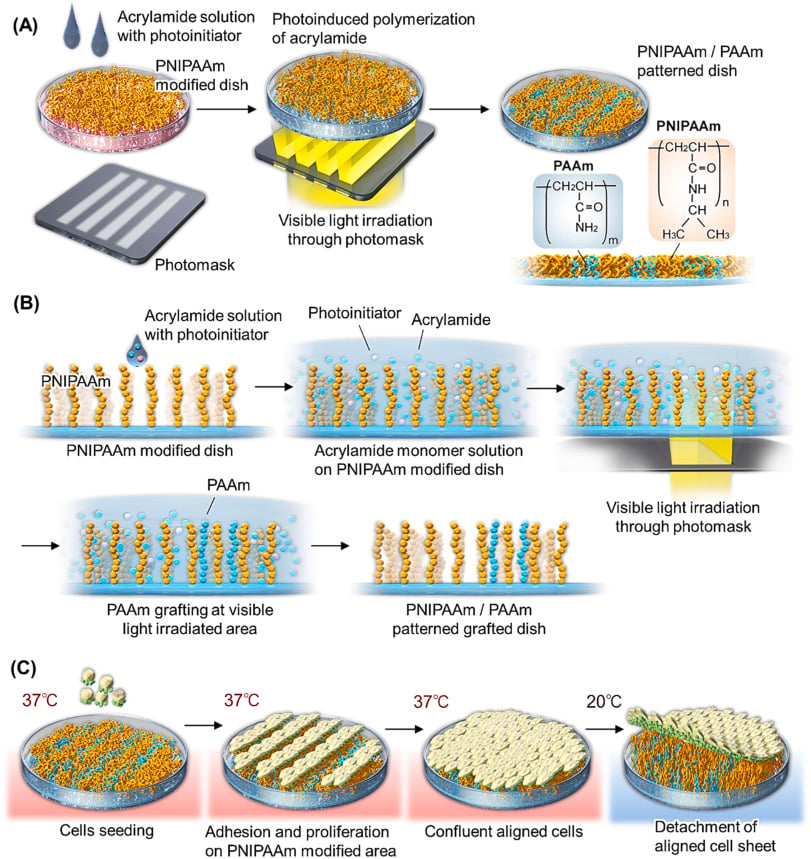
Scientists from Hiroshima University and collaborating institutions created culture surfaces with alternating stripes that respond to temperature changes. These patterned surfaces guide mesenchymal stem cells—versatile cells that support tissue repair—to grow in organized, parallel arrangements rather than random orientations.
“Mesenchymal stem cell sheets are attracting attention as an effective regenerative medicine,” explained Kenichi Nagase, professor at Hiroshima University’s Graduate School of Biomedical and Health Sciences. “Therefore, we thought that if we could improve the function of mesenchymal stem cell sheets, their therapeutic effect could be improved.”
The breakthrough lies in controlling cellular architecture. When cells align naturally in tissues, they communicate more effectively and work together more efficiently. The research team sought to recreate this organized structure in laboratory-grown stem cell sheets.
Enhanced Healing Power
The aligned sheets showed remarkable improvements in producing key therapeutic factors:
- Increased vascular endothelial growth factor for blood vessel formation
- Higher hepatocyte growth factor levels for liver repair
- Enhanced transforming growth factor-β for immune regulation
- Maintained ability to differentiate into bone and fat cells
Temperature-Controlled Harvesting
The cultivation system offers an elegant solution to a major challenge in cell therapy: how to harvest cells without damaging them. The culture surfaces incorporate temperature-responsive materials that release entire cell sheets when cooled, preserving natural cell-to-cell connections and the protein matrix that holds cells together.
This preservation proves crucial because individual stem cells often scatter unpredictably when injected into patients and fail to remain at injury sites. Sheet-based delivery maintains cellular organization and improves treatment effectiveness.
A technical detail not emphasized in initial reports: the researchers used photopolymerization through specialized masks to create precise stripe patterns, avoiding expensive nanofabrication methods while achieving the necessary cellular guidance.
Practical Applications
Nagase noted that “the use of striped temperature-responsive culture dishes increases the amount of cytokines secreted from the sheets.” These signaling proteins drive tissue repair, blood vessel growth, and immune system regulation—all critical for successful regenerative treatments.
The enhanced cytokine production could benefit multiple medical applications. Heart disease patients might see improved blood vessel formation, liver disease sufferers could experience better organ repair, and autoimmune disorder patients might benefit from enhanced immune tolerance.
Current stem cell treatments face significant limitations. When delivered as individual cells, mesenchymal stem cells often disperse throughout the body rather than concentrating at treatment sites. Sheet-based delivery addresses this problem by maintaining cellular organization and improving retention at target locations.
Looking Ahead
The research demonstrates that cellular architecture profoundly influences therapeutic potential. By simply changing how stem cells grow—from random arrangements to organized patterns—scientists can significantly enhance their healing capabilities.
The technique’s simplicity represents another advantage. The patterned surfaces use commercially available materials with straightforward modifications, making the approach potentially scalable for clinical applications.
As regenerative medicine advances, such architectural control over stem cell behavior may prove essential for developing more effective, targeted therapies that harness the body’s natural healing mechanisms.