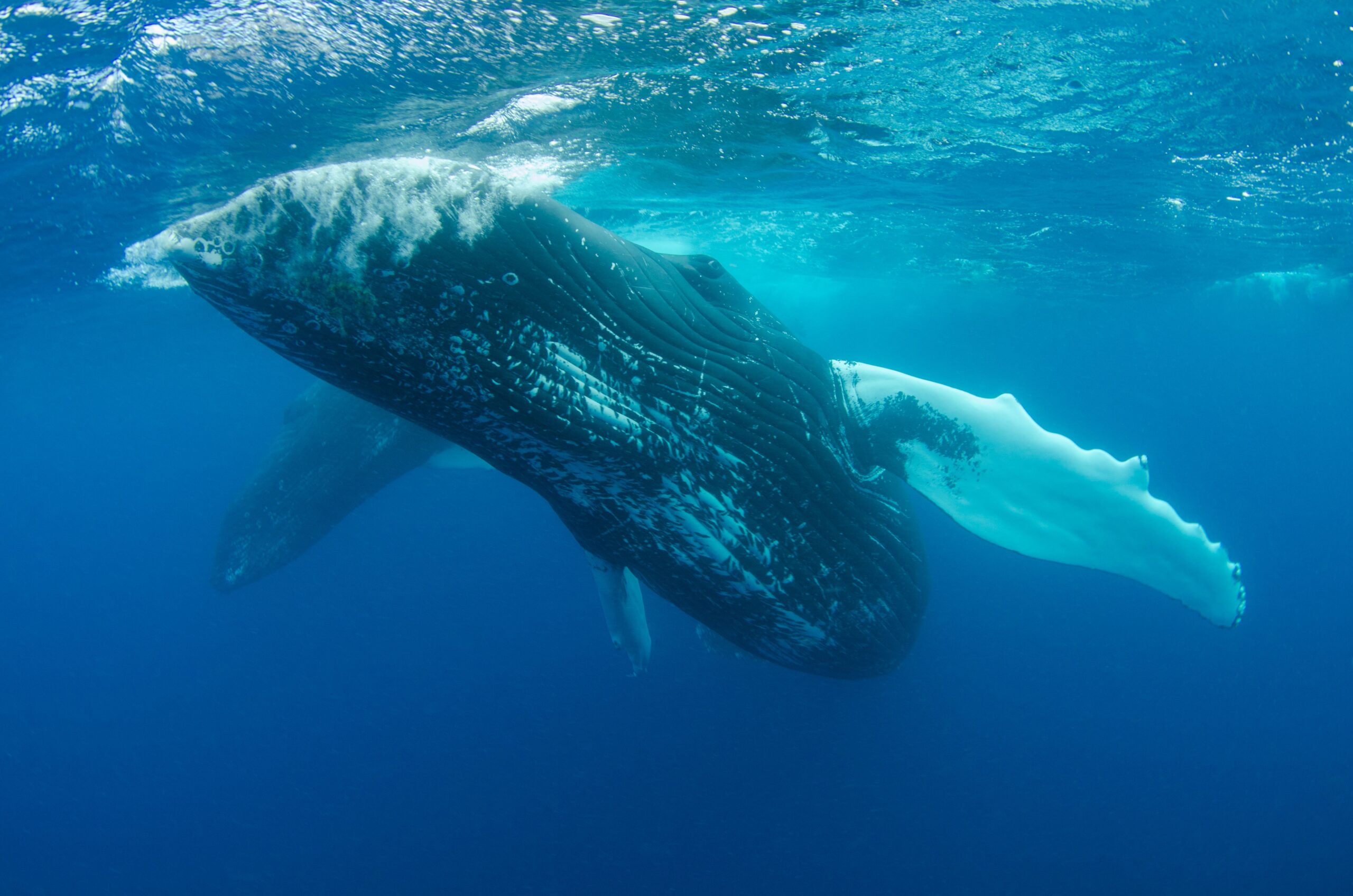
A blue whale can make a sound so low that part of it sits at the edge of what a human ear can hear, or below it. In the right ocean conditions, NOAA says those sounds may be heard by other whales up to 1,000 miles away, about 1,600 kilometers.
The finding is worth reading carefully. This is not a claim that every blue whale call always travels that far, or that scientists have fully settled every part of what whales understand at those distances. It is a claim about physics, biology, and a layer of the ocean that carries low-frequency sound with unusual efficiency.
I find that more interesting than the cleaner version. The ocean is not just water between animals. It is a structure with channels, layers, bends, noise, and quiet pathways that living things were using long before humans put hydrophones into the sea.
The call sits at the edge of hearing
Blue whales are the largest animals known to have lived, but their most consequential signals are not high, sharp, or easy for us to notice. NOAA Fisheries describes blue whale vocalizations as low-frequency sounds, and says that in the right oceanographic conditions they may be heard by other whales up to 1,000 miles away.
The National Research Council’s report Ocean Noise and Marine Mammals gives the frequency range in more technical terms. It notes that blue whales and fin whales produce low-frequency moans in the 10 to 25 hertz range, with infrasonic signals in the 10 to 20 hertz band well documented in blue whales and fin whales.
Human hearing is usually described as beginning around 20 hertz, though the boundary is not a clean wall. That means some blue whale sound sits below ordinary human hearing, while some sits near the lower edge. A person standing over the ocean may hear nothing at all while a signal with real biological meaning is moving through the water beneath them.
That is the first useful correction. The call is not impressive because it is loud in the human sense. It is impressive because it is tuned to a medium where low sound can travel extraordinarily far.
SOFAR is a sound channel, not a metaphor
NOAA’s Ocean Service describes the SOFAR channel, short for Sound Fixing and Ranging, as a naturally occurring ocean channel that allows sound to carry great distances. It exists because temperature, pressure, and salinity shape how fast sound moves through different layers of seawater.
Sound bends toward the depth where its speed is lowest. When low-frequency sound enters that layer, it can become trapped in a broad vertical corridor, bending up and down rather than escaping quickly to the surface or seafloor. NOAA explains that this can allow sound to travel for hundreds of miles without losing much energy, and in some cases across entire ocean basins.
That last phrase is easy to romanticize, so it helps to keep the physical picture plain. The SOFAR channel is not a tunnel with walls. It is a zone in the water column where sound speed changes guide waves over long distances.
The same pathway can carry whale calls, earthquakes, volcanic activity, ship noise, and human-made signals. The channel does not belong to whales. It is simply part of the ocean’s acoustic architecture.
Humans found it during a war
The discovery story is not peaceful. NOAA says that at the height of the Second World War, scientists tested the idea that low-frequency sound could travel long distances in the deep ocean. A research vessel near Woods Hole, Massachusetts, used a hydrophone, while another ship about 900 miles away lowered an explosive to a specific depth. The signal crossed the distance clearly enough to confirm what researchers called a SOFAR transmission.
Woods Hole Oceanographic Institution gives more of the military context. During the war, Maurice Ewing and J. Lamar Worzel were conducting basic research on underwater sound propagation at WHOI while seeking advantages that could help the Navy detect enemy submarines or mines, or help American submarines avoid detection. In one experiment, WHOI says, they detonated a pound of TNT near the Bahamas and detected the sound 2,000 miles away near West Africa.
The same discovery had different meanings depending on who was listening. To military planners, a long-distance sound channel could help locate submarines and survivors. To ocean scientists, it opened a way to listen across vast water. To whales, if I can put it this way carefully, the channel was not a discovery at all.
They had evolved inside it.
What whales use it for is still handled carefully
It is tempting to say whales use the SOFAR channel as a long-distance telephone network. That may be directionally right, but the evidence is not quite that tidy.
The National Research Council report says suggestions that low-frequency whale signals are used for long-distance communication and large-scale environmental imaging are intriguing, but have not been definitively demonstrated. It also notes that fin and blue whale vocalizations have been detected at estimated ranges greater than 100 kilometers, with one confirmed blue whale detection at 600 kilometers using a large-aperture array.
NOAA’s broader public explanation gives the more accessible version: whales tuned into the SOFAR channel long before scientists, and migrating whales rely on it to communicate over hundreds and even thousands of miles. Those two statements are not really in conflict. One is explaining the phenomenon for a general reader. The other is reminding us that detection, interpretation, and animal behavior are different things.
As a writer, I think the honest middle is enough. Blue whales produce very low-frequency calls. The ocean has a natural channel that carries low-frequency sound unusually far. Scientists have recorded such sounds across long distances. The exact social meaning of every call is harder to pin down.
The ocean is quieter in our imagination than in reality
One reason this story matters is that it corrects a common mistake. We often imagine the deep ocean as silent because it is dark and remote. In reality, it is full of sound: animals, waves, rain, ice, earthquakes, ships, sonar, and machinery.
I wrote recently about Earth’s five named oceans forming one connected system, and this is another version of the same idea. The divisions we put on maps are useful, but the water itself keeps joining things together. A sound does not care which ocean name appears above it.
That same connectedness is why human noise matters. NOAA notes that ship traffic and other human activities make the ocean noisier, and that louder noise levels can interfere with whale communication. The National Research Council report also discusses long-term increases in low-frequency ocean noise associated with commercial shipping.
This is not a moral lecture about every ship at sea. It is a reminder that the ocean’s soundscape is habitat. For animals that depend on sound, noise is not background in the way it is for us. It can change how far a call travels, how easily a signal is detected, and how much work communication requires.
A hidden channel changes the scale of the animal
The blue whale is already difficult to hold in the mind because of its size. The animal can be longer than a basketball court and heavier than any dinosaur yet known from a complete skeleton. But the call changes the scale again.
A body is one kind of size. A voice moving through the ocean is another.
That is why this fact stays with me. A whale does not need to be seen to occupy space. It can be physically present in one patch of ocean and acoustically present far beyond it, sending a low sound into a layer of water that bends the signal onward.
I had a similar feeling when writing about the Pacific being larger than all the continents combined. Some Earth facts are not hard because they are complicated. They are hard because they are too large for ordinary intuition.
The SOFAR channel belongs in that category. It is a piece of ocean physics discovered in wartime, used by science, complicated by human noise, and inhabited by animals whose calls were already fitted to it.
The quiet surface was never the whole ocean.