Skip to content
ScienceBlog.com
  • Featured Blogs
    • EU Horizon Blog
    • ESA Tracker
    • Experimental Frontiers
    • Josh Mitteldorf’s Aging Matters
    • Dr. Lu Zhang’s Gondwanaland
    • NeuroEdge
    • SciChi
    • The Poetry of Science
    • Wild Science
  • Topics
    • Brain & Behavior
    • Earth, Energy & Environment
    • Health
    • Life & Non-humans
    • Physics & Mathematics
    • Social Sciences
    • Space
    • Technology
  • Our Substack
  • Follow Us!
    • Bluesky
    • Threads
    • FaceBook
    • Google News
    • Twitter/X
  • Contribute/Contact

Alzheimers disease

Man smoking. Unsplash

Smoking causes brain shrinkage

DNA illustration

Clues to preventing Alzheimer’s come from patient who, despite genetics, evaded disease

Electric current. Pixabay

Twice daily electrical stimulation may boost mental processes in Alzheimer’s disease

Brain MRI images.

Black patients face delays in Alzheimer’s diagnosis

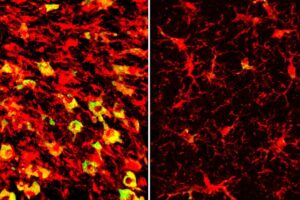
Lipid deposits (green) in brain immune cells (red) from mice with Alzheimer’s-like disease all but disappear (right) after the mice are treated with an experimental drug. Researchers at Washington University School of Medicine in St. Louis have found that a form of cholesterol known as cholesteryl esters builds up in the brains of mice with Alzheimer’s-like disease, and that clearing out the cholesteryl esters helps prevent brain damage and behavioral changes.

Lowering a form of brain cholesterol cuts Alzheimer’s-like damage in mice

male belly. pixabay

Hidden belly fat in midlife linked to Alzheimer’s disease

Human digestive tract and biome. Pixabay

Microorganisms living in gastrointestinal tracts may foretell diagnoses of debilitating diseases including Alzheimer’s and Parkinson’s


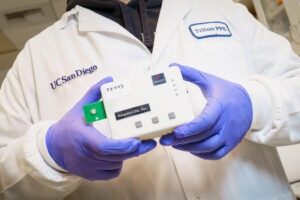
The biosensor and reader are designed to be used at home or at a point of care. The system can transmit results wirelessly to physicians, patients and patient's caregivers and family.

Wireless, handheld, non-invasive device detects Alzheimer’s and Parkinson’s biomarkers

An elderly couple walking together

Why Progress in Alzheimer’s Disease Treatment Has Taken 30 Years

Candid albicans

Fungal infection produces changes like those seen in Alzheimer’s

Mature woman crossing the street

Certain navigational mistakes could be early signs of Alzheimer’s disease

Breakthrough in understanding the onset of sporadic Alzheimer’s disease

Alzheimer's brain illustration from MIT

Study Identifies Genetic Drivers of Alzheimer’s Progression, Drug Targets

In 2015, Drs. Xiao Zhen Zhou (left) and Kun Ping Lu discovered the association between cis P-tau and Alzheimer’s, traumatic brain injuries and stroke. The new study is the first to identify the toxic protein outside the brain in the placenta and the blood of preeclampsia patients. (Schulich School of Medicine & Dentistry photo)

In major breakthrough, researchers close in on preeclampsia cure

Older posts
Newer posts
← Previous Page1 … Page5 Page6 Page7 … Page10 Next →
Substack subscription form sign up

Comments

  • Forehead Slap on Women With HIV Are Dying of Trauma, Not the Virus, and Death Records Are Missing It
  • Andrea on Women With HIV Are Dying of Trauma, Not the Virus, and Death Records Are Missing It
  • Foo on A New Theory Says DMT Entities Might Be Real, and Proposes How to Test It
  • John E on A New Theory Says DMT Entities Might Be Real, and Proposes How to Test It
  • Fully Whelmed on A New Theory Says DMT Entities Might Be Real, and Proposes How to Test It
© 2026 ScienceBlog.com | Follow our RSS / XML feed