Skip to content
ScienceBlog.com
  • Featured Blogs
    • EU Horizon Blog
    • ESA Tracker
    • Experimental Frontiers
    • Josh Mitteldorf’s Aging Matters
    • Dr. Lu Zhang’s Gondwanaland
    • NeuroEdge
    • NIAAA
    • SciChi
    • The Poetry of Science
    • Wild Science
  • Topics
    • Brain & Behavior
    • Earth, Energy & Environment
    • Health
    • Life & Non-humans
    • Physics & Mathematics
    • Social Sciences
    • Space
    • Technology
  • Our Substack
  • Follow Us!
    • Bluesky
    • Threads
    • FaceBook
    • Google News
    • Twitter/X
  • Contribute/Contact

animal behavior

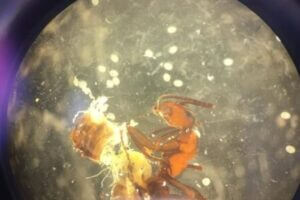
Dissected ant and where you can see the encapsulated parasites (white oval structures) spilling out of the hind body. Photo: Brian Lund Fredensborg

Brain-altering parasite turns ants into zombies at dawn and dusk

Ohio State logo

What to expect when you adopt a shelter pet

Ohio State logo

It’s not just humans: City life is stressful for coyotes, too

I smell ... Covid.

Dogs can detect COVID-19 infections faster and more accurately than conventional technology, demonstrating readiness for mainstream medical applications

Nictation and leaping of dauer larvae under an electric field. Top row, single dauer larva; middle row, two dauer larvae; bottom row, a group of dauer larvae. (Takuya Chiba et al. Current Biology. July 10, 2023)

Worms joy ride across electric voltages

Funky animal from Cambrian period. Pixabay

Genes for Learning, Aggression Traced Back 650 Million Years

Snarling do. From Harvard PIO

As temps climb so do number of dog bites

The scientists used a special testing apparatus for their measurements.

Rattlesnakes Help Each Other Destress

An alpha male harvestman

Arachnid has three versions of `male.’ How does that happen?

Hummingbird. Pixabay

Sipping at the Bar: Hummingbirds Consume Alcohol in Nectar

A smiling primate. Credit Pixabay

Origins and advantages of, er, self love

Two gorillas

Gorilla Resilience Unleashed: How Early Adversity Can’t Bring Them Down

Elephant seals asleep on land

Elephant seals drift off to sleep while diving far below the ocean surface

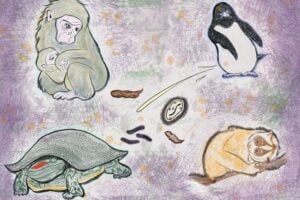
Animals' reactions to respective excrements monitored by research team. Top left: Japanese macaques/human-like. Top right: Adélie penguin/white-splash (parasites, pathogens). Bottom left: Red-eared slider/black-pellet. Bottom right: Slow loris/macaque-like but smaller.

Survival is a disgusting matter

Older posts
Newer posts
← Previous Page1 … Page4 Page5 Page6 Page7 Next →
Substack subscription form sign up

Comments

  • Anon on Why Fructose Behaves Less Like a Calorie and More Like a Hormone
  • Mark Mellinger on Living Plastic Can Self-Destruct on Command
  • Marie Feret on The Silent Frequency That Makes Old Buildings Feel Haunted
  • Dax on The Silent Frequency That Makes Old Buildings Feel Haunted
  • Karoly Mirnics on Common Prescription Drugs May Disrupt Cholesterol Pathways in the Womb and Raise Autism Risk
© 2026 ScienceBlog.com | Follow our RSS / XML feed