Skip to content
ScienceBlog.com
  • Featured Blogs
    • EU Horizon Blog
    • ESA Tracker
    • Experimental Frontiers
    • Josh Mitteldorf’s Aging Matters
    • Dr. Lu Zhang’s Gondwanaland
    • NeuroEdge
    • NIAAA
    • SciChi
    • The Poetry of Science
    • Wild Science
  • Topics
    • Brain & Behavior
    • Earth, Energy & Environment
    • Health
    • Life & Non-humans
    • Physics & Mathematics
    • Social Sciences
    • Space
    • Technology
  • Our Substack
  • Follow Us!
    • Bluesky
    • Threads
    • FaceBook
    • Google News
    • Twitter/X
  • Contribute/Contact

animal behavior

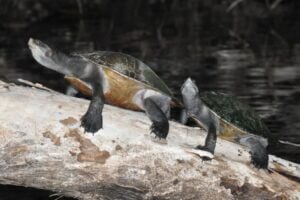
Freshwater turtle basking at night. Image captured for study into nocturnal basking habits.

Freshwater turtles found basking in the moonlight

Professor Yun Zhang (far right) and her team — Taihong Wu (left) and Minghai Ge — discovered that hermaphrodite worms infected by a pathogen became more interested in mating with males, increasing their genetic diversity. Kris Snibbe/Harvard Staff Photographer

How does infection change social behavior?

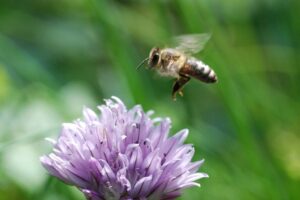
A bee above a purple flower

Making Beelines

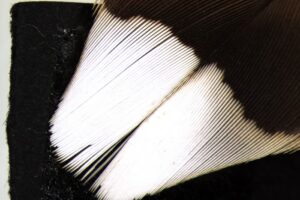
Woodcock tail feathers

The brightest white feathers ever measured

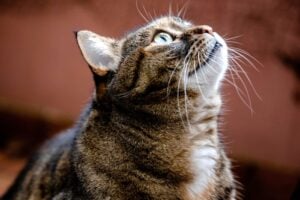
Cat looking thoughtful

How consciousness in animals can be researched

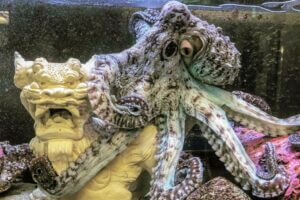
Octopuses are mollusks, a large evolutionary group to which slugs and snails also belong. Their complex brains, and those of other closely-related cephalopods, like squid and cuttlefish, have evolved separately from vertebrates, and so octopuses are often referred to as alien-like. Here, a day octopus (Octopus cyanea) poses with a Shisa, a creature from Okinawan folklore.

Scientists record first-ever brain waves from freely moving octopuses

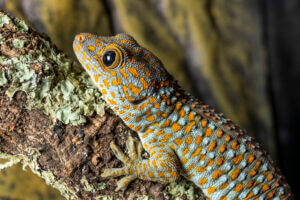
A closeup of a colorful gecko

Tasting Geckos

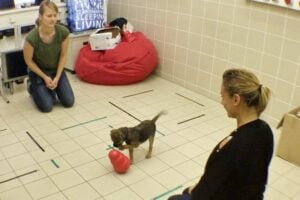
The researchers of the Department of Ethology at Eötvös Loránd University, Budapest, investigated whether young puppies, kittens and wolf pups have different tendencies to observe and imitate what a person did, without any pre-training and food reward.

Dog puppies spontaneously match human actions, while kittens, wolf pups not so much

Closeup of ant with object in its jaws

These ants don’t just walk randomly; they “meander” systematically

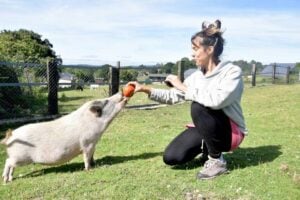
Woman playing with a pig and holding an apple

Dogs show things to humans but pigs do not

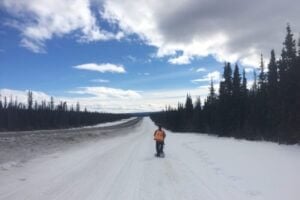
Squirrel researcher walking along the Alaska Highway in the Yukon, Canada. Image credit: Ben Dantzer

Squirrels that gamble win big when it comes to evolutionary fitness

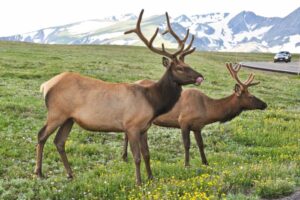
Two elk stand near a roadway in the Rocky Mountains.

Is it safe? Why some animals fear using wildlife crossings

Digital art of a badger climbing a tree where, at the top, there is hanging bird nest

Birds build hanging nests to protect offspring from invaders

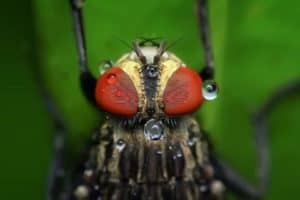
Fly with big red eyes

Research reveals which animals perceive time the fastest

Older posts
Newer posts
← Previous Page1 … Page5 Page6 Page7 Next →
Substack subscription form sign up

Comments

  • Mark Mellinger on Living Plastic Can Self-Destruct on Command
  • Marie Feret on The Silent Frequency That Makes Old Buildings Feel Haunted
  • Dax on The Silent Frequency That Makes Old Buildings Feel Haunted
  • Karoly Mirnics on Common Prescription Drugs May Disrupt Cholesterol Pathways in the Womb and Raise Autism Risk
  • Aizen on Laziness helped lead to extinction of Homo erectus
© 2026 ScienceBlog.com | Follow our RSS / XML feed