Skip to content
ScienceBlog.com
  • Featured Blogs
    • EU Horizon Blog
    • ESA Tracker
    • Experimental Frontiers
    • Josh Mitteldorf’s Aging Matters
    • Dr. Lu Zhang’s Gondwanaland
    • NeuroEdge
    • NIAAA
    • SciChi
    • The Poetry of Science
    • Wild Science
  • Topics
    • Brain & Behavior
    • Earth, Energy & Environment
    • Health
    • Life & Non-humans
    • Physics & Mathematics
    • Social Sciences
    • Space
    • Technology
  • Our Substack
  • Follow Us!
    • Bluesky
    • Threads
    • FaceBook
    • Google News
    • Twitter/X
  • Contribute/Contact

Antibiotic development

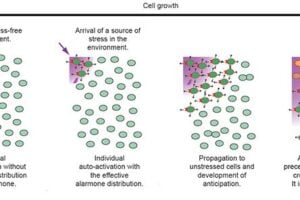
A (light green) bacterial cell detects a source of stress and becomes activated (dark green). It then produces alarmones (depicted as red triangles) and can transmit them to neighboring cells via cell-to-cell contact (black arrows). As the source of stress arrives, the percentage of activated cells increases, converting unstressed neighboring cells and triggering the stress response mechanism.

Bacteria’s Secret ‘Alarm System’ Against Antibiotics Uncovered

Substack subscription form sign up

Comments

  • landman on Urine Test Cuts Unnecessary Prostate Biopsies by Nearly Two-Thirds in Head-to-Head Trial Against MRI
  • Marco Messina on More Than a Third of Americans Have Lost Relationships Over Politics
  • Anon on Why Fructose Behaves Less Like a Calorie and More Like a Hormone
  • Mark Mellinger on Living Plastic Can Self-Destruct on Command
  • Marie Feret on The Silent Frequency That Makes Old Buildings Feel Haunted
© 2026 ScienceBlog.com | Follow our RSS / XML feed