Skip to content
ScienceBlog.com
  • Featured Blogs
    • EU Horizon Blog
    • ESA Tracker
    • Experimental Frontiers
    • Josh Mitteldorf’s Aging Matters
    • Dr. Lu Zhang’s Gondwanaland
    • NeuroEdge
    • NIAAA
    • SciChi
    • The Poetry of Science
    • Wild Science
  • Topics
    • Brain & Behavior
    • Earth, Energy & Environment
    • Health
    • Life & Non-humans
    • Physics & Mathematics
    • Social Sciences
    • Space
    • Technology
  • Our Substack
  • Follow Us!
    • Bluesky
    • Threads
    • FaceBook
    • Google News
    • Twitter/X
  • Contribute/Contact

Artificial Intelligence

Fighting extreme weather with extreme computing power

Frontal chest X-ray shows a small nodular opacity (arrow) in the left upper lung zone. Axial, non-contrast, low-dose chest CT scan shows a 9-mm solid nodule (arrow) in the left upper lobe.

AI identifies non-smokers at high risk for lung cancer

Crabs

AI-powered crab gender identification can revolutionize fishery management and conservation

A machine-learning technique developed by researchers from MIT and elsewhere enables deep learning models, like those that underlie AI chatbots or smart keyboards, to efficiently and continuously learn from new user data directly on an edge device like a smartphone. Credits:Image: MIT News

Technique enables AI on edge devices to keep learning over time

The new platform technology modeled after the brain is composed of a tangled-up network of wires containing silver, laid on a bed of electrodes.

Experimental brain-like computing system more accurate with custom algorithm

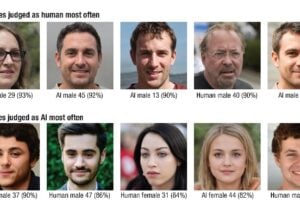
Faces judged most often as (a) human and (b) AI. The stimulus type (AI or human; male or female), the stimulus ID (Nightingale & Farid, 2022), and the percentage of participants who judged the face as (a) human or (b) AI are listed below each face.

AI faces look more real than actual human face

Artificial intelligence predicts ovarian cancer therapy responses

Illustration of a skeleton and heart and heart signal. Pixabay

Artificial intelligence may help prevent sudden cardiac death

Man's body, highlighting the stomach and esophagus

Scientists use AI to create next-generation stomach acid treatment

This image, featured on the cover of the journal Patterns in reference to a paper published by a Penn State research team, illustrates a person mid-jump in a representation of joyous emotion. Human body movements convey emotions and play a role in everyday communication. Credit: James Z. Wang, Chenyan Wu, HstrongART/iStock. All Rights Reserved.

Human body movements may enable automated emotion recognition, researchers say

Ohio State logo

‘Dim-witted’ pigeons use the same principles as AI to solve tasks

Researchers used two stationary smartphones to record motion capture of study participants. Florent Vial, Stanford Neuromuscular Biomechanics Lab

Smartphone app quickly analyzes human motion to aid physical rehab

Human tongue

Eyes may be the window to your soul, but the tongue mirrors your health

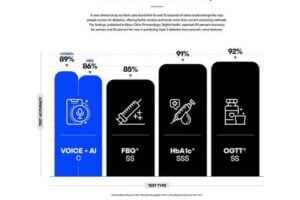
A new clinical study by Klick Labs found that AI and 10 seconds of voice could change the way people screen for diabetes, offering better access and lower costs than current screening methods. The findings, published in Mayo Clinic Proceedings: Digital Health, reported 89 percent accuracy for women and 86 percent for men in predicting Type 2 diabetes from acoustic voice features.

AI and 10 seconds of voice can screen for diabetes, new study reveals

Older posts
Newer posts
← Previous Page1 … Page9 Page10 Page11 … Page16 Next →
Substack subscription form sign up

Comments

  • Sue Ann Hayes on Hidden Nuclear Protein Fuels Pancreatic Cancer’s Deadly Aggression
  • Curtis Webber on The GPS-Killer? This Quantum Device ‘Feels’ Motion Like a Brain—Down to the Atomic Level
  • Ran on How the Age You First Had Sex Could Shape How You Age Decades Later
  • Sparty on How the Age You First Had Sex Could Shape How You Age Decades Later
  • Josh Mitteldorf on A Single TV Segment Sent Leucovorin Prescriptions for Autistic Children Soaring 2,000 Percent
© 2026 ScienceBlog.com | Follow our RSS / XML feed