Skip to content
ScienceBlog.com
  • Featured Blogs
    • EU Horizon Blog
    • ESA Tracker
    • Experimental Frontiers
    • Josh Mitteldorf’s Aging Matters
    • Dr. Lu Zhang’s Gondwanaland
    • NeuroEdge
    • NIAAA
    • SciChi
    • The Poetry of Science
    • Wild Science
  • Topics
    • Brain & Behavior
    • Earth, Energy & Environment
    • Health
    • Life & Non-humans
    • Physics & Mathematics
    • Social Sciences
    • Space
    • Technology
  • Our Substack
  • Follow Us!
    • Bluesky
    • Threads
    • FaceBook
    • Google News
    • Twitter/X
  • Contribute/Contact

Artificial Intelligence

Dentist working in the mouth of a patient

Dentists could soon have a new AI co-pilot to detect tooth decay

AI Chatbot intelligent digital customer service application concept, computer mobile application uses artificial intelligence chatbots automatically respond online messages to help customers instantly

Out with the life coach, in with the chatbot

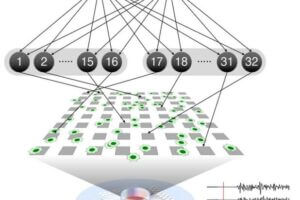
The experimental setup. Cultured neurons grew on top of electrodes. Patterns of electrical stimulation trained the neurons to reorganize so that they could distinguish two hidden sources. Waveforms at the bottom represent the spiking responses to a sensory stimulus (red line).

Math theory predicts self-organized learning in real neurons

Illustration of a digital brain

AI transformation of medicine: Why doctors are not prepared

Patient and physician confer. Courtesy of USC

Why doctors using ChatGPT are unknowingly violating HIPAA

Heart illustration. Pixabay

AI Tool Detects Hidden Heart Disorders From ECG Photos

Woman interacting with a desktop robot.

AI Advances Could Equip Robots to Counter Human Loneliness

Caption: Deployed for the assembly of individual proteins, FrameDiff demonstrates its prowess by crafting extensive proteins with as many as 500 components. This method exhibits a significant advancement as it forges ahead, independent of the need for a pre-charted protein structure blueprint. Credits: Image: Alex Shipps/MIT CSAIL

AI is Shaping the Future of Biomedicine With Artificially Engineered Proteins

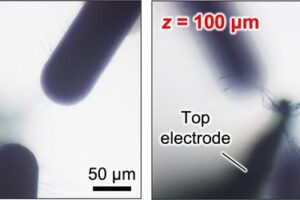
Optical microscopy images of the 3D polymer wiring between a top electrode (TE) and three bottom electrodes (BEs) at the vertical distance from the surface of glass substrate z = 0 and 100 μm.

Neuromorphic Wetware: A Rainforest of Neural Networks in a Polymer Brain

Illustration of AI

There’s a faster, cheaper way to train large language models

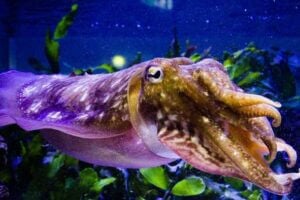
The common cuttlefish, Sepia officinalis.

Cuttlefish camouflage even wilder than previously thought

Computer memory

Researchers Develop Brain-Inspired Computer Memory

Child laughing

Emotion Recognition for People with Neurodiverse Conditions

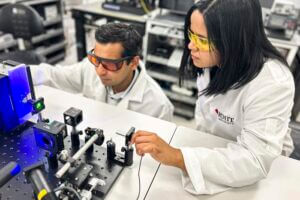
Prof Sumeet Walia (left) and PhD researcher Aishani Mazumder with a demonstration (using visible light) of the experimental set up for the research that used ultraviolet light.

Tiny device mimics human vision and memory abilities

Older posts
Newer posts
← Previous Page1 … Page11 Page12 Page13 … Page16 Next →
Substack subscription form sign up

Comments

  • Sue Ann Hayes on Hidden Nuclear Protein Fuels Pancreatic Cancer’s Deadly Aggression
  • Curtis Webber on The GPS-Killer? This Quantum Device ‘Feels’ Motion Like a Brain—Down to the Atomic Level
  • Ran on How the Age You First Had Sex Could Shape How You Age Decades Later
  • Sparty on How the Age You First Had Sex Could Shape How You Age Decades Later
  • Josh Mitteldorf on A Single TV Segment Sent Leucovorin Prescriptions for Autistic Children Soaring 2,000 Percent
© 2026 ScienceBlog.com | Follow our RSS / XML feed