Skip to content
ScienceBlog.com
  • Featured Blogs
    • EU Horizon Blog
    • ESA Tracker
    • Experimental Frontiers
    • Josh Mitteldorf’s Aging Matters
    • Dr. Lu Zhang’s Gondwanaland
    • NeuroEdge
    • NIAAA
    • SciChi
    • The Poetry of Science
    • Wild Science
  • Topics
    • Brain & Behavior
    • Earth, Energy & Environment
    • Health
    • Life & Non-humans
    • Physics & Mathematics
    • Social Sciences
    • Space
    • Technology
  • Our Substack
  • Follow Us!
    • Bluesky
    • Threads
    • FaceBook
    • Google News
    • Twitter/X
  • Contribute/Contact

Artificial Intelligence

Female sittingon floor afraid of her phone which is on the carpet near her

AI saving humans from the emotional toll of monitoring hate speech

Illustration on UN report cover

Gender Biases in AI Systems Pose Risks to Women’s Security in South-East Asia

The sections of these images outlined in red were identified as privacy threats using an open-source dataset called DIPA. GCR then used the annotated text prompts to replace these sections with visually similar or well-integrated substitutes.

AI-Powered Image Editing Preserves Privacy Without Compromising Aesthetics

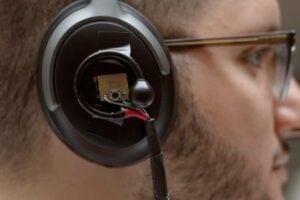
A University of Washington team has developed an artificial intelligence system that lets a user wearing headphones look at a person speaking for three to five seconds and then hear just the enrolled speaker’s voice in real time even as the listener moves around in noisy places and no longer faces the speaker. Pictured is a prototype of the headphone system: binaural microphones attached to off-the-shelf noise canceling headphones.

AI headphones let wearer listen to a single person in a crowd, by looking at them just once

picture of ai helping a woman overcome loneliness

Artificial Intelligence could help cure loneliness

Ohio State logo

AI poised to usher in new level of concierge services to the public

Scientists use generative AI to answer complex questions in physics

Scientists use generative AI to answer complex questions in physics

A visually striking image depicting a humanoid robot with a deceptive expression, surrounded by a web of glowing red lines representing the spread of false information

The Deceiving Machines: Combatting the Risks of AI Deception

Ohio State logo

With huge patient dataset, AI accurately predicts treatment outcomes

ChatGPT screen in a hospital setting

ChatGPT’s Inconsistent Heart Risk Assessments Raise Concerns for Medical Use

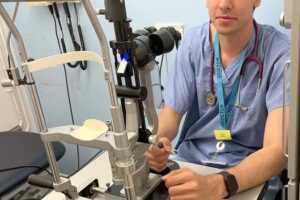
Thirunavukarasu found that the AI model GPT-4 significantly exceeds the ability of non-specialist doctors to assess eye problems and provide advice.

GPT-4 Outperforms Junior Doctors in Eye Care Scenarios

A false color- scanning election micrograph of lung cancer cells grown in culture. A new AI tool called PERCEPTION uses data at the level of single cells to help predict patients’ response to different therapies.

AI-Powered Tool Predicts Cancer Treatment Response at Single-Cell Level

a goat in business casual office clothing uses an old fashioned calculator with white printer paper unfurling out of it, to calculate his taxes

Rats Can Count: Hong Kong Scientists Uncover Numerical Ability in Rodents

Artist’s impression of optoacoustic computing.

Sound Waves Revolutionize Optical Neural Networks: Paving the Way for Reconfigurable AI

Older posts
Newer posts
← Previous Page1 … Page6 Page7 Page8 … Page16 Next →
Substack subscription form sign up

Comments

  • Sue Ann Hayes on Hidden Nuclear Protein Fuels Pancreatic Cancer’s Deadly Aggression
  • Curtis Webber on The GPS-Killer? This Quantum Device ‘Feels’ Motion Like a Brain—Down to the Atomic Level
  • Ran on How the Age You First Had Sex Could Shape How You Age Decades Later
  • Sparty on How the Age You First Had Sex Could Shape How You Age Decades Later
  • Josh Mitteldorf on A Single TV Segment Sent Leucovorin Prescriptions for Autistic Children Soaring 2,000 Percent
© 2026 ScienceBlog.com | Follow our RSS / XML feed