Skip to content
ScienceBlog.com
  • Featured Blogs
    • EU Horizon Blog
    • ESA Tracker
    • Experimental Frontiers
    • Josh Mitteldorf’s Aging Matters
    • Dr. Lu Zhang’s Gondwanaland
    • NeuroEdge
    • NIAAA
    • SciChi
    • The Poetry of Science
    • Wild Science
  • Topics
    • Brain & Behavior
    • Earth, Energy & Environment
    • Health
    • Life & Non-humans
    • Physics & Mathematics
    • Social Sciences
    • Space
    • Technology
  • Our Substack
  • Follow Us!
    • Bluesky
    • Threads
    • FaceBook
    • Google News
    • Twitter/X
  • Contribute/Contact

Astronomy

Research by Greg Girolami, the William and Janet Lycan Professor of Chemistry, uncovered previously unknown details about the enigmatic English scholar Margaret Bryan, including her family background and the names of her husband and two daughters. Photo by Fred Zwicky

Research uncovers details about the mysterious author of early astronomy textbooks

Artist’s Impression of the “Tadpole” Molecular Cloud and the black hole at the gravitational center of its orbit.

‘Tadpole’ Spotted Playing Around Black Hole

Application of machine learning techniques to large astronomy data sets can discover thousands of cosmic objects of various classes.

Machine learning techniques identify thousands of new cosmic objects

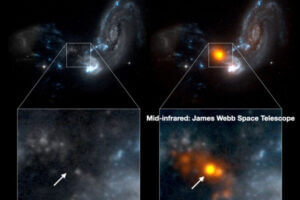
Astronomers from an international team have used the James Webb Space Telescope to reveal, for the first time, the exact location of the source powering colliding galaxies. Curiously, this source lies outside of the main parts of the galaxies and is not visible at all in the ultraviolet or visible light observed with the Hubble Space Telescope.

‘Engine’ of luminous merging galaxies pinpointed for the first time

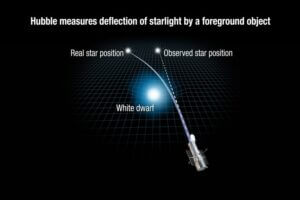
This artist's illustration shows how the gravity of a foreground white dwarf star warps space and bends the light of a distant star behind it. Astronomers using NASA's Hubble Space Telescope have for the first time directly measured the mass of a single, isolated white dwarf (the surviving core of a burned-out Sun-like star) – due to this optical trick of nature. The greater the temporary, infinitesimal deflection of the background star's image, the more massive the foreground star is. (This deviation is so small that it is equivalent to observing an ant crawl across the surface of a quarter from 1,500 miles away.) Researchers found that the dwarf is 56 percent the mass of our Sun. This effect, called gravitational lensing was predicted as a consequence of Einstein's theory of general relativity from a century ago. Observations of a solar eclipse in 1919 provided the first experimental proof for general relativity. But Einstein didn't think the same experiment could be done for stars beyond our Sun because of the extraordinary precision required.

For the first time Hubble directly measures mass of a lone white dwarf

Graphic showing how microlensing was used to measure the mass of a white dwarf star.

Astronomers observe light bending around an isolated white dwarf

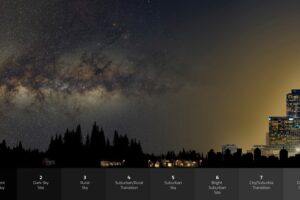
A startling analysis from Globe at Night — a citizen science program run by NSF’s NOIRLab — concludes that stars are disappearing from human sight at an astonishing rate. The study finds that, to human eyes, artificial lighting has dulled the night sky more rapidly than indicated by satellite measurements. The study showcases the unique contributions that citizen scientists can make in essential fields of research. This graphic illustrates how the greater the amount of light pollution, and therefore skyglow, the fewer the stars that are visible.

Stars disappear before our eyes, citizen scientists report

Circumpolar Laser Tests at Gemini North

SpaceX Agrees to Mitigate Impact of Starlink Satellites on Astronomy

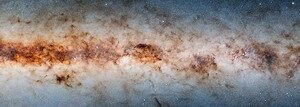
Astronomers have released a gargantuan survey of the galactic plane of the Milky Way. The new dataset contains a staggering 3.32 billion celestial objects — arguably the largest such catalog so far. The data for this unprecedented survey were taken with the US Department of Energy-fabricated Dark Energy Camera at the NSF’s Cerro Tololo Inter-American Observatory in Chile, a Program of NOIRLab. The survey is here reproduced in 4000-pixels resolution to be accessible on smaller devices.

Gargantuan survey of the Milky Way reveals billions of celestial objects

Astronomers capture radio signal from distant galaxy

Members of the public can help astronomers observe and study the night sky through NASA’s Universe of Learning Exoplanet Watch program. Credit: NASA/Bill Dunford

NASA Wants You to Help Study Planets Around Other Stars

This artist’s conception shows a late-stage galaxy merger and its two newly-discovered central black holes. The binary black holes are the closest together ever observed in multiple wavelengths.

Doomed pair of supermassive black holes the closest to collision ever seen

Pictured above: Artist's depiction of our Milky Way galaxy and its small galaxy companions surrounded by a giant halo of million-degree gas. Credit: NASA/CXC/M.Weiss/Ohio State/A Gupta et al

Milky Way’s Halo Surprisingly Empty

Halton Arp: Looking at the sky with an open mind

Older posts
Newer posts
← Previous Page1 … Page10 Page11 Page12 Next →
Substack subscription form sign up

Comments

  • Karoly Mirnics on Common Prescription Drugs May Disrupt Cholesterol Pathways in the Womb and Raise Autism Risk
  • Aizen on Laziness helped lead to extinction of Homo erectus
  • Norwood johnson on Electrons in New Crystals Behave as If They Live in Four Dimensions
  • ScienceBlog.com on Hidden Geometry Could Finally Fix Quantum Computers
  • Theo Prinse on America Is Going Back to the Moon. This Time, It Plans to Stay
© 2026 ScienceBlog.com | Follow our RSS / XML feed