Skip to content
ScienceBlog.com
  • Featured Blogs
    • EU Horizon Blog
    • ESA Tracker
    • Experimental Frontiers
    • Josh Mitteldorf’s Aging Matters
    • Dr. Lu Zhang’s Gondwanaland
    • NeuroEdge
    • NIAAA
    • SciChi
    • The Poetry of Science
    • Wild Science
  • Topics
    • Brain & Behavior
    • Earth, Energy & Environment
    • Health
    • Life & Non-humans
    • Physics & Mathematics
    • Social Sciences
    • Space
    • Technology
  • Our Substack
  • Follow Us!
    • Bluesky
    • Threads
    • FaceBook
    • Google News
    • Twitter/X
  • Contribute/Contact

Astronomy

The Hubble Space Telescope has captured an image of an object in the ultraviolet part of the spectrum, which appears similar in size to our Milky Way. Researchers have been puzzled by this object for some time, but recently found similarities between it and a nearby galaxy known as IC 5249, which lacks a bulge and is observed edge-on. The images in ultraviolet and visible light of both objects are strikingly similar and suggest that the object could be a galaxy without a bulge viewed edge-on. Credit for the images goes to HST.

Starry Trail Not a Fleeing Black Hole After All

The Hubble Space Telescope has captured images of gas-and-dust disks around the young star TW Hydrae. These images show shadows moving across the disks surrounding the system. Scientists believe that these shadows are being cast by inner disks that are slightly tilted and blocking the light from reaching the outer disk. This tilt is due to the gravitational pull of unseen planets that are changing the structure of the disks.

Two Baby Planets May Be Playing Hide-and-Seek in Distant Star System

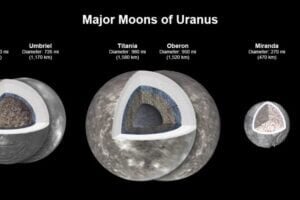
New modeling shows that there likely is an ocean layer in four of Uranus’ major moons: Ariel, Umbriel, Titania, and Oberon. Salty – or briny – oceans lie under the ice and atop layers of water-rich rock and dry rock. Miranda is too small to retain enough heat for an ocean layer. Credit: NASA/JPL-Caltech

Uranus Moons Hide Watery Secrets

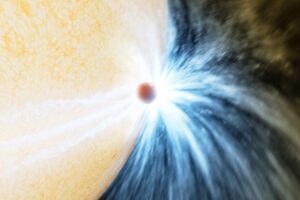
ZTF and NEOWISE spot evidence for the first known case of a star engulfing its planet

Star Eats Planet, Brightens Dramatically

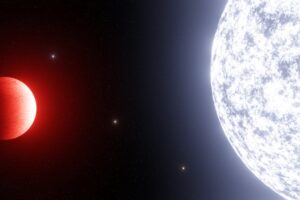
Illustration: Bibiana Prinoth

Scientists discover rare element terbium in exoplanet’s atmosphere

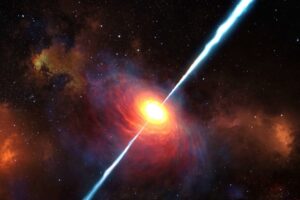
An artist's rendering of quasar P172+18

Mystery of quasars solved: Most powerful objects in the Universe ignited by colliding galaxies

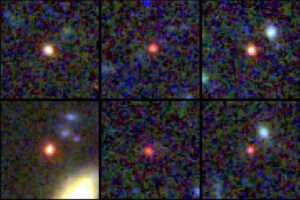
Images of six candidate massive galaxies, seen 500-800 million years after the Big Bang. Image credit: NASA/ESA/CSA/I. Labbe

Webb images challenge theories of how universe evolved

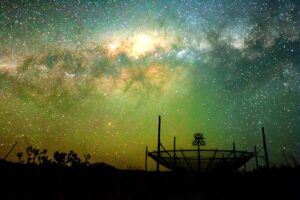
The HERA radio telescope, located in Karoo in South Africa, consists of 350 dishes pointed upward to detect radio waves from the early universe.

How different were galaxies in the early universe?

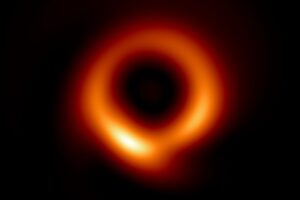
New image of M87 supermassive black hole generated by the PRIMO algorithm using 2017 EHT data

A sharper look at the M87 black hole

An illuminated manuscript from the late 14th to the early 15th century, depicting two individuals observing a lunar eclipse Credit: Recueil de poésies françaises. Consolation de Boèce, Ms. 822, fol. 61v, Bibliothèque Municipale de Toulouse /Gallica, BnF

Medieval monks accidentally recorded some of history’s biggest volcanic eruptions

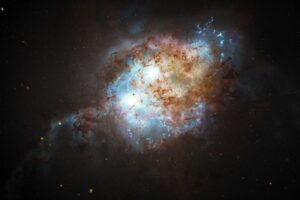
This artist's concept shows the brilliant glare of two quasars residing in the cores of two galaxies that are in the chaotic process of merging. The gravitational tug-of-war between the two galaxies ignites a firestorm of star birth.

Hubble unexpectedly finds double quasar in distant universe

Cosmic April Fool

A big ol explosion somewhere out there

Scientists observe flattest explosion ever seen in space

meteor streaking across day sky

Two meteorites are providing a detailed look into outer space

Older posts
Newer posts
← Previous Page1 … Page9 Page10 Page11 Page12 Next →
Substack subscription form sign up

Comments

  • Karoly Mirnics on Common Prescription Drugs May Disrupt Cholesterol Pathways in the Womb and Raise Autism Risk
  • Aizen on Laziness helped lead to extinction of Homo erectus
  • Norwood johnson on Electrons in New Crystals Behave as If They Live in Four Dimensions
  • ScienceBlog.com on Hidden Geometry Could Finally Fix Quantum Computers
  • Theo Prinse on America Is Going Back to the Moon. This Time, It Plans to Stay
© 2026 ScienceBlog.com | Follow our RSS / XML feed