Skip to content
ScienceBlog.com
  • Featured Blogs
    • EU Horizon Blog
    • ESA Tracker
    • Experimental Frontiers
    • Josh Mitteldorf’s Aging Matters
    • Dr. Lu Zhang’s Gondwanaland
    • NeuroEdge
    • NIAAA
    • SciChi
    • The Poetry of Science
    • Wild Science
  • Topics
    • Brain & Behavior
    • Earth, Energy & Environment
    • Health
    • Life & Non-humans
    • Physics & Mathematics
    • Social Sciences
    • Space
    • Technology
  • Our Substack
  • Follow Us!
    • Bluesky
    • Threads
    • FaceBook
    • Google News
    • Twitter/X
  • Contribute/Contact

Astronomy

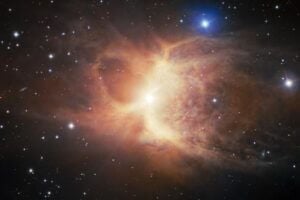
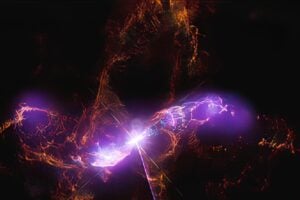
A billowing pair of nearly symmetrical loops of dust and gas mark the death throes of an ancient red-giant star, as captured by Gemini South, one half of the International Gemini Observatory, operated by NSF’s NOIRLab. The resulting structure, said to resemble an old style of English jug, is a rarely seen bipolar reflection nebula. Evidence suggests that this object formed by the interactions between the dying red giant and a now-shredded companion star. The image was obtained by NOIRLab’s Communication, Education & Engagement team as part of the NOIRLab Legacy Imaging Program.

Rare, double-lobe nebula resembles overflowing cosmic ‘jug’

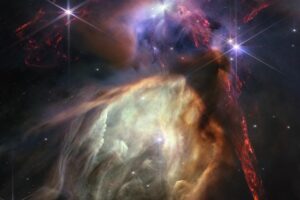
The first anniversary image from NASA’s James Webb Space Telescope displays star birth like it’s never been seen before, full of detailed, impressionistic texture. The subject is the Rho Ophiuchi cloud complex, the closest star-forming region to Earth. It is a relatively small, quiet stellar nursery, but you’d never know it from Webb’s chaotic close-up. Jets bursting from young stars crisscross the image, impacting the surrounding interstellar gas and lighting up molecular hydrogen, shown in red. Some stars display the telltale shadow of a circumstellar disk, the makings of future planetary systems. Download the full-resolution, uncompressed version and supporting visuals from the Space Telescope Science Institute: https://webbtelescope.org/contents/media/images/2023/128/01H449193V5Q4Q6GFBKXAZ3S03?news=true

Webb celebrates first year of science with close-up on birth of sun-like stars

Professor Geraint Lewis in the Sydney Institute for Astronomy in the School of Physics at the University of Sydney.

Quasar ‘clocks’ show Universe was five times slower soon after the Big Bang

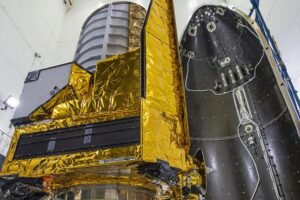
Last glimpse of Euclid on Earth Credit: ESA

Mission to map the dark Universe sets off on space journey

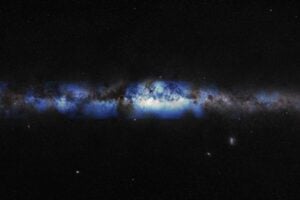
Milky Way seen through a neutrino lens (blue)

The first neutrino image of our galaxy

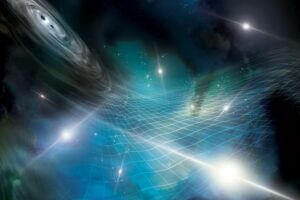
Artist's concept of a collection of pulsars that detect gravitational waves from pairs of orbiting supermassive black holes.

Scientists find evidence for slow-rolling sea of gravitational waves

Galaxy illustration

Hawaiʻi astronomers find a planet that shouldn’t exist

R Aquarii Sonofication

Cosmic Harmonies: Sonifications From NASA Telescopes

Ohio State logo

Planet orbiting 2 stars discovered using new technique

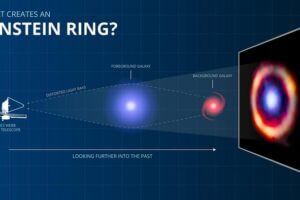
The galaxy observed by Webb shows an Einstein ring caused by a phenomenon known as lensing, which occurs when two galaxies are almost perfectly aligned from our perspective on Earth. The gravity from the galaxy in the foreground causes the light from the background galaxy to be distorted and magnified, like looking through the stem of a wine glass. Because they are magnified, lensing allows astronomers to study very distant galaxies in more detail than otherwise possible.

Webb telescope detects universe’s most distant organic molecules

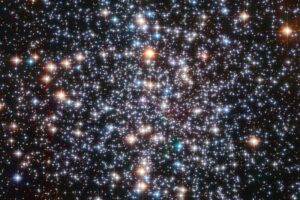
A Hubble Space Telescope image of the globular star cluster, Messier 4. The cluster is a dense collection of several hundred thousand stars. Astronomers suspect that an intermediate-mass black hole, weighing as much as 800 times the mass of our Sun, is lurking, unseen, at its core. Credits: ESA/Hubble, NASA

NASA’s Hubble hunts for intermediate-sized black hole close to home

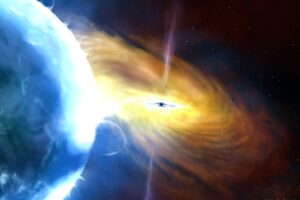
Illustration: a black hole accretion.

Biggest Explosion Ever

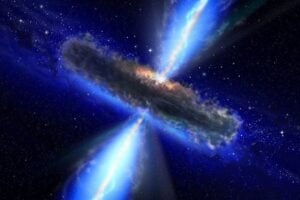
Galactic collision course triggers black hole bursts

Galactic collision course triggers black hole bursts

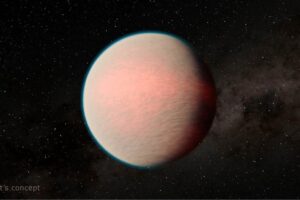
Artist’s concept of the planet GJ 1214 b, a “mini-Neptune” with what is likely a steamy, hazy atmosphere. Credit: NASA/JPL-Caltech/R. Hurt (IPAC)

Planet has surprisingly cool attitude: ‘I’m not hot, I’m just reflective’

Older posts
Newer posts
← Previous Page1 … Page8 Page9 Page10 … Page12 Next →
Substack subscription form sign up

Comments

  • Karoly Mirnics on Common Prescription Drugs May Disrupt Cholesterol Pathways in the Womb and Raise Autism Risk
  • Aizen on Laziness helped lead to extinction of Homo erectus
  • Norwood johnson on Electrons in New Crystals Behave as If They Live in Four Dimensions
  • ScienceBlog.com on Hidden Geometry Could Finally Fix Quantum Computers
  • Theo Prinse on America Is Going Back to the Moon. This Time, It Plans to Stay
© 2026 ScienceBlog.com | Follow our RSS / XML feed