Skip to content
ScienceBlog.com
  • Featured Blogs
    • EU Horizon Blog
    • ESA Tracker
    • Experimental Frontiers
    • Josh Mitteldorf’s Aging Matters
    • Dr. Lu Zhang’s Gondwanaland
    • NeuroEdge
    • NIAAA
    • SciChi
    • The Poetry of Science
    • Wild Science
  • Topics
    • Brain & Behavior
    • Earth, Energy & Environment
    • Health
    • Life & Non-humans
    • Physics & Mathematics
    • Social Sciences
    • Space
    • Technology
  • Our Substack
  • Follow Us!
    • Bluesky
    • Threads
    • FaceBook
    • Google News
    • Twitter/X
  • Contribute/Contact

Astronomy

The red region (left) shows the shell enclosed by the Baryon Acoustic Oscillation, with individual galaxies depicted as luminous tiny specks. The blue filaments show the greater Cosmic Web, with previously known features like Laniākea highlighted.

Vast bubble of galaxies discovered, given Hawaiian name

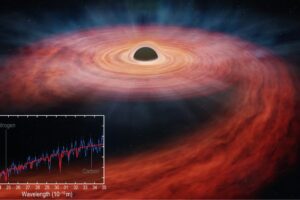
This artist’s illustration depicts the “tidal disruption event” (TDE) called ASASSN-14li, which is the focus of the latest study. As a star approached too closely to the supermassive black hole at the system, the strong gravity tore the star apart. This artist’s impression depicts the aftermath of this destruction. After the star was ripped apart, some of its gas (red) was left orbiting around and falling into the black hole. A portion of the gas was driven away in a wind (blue). Image credit: NASA/CXC/University of Michigan/J. Miller et al; Illustration: NASA/CXC/M.Weiss

A giant black hole destroys a massive star

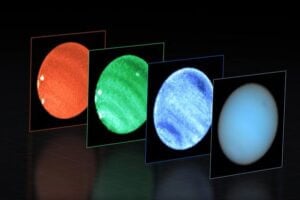
This image shows Neptune observed with the MUSE instrument at ESO’s Very Large Telescope (VLT). At each pixel within Neptune, MUSE splits the incoming light into its constituent colours or wavelengths. This is similar to obtaining images at thousands of different wavelengths all at once, which provides a wealth of valuable information to astronomers. The image to the right combines all colours captured by MUSE into a “natural” view of Neptune, where a dark spot can be seen to the upper-right. Then we see images at specific wavelengths: 551 nanometres (blue), 831 nm (green), and 848 nm (red); note that the colours are only indicative, for display purposes. The dark spot is most prominent at shorter (bluer) wavelengths. Right next to this dark spot MUSE also captured a small bright one, seen here only in the middle image at 831 nm and located deep in the atmosphere. This type of deep bright cloud had never been identified before on the planet. The images also show several other shallower bright spots towards the bottom-left edge of Neptune, seen at long wavelengths. Imaging Neptune’s dark spot from the ground was only possible thanks to the VLT’s Adaptive Optics Facility, which corrects the blur caused by atmospheric turbulence and allows MUSE to obtain crystal clear images. To better highlight the subtle dark and bright features on the planet, the astronomers carefully processed the MUSE data, obtaining what you see here.

Mysterious Neptune dark spot detected from Earth for the first time

Saturn

The Storms of Saturn

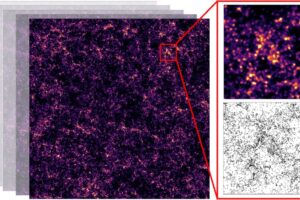
A line intensity image appears smeared compared to traditional galaxy survey images. (Patrick Breysse)

The universe’s missing teenage pictures

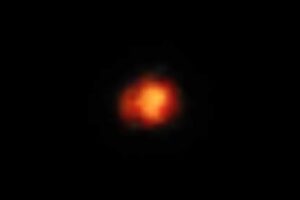
Spectroscopic observations reveal that Maisie’s galaxy, named after Steven Finkelstein’s daughter, was detected 390 million years after the Big Bang. That makes it one of the four earliest confirmed galaxies ever observed.

Astronomers confirm Maisie’s galaxy is among earliest ever observed

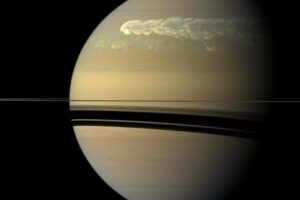
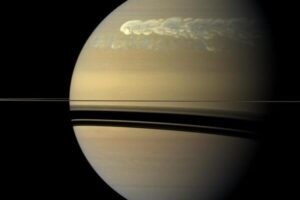
A huge storm dominates the rather featureless surface of Saturn in an image taken by the Cassini spacecraft on Feb. 25, 2011, about 12 weeks after the powerful storm was first detected in the planet's northern hemisphere. The megastorm is seen overtaking itself as it encircles the entire planet. Astronomers have found deep in the atmosphere the aftereffects of megastorms that occurred hundreds of years ago. The dark stripes are the shadows of Saturn's rings.

Hundred-year storms? That’s how long they last on Saturn.

Alessandra Corsi, via Texas Tech

In search of electromagnetic counterparts of gravitational waves

Ohio State logo

Using cosmic weather to study which worlds could support life

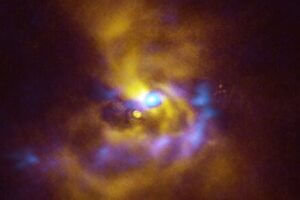
Combined SPHERE and ALMA image of material orbiting V960 Mon

New image reveals secrets of planet birth

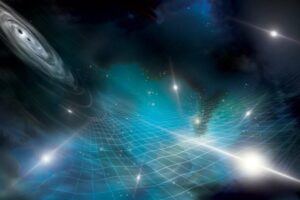
This artist’s concept shows stars, black holes, and nebula laid over a grid representing the fabric of space-time. Ripples in this fabric are called gravitational waves. The NANOGrav collaboration detected evidence of gravitational waves created by black holes billions of times the mass of the Sun. Credit: NANOGrav collaboration; Aurore Simonet

15 Years of Radio Data Reveals Evidence of Space-Time Murmur

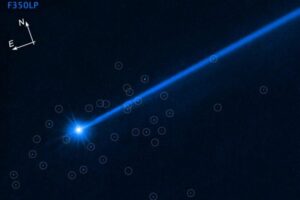
Image of the asteroid Dimorphos, with compass arrows, scale bar, and color key for reference. The north and east compass arrows show the orientation of the image on the sky. Note that the relationship between north and east on the sky (as seen from below) is flipped relative to direction arrows on a map of the ground (as seen from above).

Hubble sees boulders escaping from asteroid dimorphos

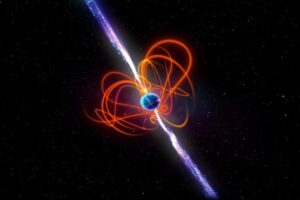
An artist’s impression of the ultra-long period magnetar. Astronomers discovered the object using the Murchison Widefield Array (MWA), a radio telescope on Wajarri Yamaji Country in outback Western Australia.

Astronomers find new type of stellar object

Ohio State logo

Astronomers discover striking evidence of ‘unusual’ stellar evolution

Older posts
Newer posts
← Previous Page1 … Page7 Page8 Page9 … Page12 Next →
Substack subscription form sign up

Comments

  • Karoly Mirnics on Common Prescription Drugs May Disrupt Cholesterol Pathways in the Womb and Raise Autism Risk
  • Aizen on Laziness helped lead to extinction of Homo erectus
  • Norwood johnson on Electrons in New Crystals Behave as If They Live in Four Dimensions
  • ScienceBlog.com on Hidden Geometry Could Finally Fix Quantum Computers
  • Theo Prinse on America Is Going Back to the Moon. This Time, It Plans to Stay
© 2026 ScienceBlog.com | Follow our RSS / XML feed